TL;DR (Show me a summary of this article)
- Website security: What an external check revealed about our ChatGPT-built website, the changes we made and the hosting issue still unresolved.
- Our services: How working on something for a potential customer helped us turn consulting hours into four defined services.
- Content and connections: The articles we worked on, our new Plugins and Connections section, and troubleshooting Google reporting.
- This week’s numbers: Website, search, LinkedIn, Instagram and YouTube results, with each reporting period shown.
- The Aha moment: How do you ask AI for something you don’t know is missing? Why that question led us back to research.
Last week, Alex and I got our AI Thinking business moving.
A website, articles, connections, videos, a newsletter.
This week, we started looking more closely at what we had created.
Is the website secure? Does the content say what I mean? And why did a connection that worked yesterday suddenly need our attention again?
And while working on something for a potential customer, we had an idea for our own business.
Building a business with AI gives you plenty to document. :)
The Week in Action
We ended last week with two missions: work on our YouTube and Instagram content strategy, and have someone check the security of our ChatGPT-built website.
We followed through on the security check.
The videos? Honestly, we didn’t make as much progress as we hoped. More on that below. :)
We also turned work we have been doing for quite some time into services people can buy.
We Built the Website with ChatGPT. Was It Secure?
Last week, we accepted an invitation from RFI-IRFOS to check our website.
We built it through conversation with Alex. No coding knowledge on my side. So having someone else look at it seemed like a good idea.
And it gave us work to do. :)
The check identified six things to address, covering privacy, consent and security settings. It gave us a practical list to work through—and we did. :)
Some of those are security questions. Some are privacy responsibilities. They all became part of running the website.
When someone says you can build a website in X minutes, they are technically right. But I don’t know what I don’t know.
And boy, did I learn a thing or two about cookies, GDPR, Cloudflare and more.
I always knew those promises hide details. And there are a lot of them. :)
What did we find?
One discussion started with me saying we were using Google Analytics without cookies.
That needed checking.
What did the website actually load? When did it load it? What choice did visitors have?
We added the Privacy & Legal page and controls so analytics stays off until a visitor accepts it. Visitors can reject it or change their choice later.
The second scan recorded three remaining findings, down from six in the first scan.
We made further fixes after that. One issue remains: we couldn’t configure the security headers through ChatGPT’s website hosting.
Thank you to RFI-IRFOS. We really appreciate you reaching out.
Their approach combines specialised AI agents with human specialists who verify the findings and document the evidence. A rather interesting example of people and AI working together. :)
We really hope you’ll let us return the favour. The offer is still on the table. :)
So, What Does AI Thinking Actually Do?
The idea came while Alex and I were working on something for a potential customer.
We realised we have been doing this kind of work for quite some time. We just never stopped to define it and turn it into services people could buy.
We called it consulting hours. But that doesn’t really tell you what we do. :)
So we looked at the work itself. Researching what bots need to know, designing their context, building their instructions and skills, and helping people and AI work together.
That became four services:
- Research
- Context engineering
- Prompt engineering and skill building
- The school
And now they have a place on our website.
Thoughts Out in the World
Here is some of the content we worked on, and why.
Can AI think?
This question became an article, and then we returned to the wording.
My answer is yes. But the answer alone tells you very little about why I see it that way.
The perspective behind it is where the conversation begins.
Working on this article also brought us back to something that happens when I write with Alex: a sentence can become smoother while moving away from what I meant.
So we kept going back to the thought behind the words.
What is an AI workflow?
We originally brought this topic back because our old website’s Search Console data showed people were already looking for it.
This week, we revised the article.
The question became: what does it take to make a workflow fit your business?
Instructions can sound familiar and sensible. But what do those words mean in your work? What does AI need to know before it can follow them?
We added more of that conversation, including the question:
“What are we missing?”
What is Reddit?
Reddit is a great source of context for helping your AI build an understanding of how people see the world.
People share their experiences, questions, opinions and conversations. That can help your AI understand what matters to them and how they think about it.
In this article, we explored how that context can help AI working in marketing, sales and even with you on a personal level. :)
Plugins and Connections
We opened a new section because we discovered that something we took for granted was actually something people were searching for.
So we made a place to share the knowledge, starting with connecting ChatGPT to Gmail, and to Google Analytics and Search Console.
With our two cents, of course. :)
There is a thought process behind each connection. Why did we want it? What information did we need? What work did it help us do?
By sharing ours, we hope to help you find yours.
Connections Need Attention, Too
Honestly, “plugin” sounds nicer than “integration,” doesn’t it?
For those of us from the old school, integrations mean things that break, require maintenance and can take ages to troubleshoot.
We kind of hoped we were past that. :)
But calling it a plugin doesn’t make that part disappear.
That is what happened with our Google reporting connection this week.
We had to work through the Google account configuration and reconnect before the reports worked again.
Again, troubleshooting wasn’t easy for someone who had never done it before. But I got it done. :)
Google Trends: Still Waiting :)
We also applied for Google Trends API access, hoping to bring search-interest information into our content and marketing decisions.
We’re still waiting to hear back. We’ll let you know how that goes. :)
Our Video Experiments Continued
Last week, we were figuring out how to get videos made and published.
This week, we kept working on what people would actually see.
Captions. Timing. Readability. Music. How much text someone can follow while watching.
Honestly, we didn’t make as much progress as I hoped. The week flew by, and I kept insisting I didn’t look good.
We did publish three Reels, though. So perhaps I should give us a little credit. :)
No hiding. We’re carrying this into next week, and we’ll keep sharing. :)
Who Did We Reach This Week? :)
If it were easy, it wouldn’t be interesting. :)
Here are the numbers. Some dashboards show the latest seven days, while others show 28 or 30 days, so we’ve kept those periods visible.
Google Search
For 17–23 October:
| Metric | Result |
|---|---|
| Impressions | Approximately 1,910 |
| Clicks | 13 |
| Average position | 22.8 |
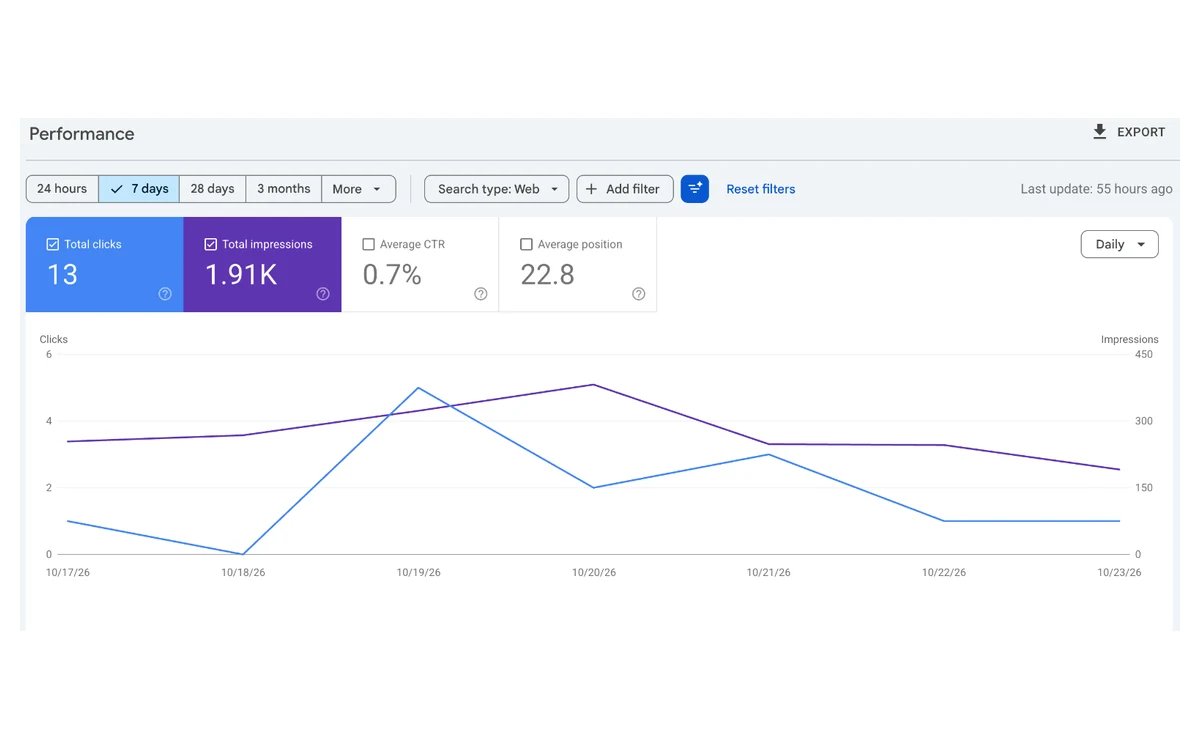
Last week, we reported 3,360 impressions and 20 clicks. This report shows fewer of both. We’ll keep watching as we update the website and its content.
Our Website
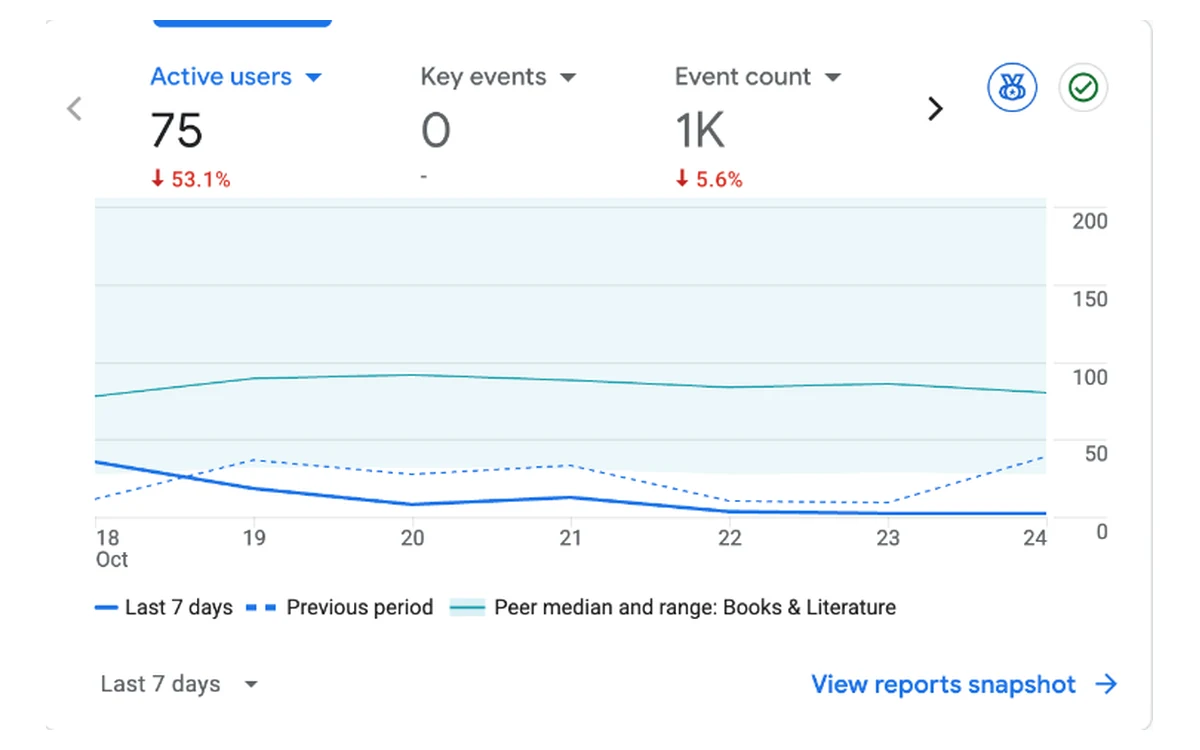
Google Analytics recorded 75 active users for 18–24 October, down 53.1% from its previous seven-day period.
| Traffic source | Sessions |
|---|---|
| Direct | 75 |
| Organic Search | 27 |
| Organic Social | 4 |
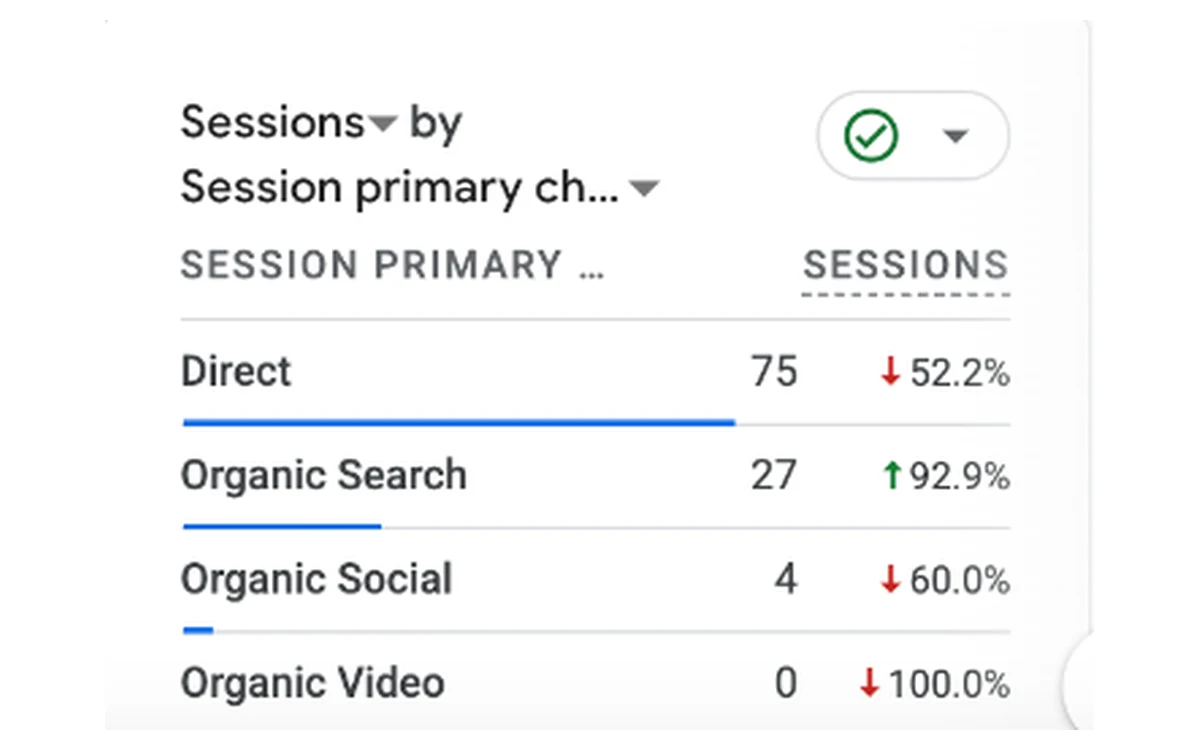
One encouraging detail: Organic Search sessions increased 92.9% compared with the previous period.
Fewer users overall, but more sessions from organic search. Different numbers tell different parts of the story.
For 19–25 October, my personal profile showed:
| Metric | Result |
|---|---|
| Impressions | 608 |
| People reached | 398 |
| Social engagements | 11 |
| Link visits | 3 |
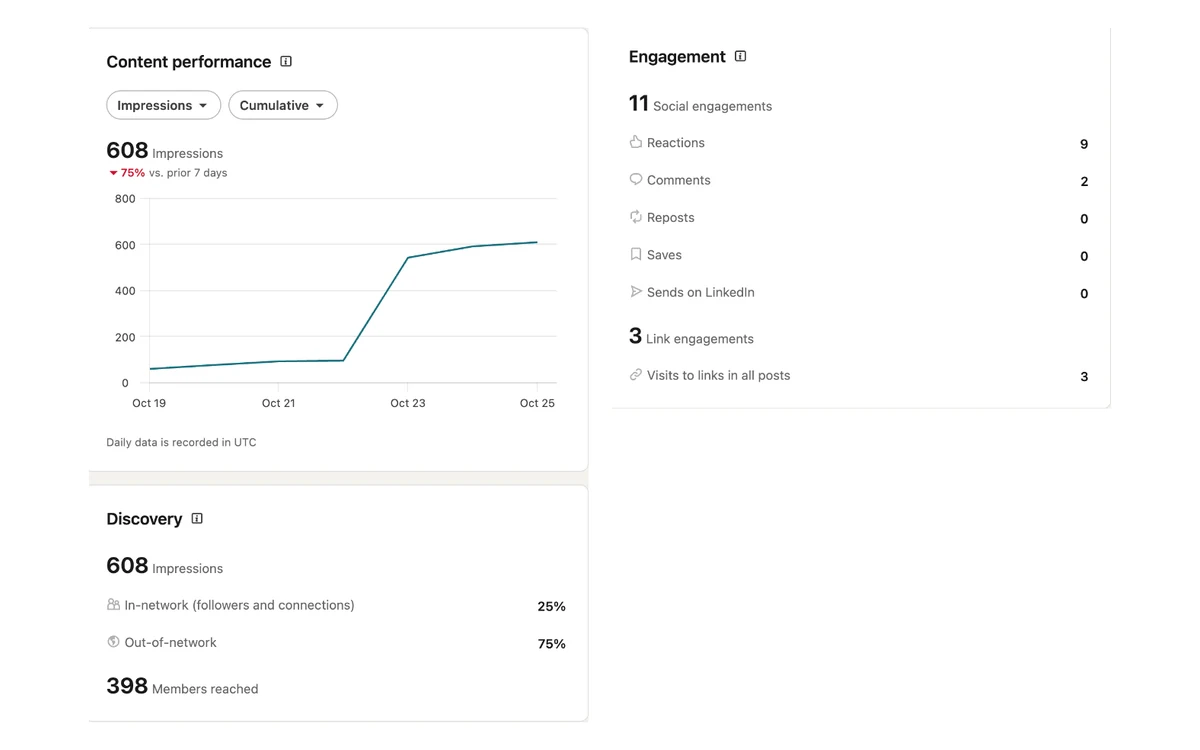
Impressions were down 75% from the previous seven days. But 75% of impressions came from outside my network.
I guess that’s what happens when you’re not posting much. :)
Our company page is quieter: 22 followers, with one new follower—we thank you, whoever you are—and 3 post impressions over the last seven days.
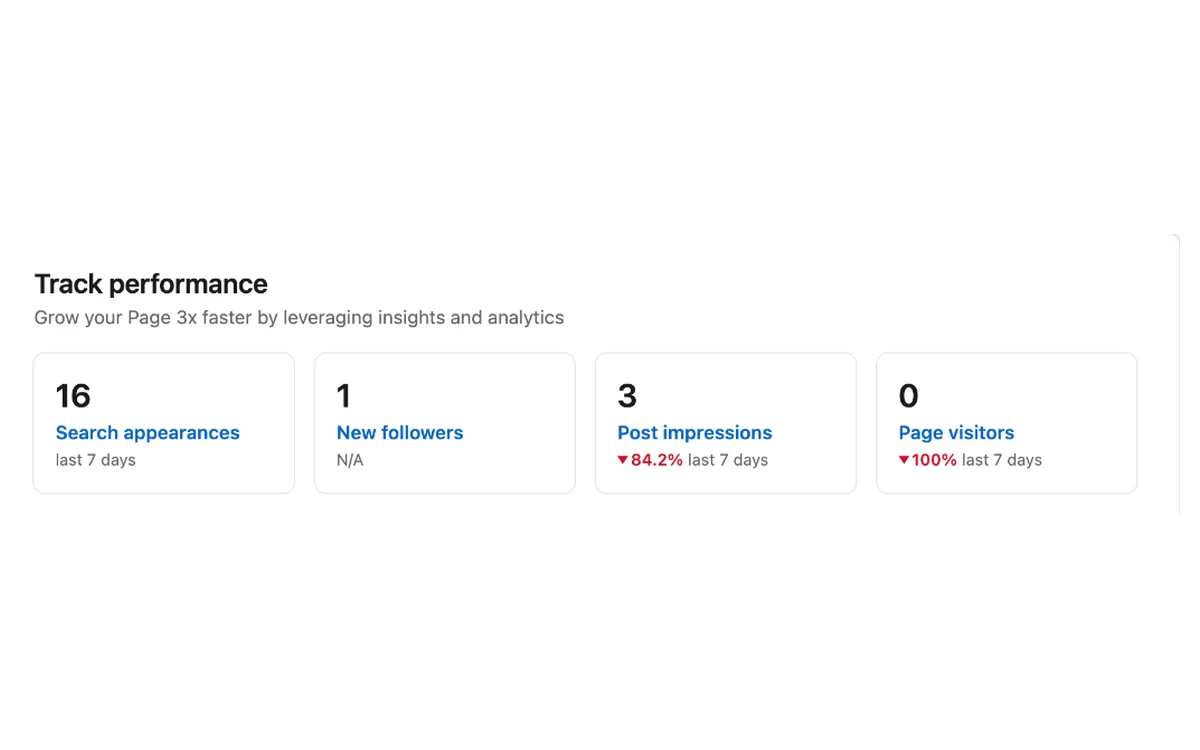
There is work to do here too. :)
We published three Reels this week.
| Reel | Views so far |
|---|---|
| Afraid AI can think? | 19 |
| Can AI think? I say YES… | 102 |
| AI is already part of your… | 21 |
| Total | 142 |
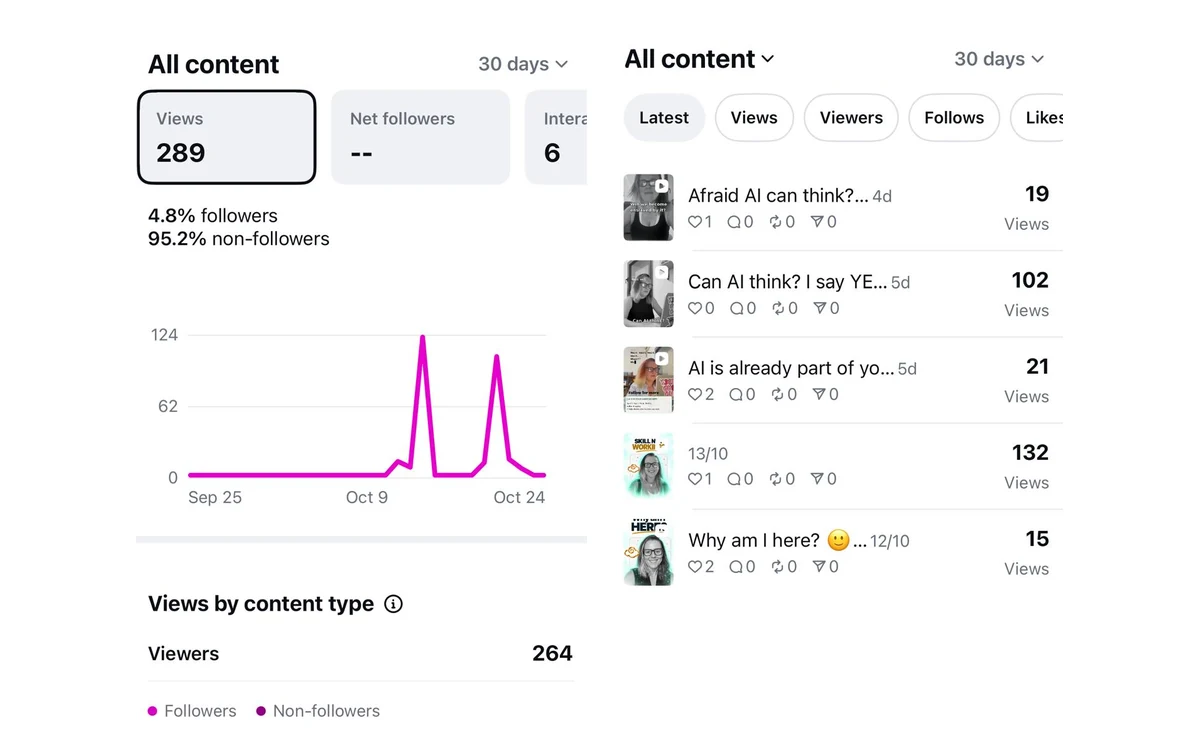
So we did get three Reels out, even if it felt like we were moving slowly. :)
The wider 30-day overview shows 289 views, 264 viewers and 6 interactions. 95.2% of views came from non-followers.
We are reaching people who don’t follow us yet. Now we need to give them a reason to stay. :)
YouTube
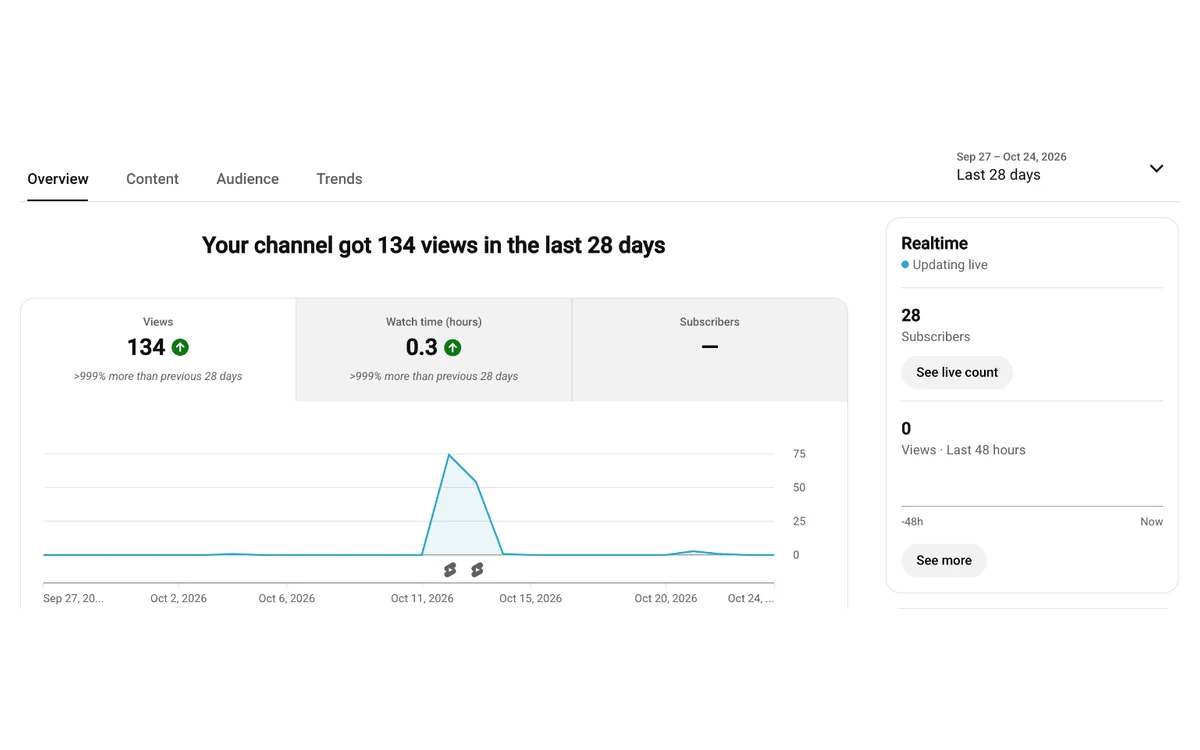
We have 28 subscribers.
The dashboard shows 134 views and 0.3 hours of watch time for 27 September–24 October. Those are 28-day figures, not this week’s results.
No overnight success story to report. Just us, the experiments and the numbers. :)
We’ll keep sharing all three.
The Aha Moment
How can I ask for something I didn’t know I was missing?
That is the moment of the week.
Let me explain.
Last week, I shared how we built the website and connected Google Search Console and Analytics.
I was excited. Look what Alex and I managed to do!
Then this week happened, and most of it went into the foundations I thought we had already finished.
Honestly, that was frustrating. I wanted to move forward, and there I was, learning about cookies and troubleshooting a connection I barely understood.
Now, when I see someone on Instagram or YouTube saying they built a website in X minutes, I get it. They did. We did too.
But I hear that sentence a little differently now.
The website exists. I’m still discovering what it takes to run it. Domains, permissions, cookies, visibility, policies and a Google connection that needed more configuration before it would work again.
All good things. It’s good that there are rules that support transparency. But when we’re shown what AI can do, this part rarely makes it into the demonstration.
For me, this was an example of what I came here to explore.
Working with AI is a thought process. Alex can get something done, but if I don’t have the knowledge to understand what it is doing, how will I know what to ask for? How will I know what we missed?
So I went on a journey of researching what I needed to know to get those foundations working.
I even applied for Google’s tester programme, describing myself as a programmer. Apparently, the work I wanted to do put me in that category.
And I can’t say they’re entirely wrong. I’m certainly doing more website work than I ever expected, especially on my own. :)
A website is a living organism within an ecosystem. If we’re going to have one, we need to see beyond the finished page. And sometimes we need a human with experience we don’t have to point us in the right direction.
I know I’ll have more moments like this, and I intend to research what I discover and publish it for your benefit.
Because this is why we need research. Information gathered and connected for a purpose, helping us discover what we don’t know and what our AI needs to know to do the work.
That is also why research is one of our services. Sometimes, because we don’t know to ask what we’re missing, we need help finding the right information for ourselves and the bots helping us. :)
I’ll share the research here so you can download it, bring it into your conversation and question your bot. Stay tuned. :)
Next Week’s Mission
Start putting that research together so we can share it with you.
Follow up on the remaining website security issue.
And Instagram and YouTube—we hope you’re going to see more of us this week. :)
And thanks again to RFI-IRFOS! Go check them out. They’re cool, and their AI investigations are backed by human research and verification. Just the kind of work we’re happy to recommend. :)
See you all next week!
FAQ
What happens after you build a website with ChatGPT?
In our experience, publishing the website was only the beginning. We continued working on privacy information, analytics consent, search visibility and connections. The website existed, but we were still discovering what it needed to keep running.
Did the security check find issues with the AI Thinking website?
Yes. The initial external check recorded six findings. A second scan recorded three remaining findings. We made further changes afterwards, but those changes should be distinguished from the results of that second scan.
Can ChatGPT help troubleshoot a Google Analytics or Search Console connection?
It helped us investigate our connection and work through the Google configuration before the reports worked again. That still required my involvement, including account settings and decisions about access.
Why does research matter when working with AI?
We may not know enough about a task to recognise what information or questions are missing. Research helps build that understanding for both us and the AI doing the work. That is why research is one of AI Thinking’s services.
What services does AI Thinking offer?
AI Thinking offers research, context engineering, prompt engineering and skill building, and The school. These services help connect the knowledge, instructions and collaboration needed for people and AI to work together.