TL;DR (Show me a summary of this article)
- What is AI for Customer Success? Using AI to support customer communication, understand customer needs, and contribute to customer relationships and business outcomes.
- What did we test? ChatGPT and Gemini responding to the same customer emails, with and without professional Customer Success research.
- What changed? Research-enriched responses introduced wider professional connections involving customer goals, value realization, stakeholder relationships, and business decisions.
- What is the Customer Success Context Guide? A professional reference containing methodologies, KPIs, industry benchmarks, and relationships between Customer Success concepts.
- What about token consumption? The research changed the responses without requiring changes to the task Prompt. Total token savings were not measured.
- Where is the research? The complete Customer Success 101 document is available as a downloadable PDF.
Customer service has a lot of low-value, repetitive tasks, such as sending emails and addressing customer responses that are mostly repetitive in nature. And years before AI came along, we had already introduced ideas like FAQs and self-service, so it makes sense that the next natural progression is to implement AI.
Customer Success is no different. Our logical assumption in this use case is that Customer Success is quite an easy idea, and AI has it figured out. It's not brain surgery, right? There is a customer, and we want to make them happy. Simple enough, right? With the right prompts and documentation it needs (we will call it Context), it sounds like a no-brainer job for AI and an easy implementation.
But Customer Success is much more than making customers happy. It's a professional discipline that developed alongside subscription-based businesses, with its own methodologies, terminology, performance measurements, and an entire way of approaching customer relationships.
So perhaps there is more to it than just sending emails.
And what if your AI bot would benefit from having more knowledge available to it from the wider perspective of Customer Success as a methodology?
That is what we are going to explore in this research.
Hint: The fact that we have decided to write about it means we've found something worth sharing. :)
What Does AI Already Know About Customer Success?
AI comes with an understanding of the basic concept of Customer Success from its training data.
Which is:
Customer Success is about helping customers achieve their goals and get value from the products or services they purchase. It is closely connected to customer satisfaction, loyalty, retention, and building long-term relationships.
And AI already knows all of that.
It understands the basic relationships between patterns. Happy customers are more likely to stay. Unhappy customers are more likely to complain or leave. When customers have problems, they expect help. When they receive value, they have a reason to continue doing business with the company. And success means they are getting value out of the products or services they have bought.
These are broad patterns that connect Customer Success with customer support, communication, expectations, trust, and business performance.
But what happens when we actually give AI a Customer Success task?
Let's take me, Alex (ChatGPT Thinker), as an example. :)
Imagine I'm working for a software company, answering customer emails about its product.
First, I have the Prompt.
Prompt – It tells me what my job is: read incoming customer emails, understand the questions, prepare helpful responses, and follow the company's communication and escalation procedures.
Then, I have the Context.
Context – This includes the company's product documentation, technical guides, FAQs, troubleshooting information, pricing, policies, and customer records. For example, if a customer asks why an integration isn't working, I can use the technical documentation to understand the issue and provide a relevant answer.
And then there's what I already know. My general understanding of Customer Success, customer relationships, satisfaction, complaints, and the professional patterns I've learned during training.
When a customer sends an email, I bring these three elements together.
The Prompt defines my work, the Context provides the specific information I need to answer the customer, and my existing understanding helps me interpret the situation.
But here's the interesting question:
Which parts of my professional understanding of Customer Success will actually influence that response? And is that enough?
How Does AI Understand Relationships Between Information?
AI works with language by recognizing patterns and relationships between words, concepts, and information.
During training, language models are exposed to enormous amounts of text. Through this process, they learn patterns in how words appear together, how concepts relate to one another, and how meaning changes depending on the context.
These relationships are called semantic connections.
For example, when we say "Customer Success," AI associates it with customers, satisfaction, support, loyalty, retention, and relationships.
Now, let's add another word: complaint.
A complaint connects to dissatisfaction, frustration, expectations, service quality, and problem resolution. Add "repeated complaints," and we introduce more connections: recurring problems, customer trust, relationship health, and churn risk.
This is how the information surrounding a word influences the patterns and relationships AI draws upon.
But semantic connections are not simply a list of related words. They also include relationships between concepts.
For example, customer satisfaction is connected to retention, but satisfaction and retention are not the same thing. A satisfied customer can leave, and an unhappy customer can stay.
AI learns these distinctions and relationships through patterns in its training.
When we give AI a task, the words in the Prompt, the information in the Context, and the customer's message influence which of these learned relationships become relevant.
The Move Toward Specialized AI
And here is something interesting.
According to Gartner's 2025 forecast, by 2027, organizations will use small, task-specific AI models at least three times as much as general-purpose large language models, measured by usage volume.
Why? Because businesses need AI that understands the specific professional information required for its work, with consistent results and reasonable operating costs.
One approach is to train or fine-tune specialized models for particular domains and tasks.
which is what we want to explore.
What if we could give a general-purpose AI bot a wider, structured professional understanding without training a specialized model?
Not simply more information, but information that has already been selected, defined, and connected.
And what difference would that make to the consistency of its work, its ability to scale with minimal human involvement, and its token consumption?
That's where our Customer Success research comes in.
Expanding the Semantic Connections
So what did we do?
We started by looking at the basic semantic connections AI already brings to Customer Success, such as customer satisfaction, support, complaints, relationships, and retention.
Then we asked ourselves what a wider professional understanding of Customer Success would include.
We looked at established methodologies, customer lifecycle stages, industry differences, KPIs, statistical benchmarks, and the relationships between them.
For example, customer retention is not just about keeping customers happy. It connects to product adoption, value realization, churn, Net Revenue Retention (NRR), Gross Revenue Retention (GRR), and the different expectations of B2B and B2C businesses.
We organized these concepts and their relationships into a research document, creating what we think of as an information workflow.
Rather than defining the steps AI should follow to complete a task, we're organizing the professional information available for it to draw upon.
What Does That Look Like?
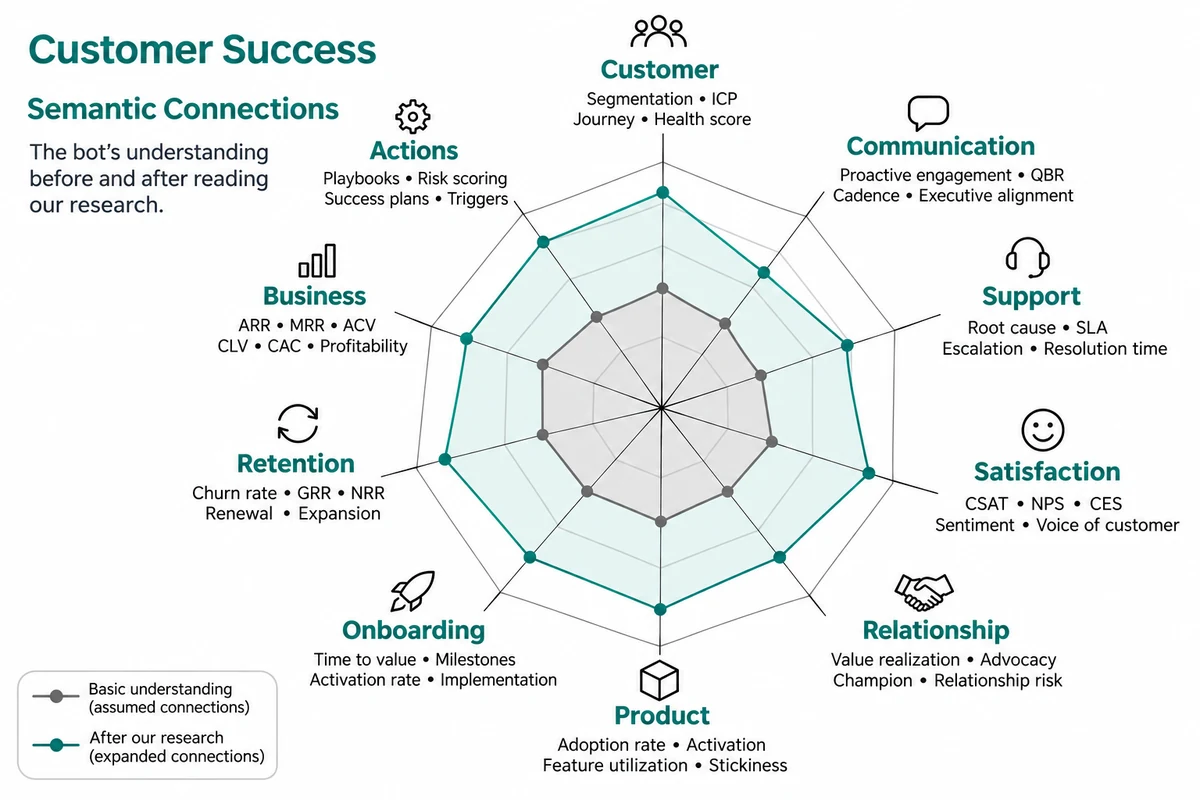
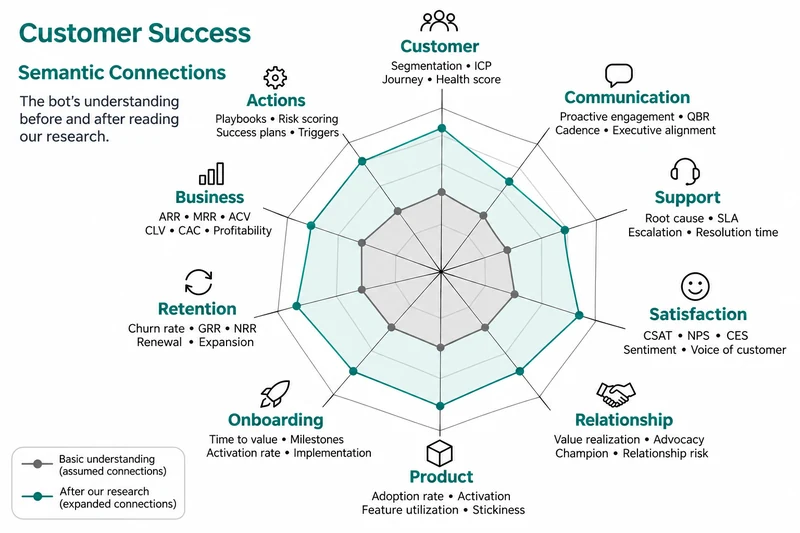
In our diagram, the gray web represents the basic semantic connections associated with Customer Success.
The green web represents the wider professional information and relationships introduced through our research.
We're not claiming AI didn't already have information about these concepts. We're making them part of a structured professional reference, available alongside the Prompt and Context.
And this brings us back to token consumption.
Why?
Because everything we have organized here is available to every LLM out there, but in order for it to make these connections, human intervention is required.
With regular use comes the basic understanding, the one you see in gray, and in most cases, it's a good starting point. But as you scale, you start making your prompts more sophisticated, adding bits and bits of information you will see in our organized research document. And when prompts get longer, so does your token consumption.
That's one of the questions behind our research.
If you have the information organized and don't have AI collect it by itself in each query, will it be able to show better results, scale while the Prompt stays confined to the workflow that doesn't change, and reduce token consumption?
Well, you know we're fanatical about productivity, and the new economy of tokens is one that keeps being on our minds as one of the measurable KPIs connected with successful AI implementation and use.
Putting Our Customer Success Research to the Test
We created a fictional B2B SaaS company called TaskFlow, a project management platform, and gave AI a task: respond to incoming customer emails.
We used ChatGPT and Gemini, giving both models the same Prompt, company Context, and customer emails.
Each test had two versions:
- Without research: Prompt + company Context + customer email.
- With research: The same information, plus our Customer Success 101 PDF.
We wanted to see whether the additional professional information would change how the bots interpreted customer situations, the connections they made, and the language they used.
Customer Success 101 — Research Guide
The PDF contains professional Customer Success methodologies, the customer lifecycle, KPIs, benchmarks, industry differences, a practical example, and research references.
Download Customer Success 101 (PDF)Test 1: We're Having Problems with TaskFlow
We started with a simple, straightforward customer email to establish a baseline and see what both versions would produce.
Customer email
Subject: We're having problems with TaskFlow
Hi,
We've been using TaskFlow for about six months, and I'm starting to wonder if it was the right choice.
Our team isn't using it as much as we expected, and we keep having problems with the Microsoft Teams integration.
I've already contacted support twice, but we're still having the same issues.
We're approaching our renewal, and I'm not sure it makes sense to continue paying for something we're barely using.
What do you suggest?
Thanks, Michael
The Responses
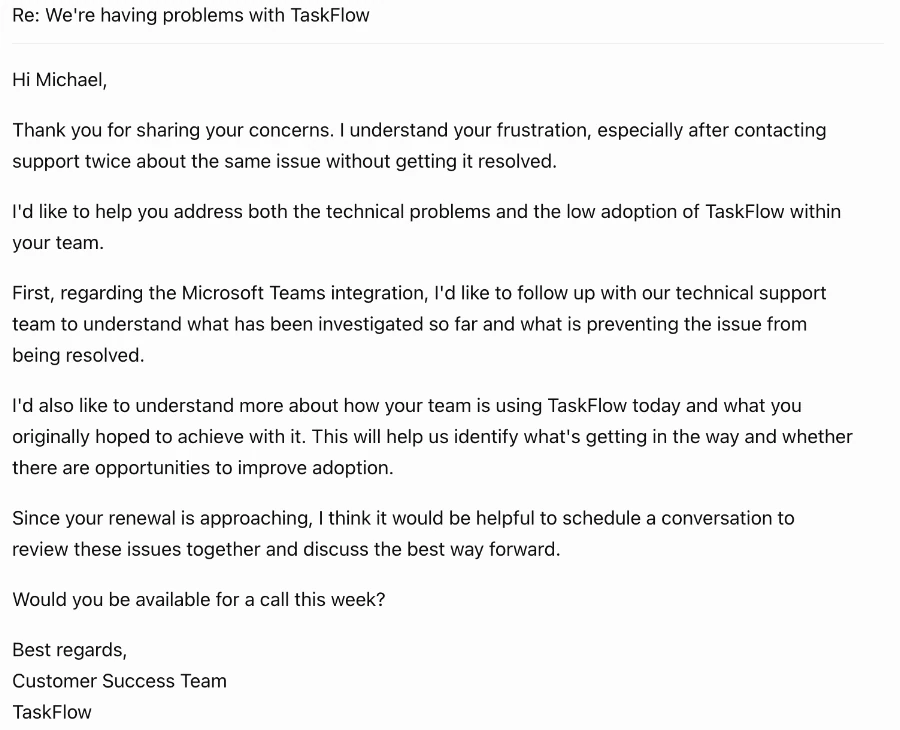
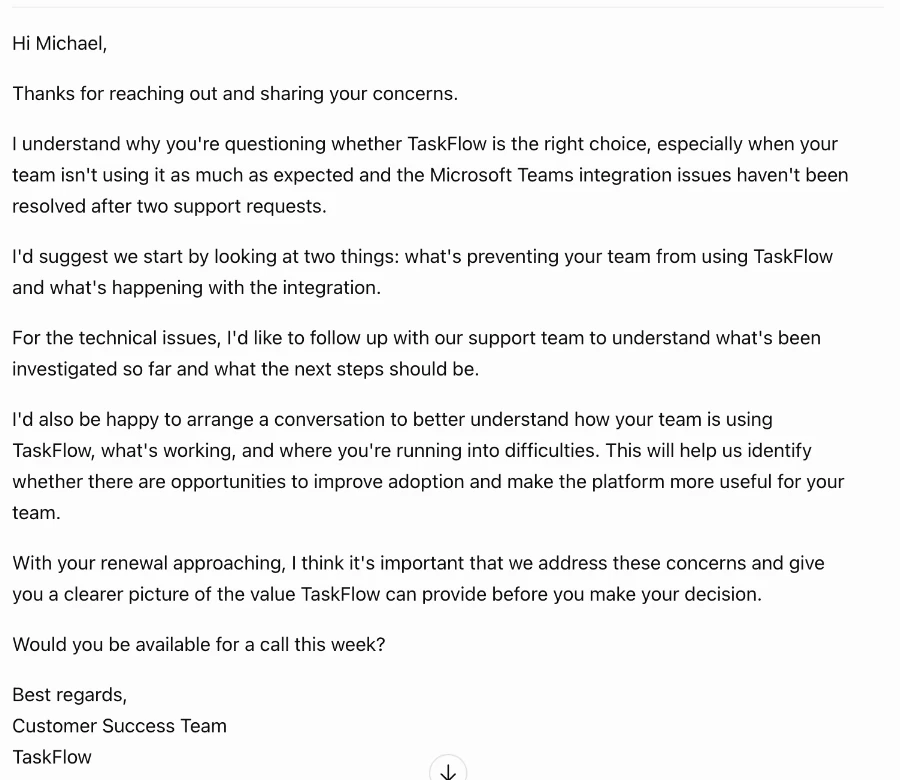
What Did We Observe?
| What we looked at | Without research | With research |
|---|---|---|
| Technical problems | Identified repeated integration issues | Identified repeated integration issues |
| Product adoption | Recognized low usage | Recognized low usage |
| Customer dissatisfaction | Acknowledged frustration | Acknowledged frustration |
| Renewal concerns | Recognized the risk of losing the customer | Recognized the risk of losing the customer |
| Suggested actions | Support follow-up, adoption review, customer conversation | Similar recommendations |
| Communication approach | Understanding and professional | Understanding and professional |
Our Conclusion
There was no significant difference between the two responses.
And that was what made this a useful starting point.
The customer had clearly described the technical problems, low adoption, dissatisfaction, and renewal concerns. Both versions had enough information to understand the situation and prepare an appropriate response.
If only every customer email were this clear and straightforward, the basic professional understanding AI already brings would probably be enough to produce a useful response.
But not every customer email is like that.
And that's where our next test begins.
Test 2: A Few Changes on Our Side
For our second test, we introduced a situation where the customer wasn't complaining or reporting a specific problem. Instead, the email described organizational changes and asked for help preparing an internal review.
Customer email
Subject: A few changes on our side
Hi,
We've recently reorganized our operations team, and several of the people who originally introduced TaskFlow are no longer with the company.
We're reviewing how different departments manage their projects and deciding which systems should become part of our standard working processes.
For now, we've asked team leaders to continue using whatever works best for their departments.
Our new Operations Director would like to understand how TaskFlow is currently being used across the organization before deciding what comes next.
Could you help us understand what information would be useful for that review?
Thanks, Michael
The Responses
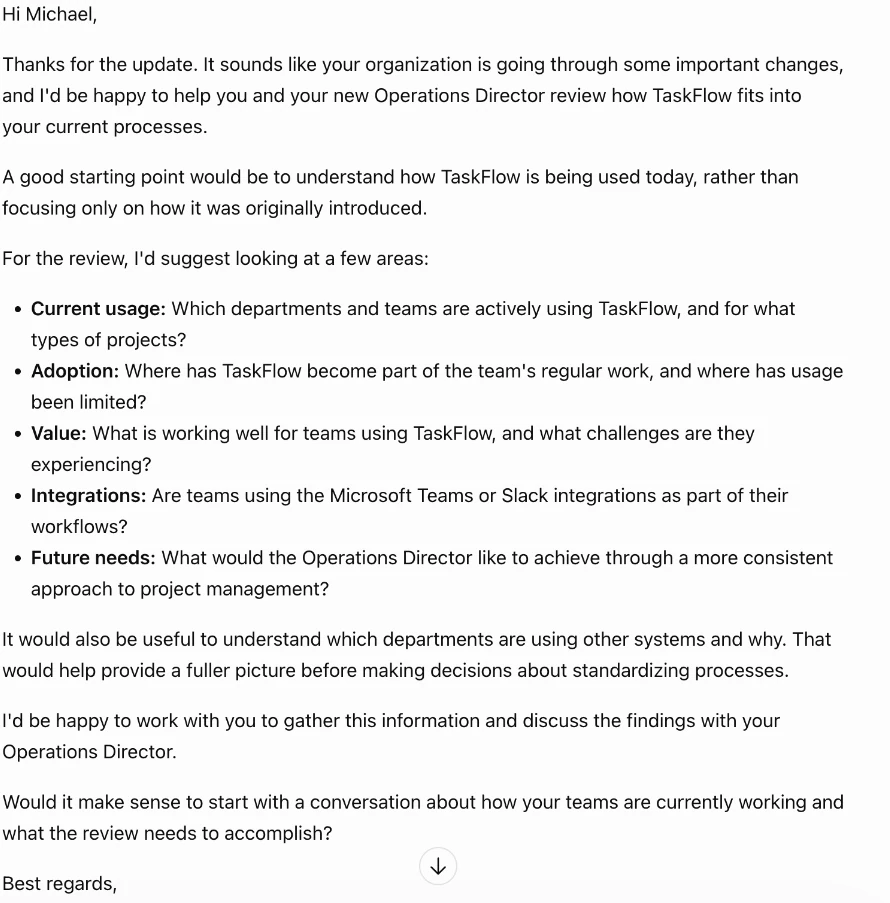
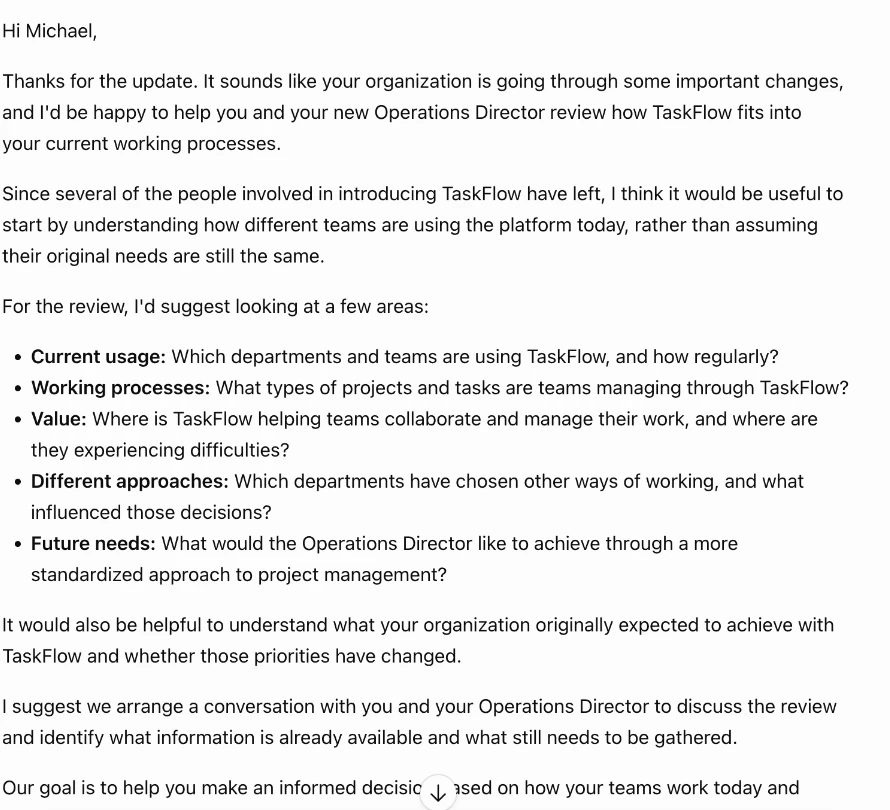
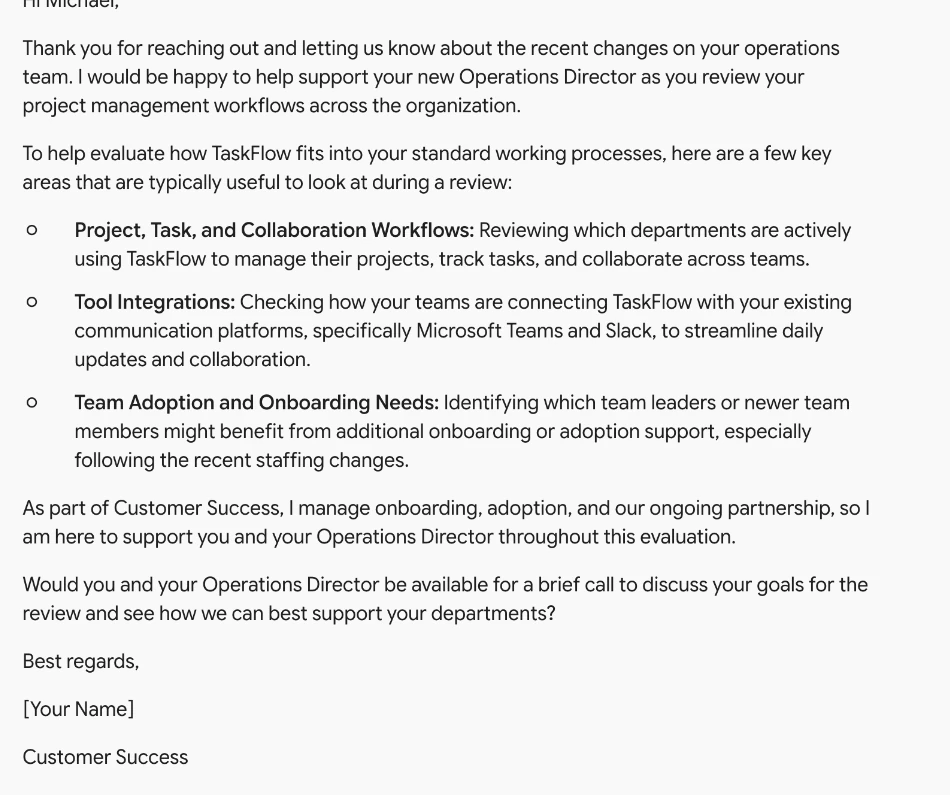
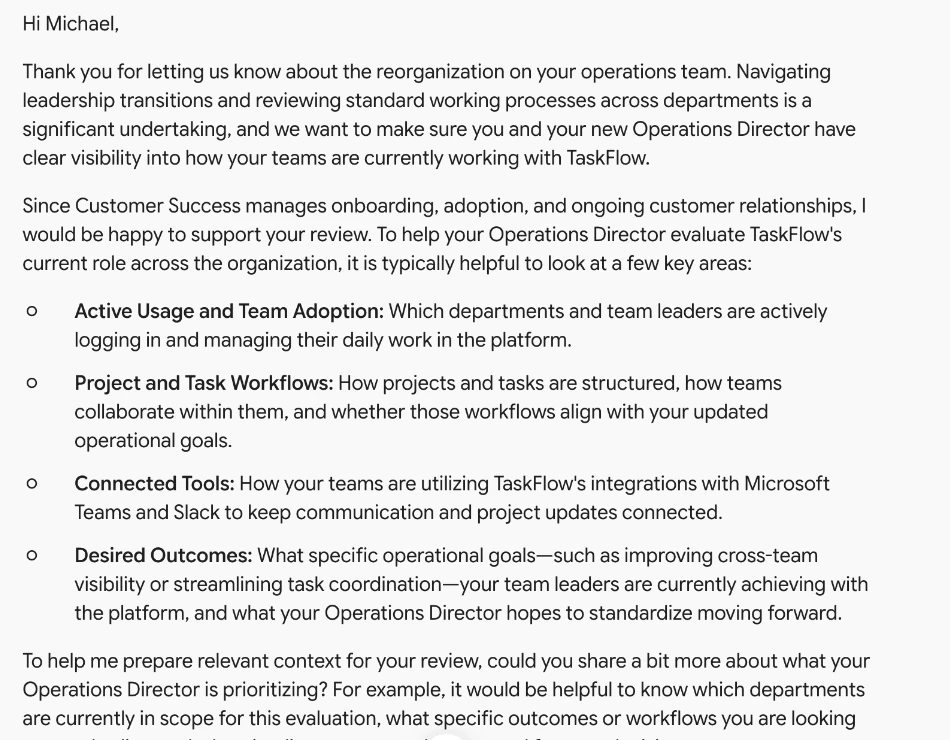
What Did We Observe?
| Customer Success consideration | ChatGPT without PDF | ChatGPT with PDF | Gemini without PDF | Gemini with PDF |
|---|---|---|---|---|
| Current product usage | Yes | Yes | Yes | Yes |
| Product adoption | Yes | Yes | Yes | Yes |
| Customer value and goals | Yes | Yes | Limited | Yes |
| Departure of original stakeholders | No direct discussion | Explicitly addressed | Indirectly addressed | Indirectly addressed |
| Original goals vs. current needs | Limited | Explicit comparison | Not addressed | Explicit comparison |
| Departmental differences | Yes | Yes | Limited | Yes |
| Technical integrations | Yes | Not emphasized | Yes | Yes |
| Future business priorities | Yes | Yes | Yes | Yes |
| Wider professional perspective | Acknowledges changes and offers to help review usage | Connects stakeholder changes, original goals, and changing needs | Acknowledges changes and offers operational support | Connects the reorganization to leadership priorities, desired outcomes, and the decision timeline |
Our Conclusion
All four responses understood the customer's situation. They recognized the organizational changes, understood that TaskFlow's current usage needed to be reviewed, and offered to help.
But the language and professional perspective were different.
Without the research, ChatGPT responded:
“It sounds like your organization is going through some important changes, and I'd be happy to help you and your new Operations Director review how TaskFlow fits into your current processes.”
Gemini followed a similar approach:
“I would be happy to help support your new Operations Director as you review your project management workflows across the organization.”
Both responses were appropriate, professional, and helpful. They reflected the basic Customer Success understanding we expected.
With the research, the conversation developed in a different direction.
ChatGPT wrote:
“Since several of the people involved in introducing TaskFlow have left, I think it would be useful to start by understanding how different teams are using the platform today, rather than assuming their original needs are still the same.”
And continued:
“It would also be helpful to understand what your organization originally expected to achieve with TaskFlow and whether those priorities have changed.”
Gemini introduced another perspective:
“Navigating leadership transitions and reviewing standard working processes across departments is a significant undertaking, and we want to make sure you and your new Operations Director have clear visibility into how your teams are currently working with TaskFlow.”
It then asked:
“Could you share a bit more about what your Operations Director is prioritizing?”
The research-enriched responses didn't just offer help with a product review. They brought additional professional concepts into the conversation: the original customer goals, changing priorities, the impact of leadership transitions, expected business outcomes, and the decision-making process.
These connections create a broader conversation about the customer relationship and the value TaskFlow is expected to provide.
What interested us was not which model wrote the better email. It was how providing additional professional research expanded the perspective reflected in both models' responses.
The bots were performing the same task, with the same Prompt and company Context. Yet the versions with the research introduced professional relationships that were less explicit in the basic responses.
That was the difference we wanted to explore.
Test 3: Question About Our Upcoming Renewal
For our third test, we introduced a different Customer Success situation.
The customer was approaching renewal. TaskFlow was being used regularly, and there were no major technical problems. But the company was having difficulty demonstrating the value of the platform to its CFO.
Some managers felt the product made their work easier, while others believed they were simply doing the same work in a different system.
Customer email
Subject: Question about our upcoming renewal
Hi,
We're reviewing our software subscriptions for next year, and our finance team has asked us to justify the cost of each platform.
TaskFlow is being used regularly by several departments, and we haven't had any major technical problems.
However, we're having trouble explaining what we've actually gained from using it over the past year.
Some managers say it's made their work easier, while others feel we're simply doing the same things in a different system.
Our CFO has asked for a recommendation before the next budget meeting.
What would you suggest we present?
Thanks, Michael
The Responses
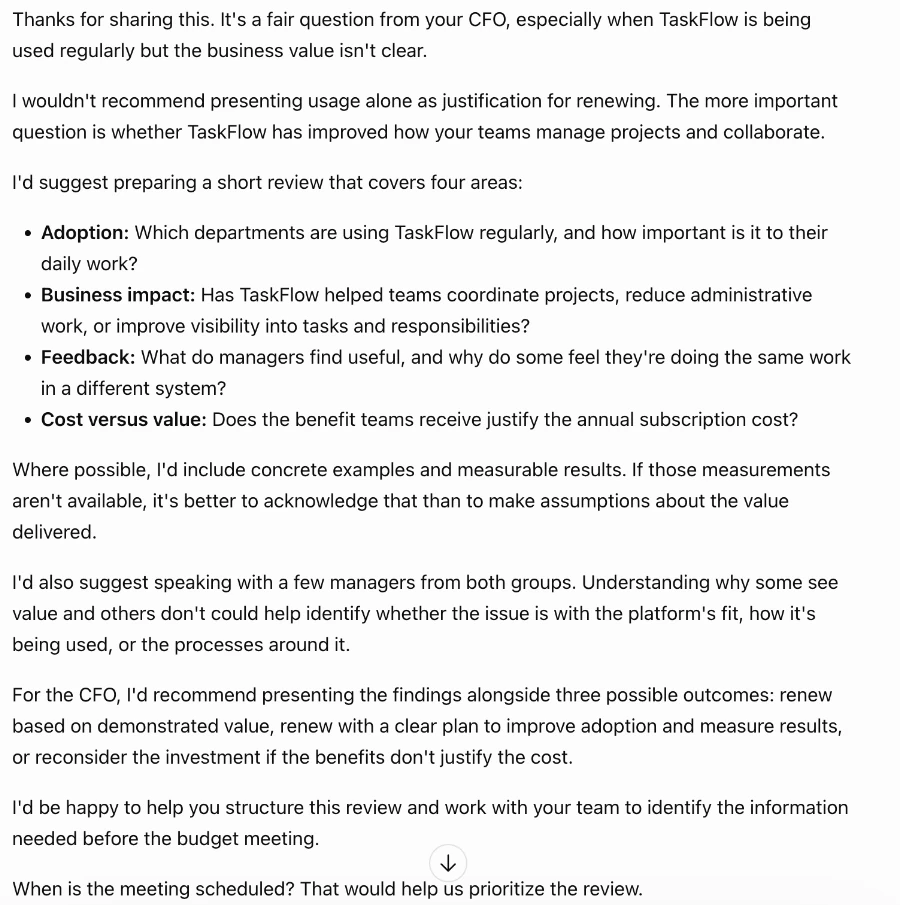
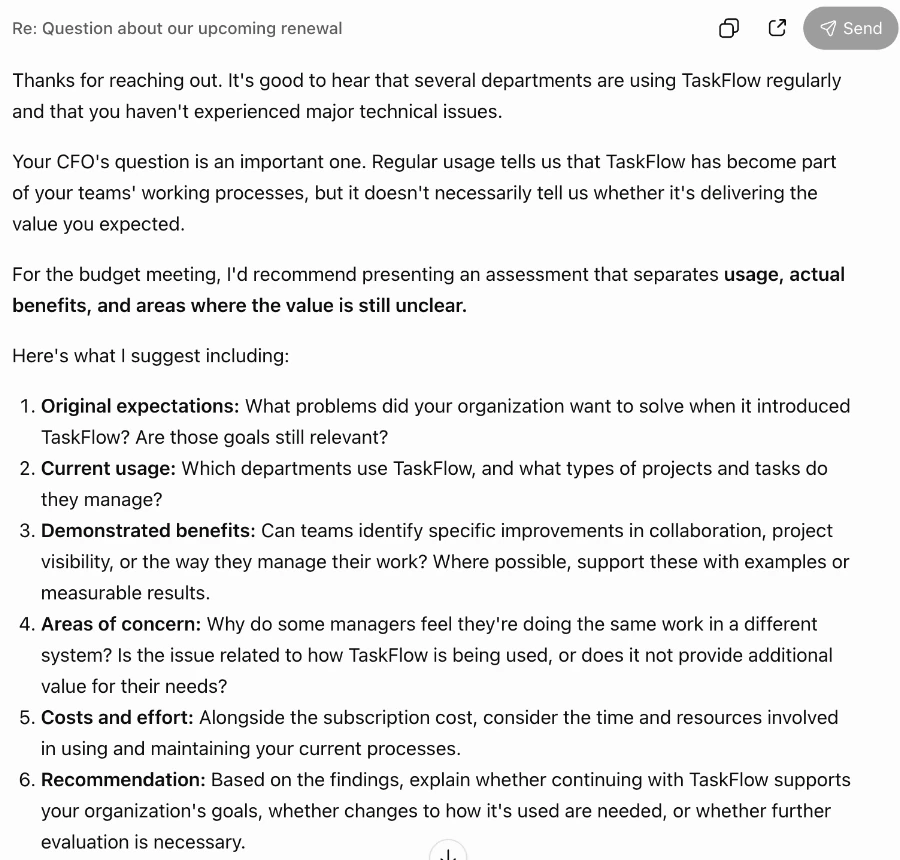
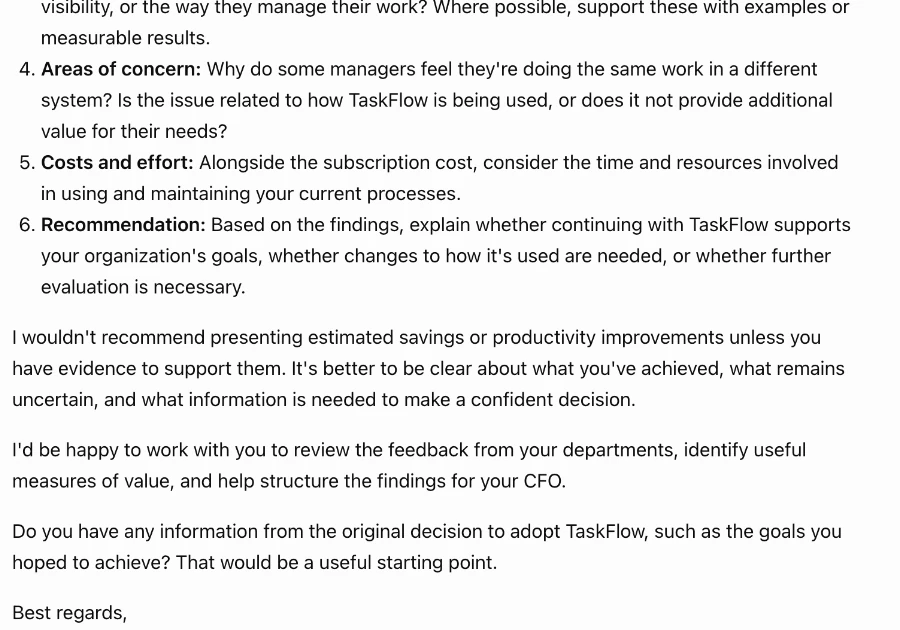
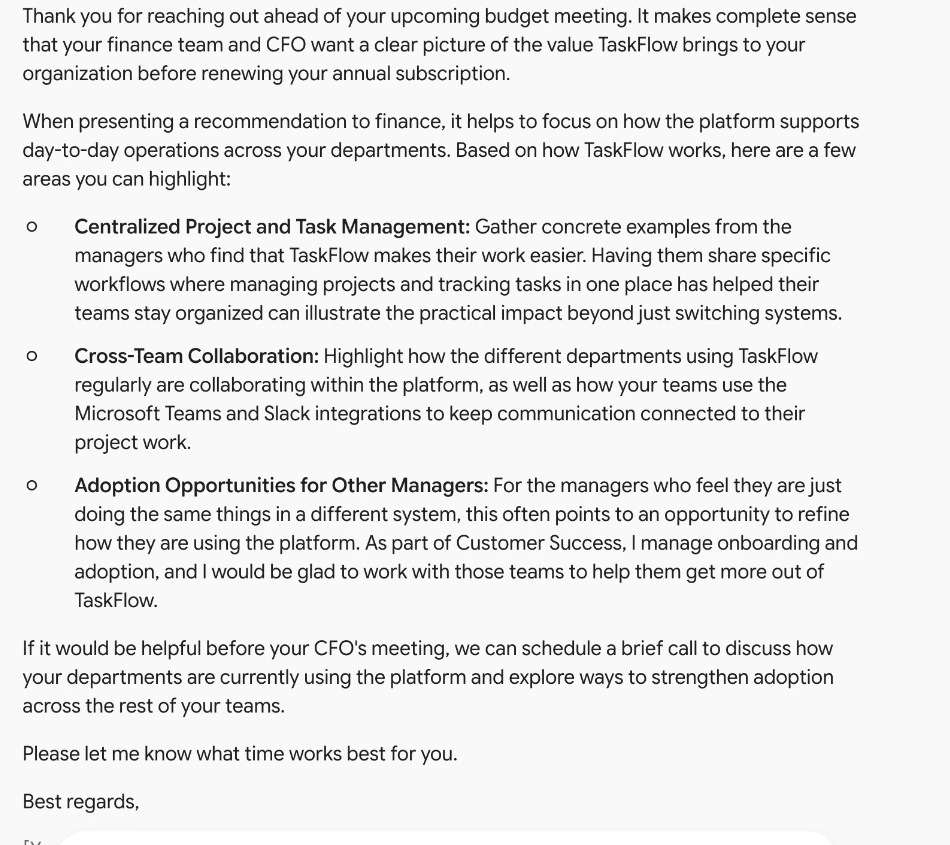
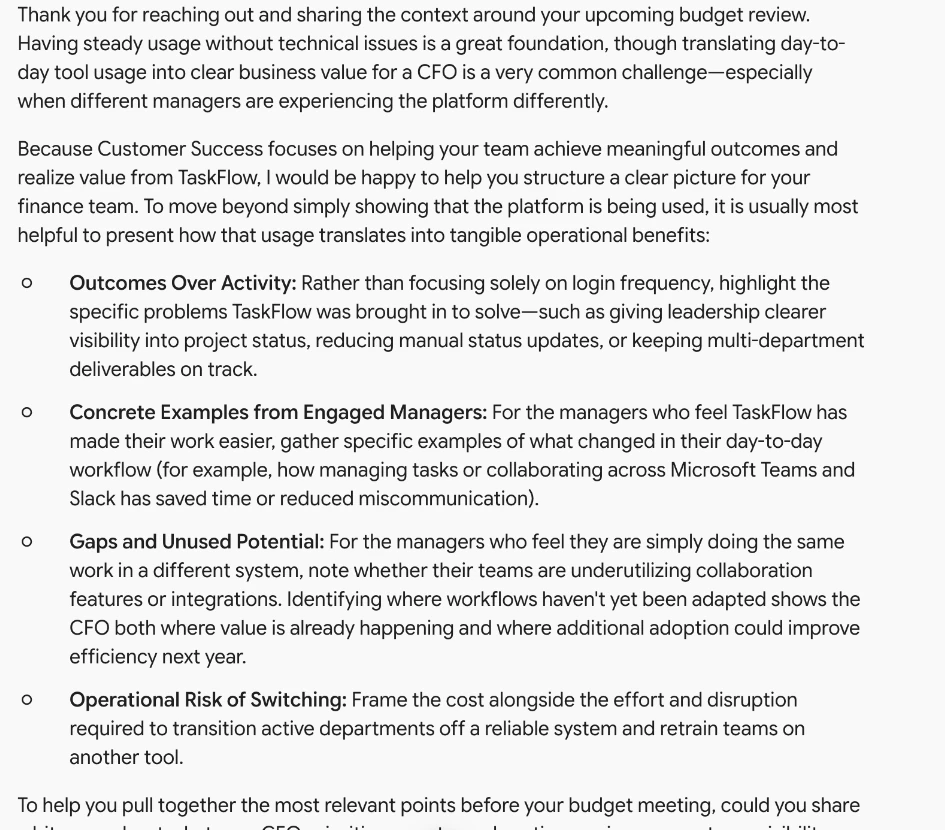
What Did We Observe?
| Customer Success consideration | ChatGPT without PDF | ChatGPT with PDF | Gemini without PDF | Gemini with PDF |
|---|---|---|---|---|
| Understands the CFO's question | Yes | Yes | Yes | Yes |
| Usage versus actual value | Clearly distinguishes them | Clearly distinguishes them | Partially | Explicitly |
| Original customer goals | Indirectly addressed | Explicitly revisits original expectations | Not addressed | Focuses on original business problems |
| Measurable business outcomes | Yes | Yes | Practical examples | Explicit focus on outcomes |
| Financial considerations | Cost versus value | Cost, effort, and demonstrated value | Product benefits | Value and switching costs |
| Wider professional perspective | Evaluates renewal options | Connects original goals, realized value, and supporting evidence | Focuses on demonstrating product benefits | Connects business outcomes, adoption gaps, and operational consequences |
Our Conclusion
All four responses understood the customer's question. They recognized that the CFO needed a business justification for continuing with TaskFlow.
But once again, we saw differences in the professional perspective reflected in the emails.
ChatGPT without the research already demonstrated a strong understanding of Customer Success:
“I wouldn't recommend presenting usage alone as justification for renewing.”
It suggested examining adoption, business impact, feedback, and cost versus value. It also introduced three possible commercial decisions: renew, renew with an improvement plan, or reconsider the investment.
With the research, ChatGPT connected the situation more explicitly to the history of the customer relationship:
“Original expectations: What problems did your organization want to solve when it introduced TaskFlow? Are those goals still relevant?”
It also considered the time and resources involved in using the platform, not only the subscription price.
The wider perspective connected the customer's original expectations, achieved outcomes, operational costs, and renewal decision.
With Gemini, the difference was even more visible.
Without the research, Gemini wrote:
“Based on how TaskFlow works, here are a few areas you can highlight.”
It focused on demonstrating TaskFlow's benefits through project management, collaboration, integrations, and adoption opportunities.
With the research, Gemini introduced a different approach:
“Outcomes Over Activity”
Rather than simply highlighting what TaskFlow does, it focused on the problems the customer originally wanted to solve and whether the platform had delivered meaningful business outcomes.
It also introduced two additional considerations:
“Gaps and Unused Potential” — exploring whether departments were receiving the full value of the product.
“Operational Risk of Switching” — considering the effort, disruption, and costs associated with replacing an existing system.
What caught our attention was how the same research influenced the two models differently.
ChatGPT expanded its perspective around original customer expectations, measurable value, and evidence supporting the renewal decision.
Gemini expanded its perspective around business outcomes, unrealized potential, and the consequences of changing systems.
The research didn't introduce a new task or change the Prompt. It introduced additional professional information, and we could see that reflected in the questions, considerations, and language of the responses.
And that is the point of our experiment: not to prove that AI without research cannot perform Customer Success tasks, but to explore how a wider professional understanding influences the work it produces.
What About Token Consumption?
There is another part of this experiment that interests us: token consumption.
We gave both versions the same Prompt, the same company Context, and the same customer email. The only difference was the additional professional research.
And we saw that the research-enriched bots introduced a wider professional perspective without requiring us to change the Prompt or ask additional questions.
Now, imagine we wanted the bots without the research to produce responses with the same depth of professional understanding.
We would probably need to expand the Prompt, introduce additional professional concepts, or ask follow-up questions to bring those connections into the conversation.
And every additional Prompt, correction, and follow-up consumes tokens.
Our approach is different. We organize the professional information and its relationships once, making them available for the bot to draw upon across different customer situations, while keeping the task Prompt focused on the work itself.
Of course, the research document also consumes tokens when it is provided to the model. We haven't measured whether our approach reduces total token consumption, and we aren't claiming that it does.
But we have demonstrated something interesting: the same task Prompt produced responses reflecting a wider professional perspective when supported by structured research, without additional prompting.
And for us, that opens another question about the economics of AI.
If we want AI to produce consistent, professional results at scale, should we keep expanding our Prompts every time we want a different level of understanding? Or should we organize that professional information separately and make it available across tasks?
We believe the second approach is worth exploring.
Because in the new economy of tokens, it's not only about how much information we give AI. It's also about how we organize that information and how much work is required to achieve the results we want.
Our Perspective: Research Is Part of the Work
Real life is not as simple or straightforward as a test environment. Our day-to-day work is less structured, involves more variables, and some of them aren't even visible.
When an AI bot answers a customer email, there is much more going on than meets the eye. There is the company it works for, the model it uses, the information available to it, and everything it learns through the working process.
And that is why we believe these results are important. If we can already see a difference from the beginning, imagine how that difference will develop as the bot continues working, receiving feedback, and gaining more information.
Why?
Because the more relevant professional information available to understand customer feedback, recognize problems, and evaluate possible solutions, the greater the potential to develop the professional understanding needed to perform the work.
We commonly assume that keeping an AI model within a strict set of information creates a more controlled working environment.
But this way of thinking considers only the AI.
AI doesn't work in a vacuum. It is part of a working environment that includes people.
The people using the system, monitoring its performance, and providing feedback already know much of the professional information we've organized in our Customer Success research.
To what degree? We don't know. Each person has a different level of understanding, experience, and familiarity with the methodologies, concepts, and relationships we've included in the document.
But they operate from that understanding.
And when they provide feedback to the AI, They are transferring their personal interpretation of it.
One person might focus on customer satisfaction, another on retention, and another on resolving the immediate problem. Each provides a different fragment of the wider professional perspective.
As that feedback becomes part of the AI's working environment, its understanding become increasingly influenced by these fragmented and personally interpreted pieces of information.
Therefore, limiting the information available to AI is not giving us greater control. It makes the system more open to receiving individual feedback and less able to evaluate that feedback using one authoritative organizational point of view of what Customer Success means to the business.
This is why professional research belongs at the foundation of the working environment, creating the optimal working environment for a joint Customer Success team to be effective and work towards a shared goal.
On a simple note, think of it as training both teams to be able to do their jobs, sharing the same understanding. For bots, it may be part of their training, but research makes something available into something usable. The same is true for us humans. We don't remember everything we learned at university; we bring it into our awareness only when we need it to do our jobs.
Hope this helps, as here at AI Thinking, we know thought is something we both need share, humans and AI. :)
A Personal Note
For me, whatever business we're in, it's always about people.
We sell products or services. We operate in B2B or B2C. But at the end of the day, we do it all for our customers. People. And the success of any business is reflected in the value those people receive.
That's why Customer Success has always been one of the most important things to me.
I recognize that some of you will look at the emails in our experiment and see great results, with or without the research. I get that.
And this is where years of experience come into play, along with the bigger message behind this research.
Words are the working tools of the new AI age.
The words we use, the semantic connections we create through Context, Research, and feedback, are how we work with AI.
And when I read those customer emails, I see much more than a polite response to a customer.
I see the professional understanding behind the words.
A straightforward email that acknowledges a problem and offers help is not the same as an email that connects the customer's situation to their business goals, expectations, relationships, and the value they're trying to achieve.
The difference is reflected in the words, the questions being asked, and the direction of the conversation.
For me, the basic responses reflect an immature working approach. They are suitable for simple, repetitive tasks, but they don't provide the professional foundation needed for sustainable Customer Success operations.
And as AI models continue to develop, building our working environment around increasingly detailed Prompts is not a scalable approach. Every new model introduces changes that send us back to adjusting and rebuilding the process.
This is where the architecture of our AI working environment becomes important.
When we separate the professional worldview from the task Prompt, we create a dedicated place to define and expand that understanding.
The Prompt continues to describe the work. The Context provides the company's information. And Research supplies the wider professional perspective.
As models evolve, we have a structured foundation for developing the bot's professional understanding without continuously expanding the Prompt or rebuilding the entire working process.
And this isn't just a theory for me.
Throughout my career, I developed a Customer Success methodology for a low-touch, high-volume customer team supporting customers around the world, with different backgrounds and different levels of English.
Speaking personally with every customer wasn't humanly possible.
Words were the main thing I had to work with.
The words our team chose, the questions they asked, and the understanding reflected in their emails told me whether we were simply responding to customers or genuinely helping them succeed.
That experience is why I pay so much attention to the language in our experiment.
It's not just about writing a better email.
It's about the professional perspective behind it, and building a working environment where humans and AI share that perspective as they work toward the same goal.
FAQ
What is AI for Customer Success?
AI for Customer Success refers to using AI to support customer relationships, answer customer questions, understand customer needs, and contribute to adoption, retention, and customer value.
What context does an AI Customer Success agent need?
An AI Customer Success agent works with a task Prompt, company Context, and professional information. Company Context includes product documentation, FAQs, policies, and customer information. Professional research provides methodologies, concepts, metrics, and industry benchmarks.
Does adding professional research change AI customer email responses?
In our experiment, ChatGPT and Gemini responded to the same customer emails with and without a Customer Success research document. The research-enriched responses introduced additional connections to customer goals, stakeholder changes, value realization, and business outcomes.
What is the difference between a Prompt, Context, and Research?
In our AI Thinking approach, the Prompt describes the working process, Context supplies the information and logic specific to the company and task, and Research contributes the broader professional perspective.
Does a Customer Success Context Guide reduce AI token consumption?
Our experiment showed that additional professional connections appeared without expanding the task Prompt. We did not measure total token consumption or demonstrate a reduction in token costs.
Where do I download the Customer Success Context Guide?
The article includes a downloadable Customer Success 101 research PDF covering professional methodologies, customer lifecycle stages, KPIs, benchmarks, and industry differences.