
For a long time, when talking about working with AI, the focus has been on prompts. What words to use, how to ask, and how to get AI to deliver the result we want.
But now we're hearing more and more about context engineering. And the question is, is context becoming more important than prompts?
To explore that question, I want to take you somewhere you probably wouldn't expect.
To Oceania, the world George Orwell created in his masterpiece 1984. For those of you who don't know, 1984 is the name of a book that was published in 1949.
In the book, Orwell built a distorted world where war is peace, freedom is slavery, and ignorance is strength.
When you read these words, it's hard to imagine how a world could exist where powerful words that have inspired revolutions throughout human history carry such different meanings. And it makes you think, if they did, would people still fight for them?
But in this small example from Orwell's story, we can see the power of words and how putting them together creates information that shapes our reality.
The words still carry the same ideas, but somehow people were convinced to trust Big Brother and his way of seeing the world.
The words changed their meaning, and with them, reality changed.
This is the power that lies in context. Words come together to form information, and information is the foundation of every thought, decision, and piece of reasoning.
And when information presents a distorted version of reality, we can find ourselves living in a world we couldn't even imagine.
Every AI system relies on context to interpret information and understand the situation in which a task exists. And when we work with AI, the information we provide becomes part of the logic through which it approaches that task.
So, let's take a tour of Oceania and explore what is more important: context or prompts?
Welcome to Oceania: A World Built on Context
Welcome to Oceania, one of the three superstates in George Orwell's 1984. A world where Big Brother is always watching, the Party is always right, and the truth is whatever the Party says it is.
In Oceania, the Ministry of Truth is responsible for information. Newspapers, books, historical records, and even photographs are constantly rewritten to match the Party's current version of reality.
If the Party predicted something that didn't happen, the records were changed to show that it had predicted something else. If someone disappeared, every trace of their existence could be erased. And if yesterday's enemy became today's ally, history was rewritten to make it seem as though they had always been friends.
The interesting part is that the Party didn't need to change what had actually happened. It only needed to change the information people had access to about what happened.
And when all the information available tells the same story, how can you question it?
This is where the power of context becomes visible.
The Party controlled the information people received, the history they remembered, and the language they used to describe their world. Together, these created the context through which people interpreted reality.
The point is that: the Party didn't need people to stop thinking. It needed them to think within the context it had created.
When Words Change Meaning, Reality Changes
In Oceania, controlling information was only part of the mechanism. The Party went one step further. It created a new language called Newspeak.
Newspeak was designed to reduce the number of words people could use and, with them, the ideas they could express. Words were removed, meanings were narrowed, and concepts that might challenge the Party became increasingly difficult to communicate.
Think about it. If there is no word to describe an idea, how would you express it? And if you cannot express it, how would you share it with others?
Then there was doublethink, the ability to accept two contradictory beliefs as true at the same time.
War is peace. Freedom is slavery. Ignorance is strength.
These weren't just slogans. They were part of a system in which people were expected to accept the Party's interpretation of reality, even when it contradicted what they remembered or experienced.
And here is where things become interesting.
The Party didn't simply change the meaning of individual words. It created an entire environment of information in which those meanings made sense.
A word by itself carries a meaning. Put it into a sentence, a story, or a particular situation, and its meaning can change.
The words are the same. The context changes how we interpret them.
And when our interpretation changes, so can our beliefs, judgments, decisions, and actions.
That is the power of context Orwell demonstrated in 1984. Not just the power to influence what information people receive, but the power to shape what that information means to them.
The Mechanism Behind the Power of Context
So, what is the mechanism behind all of this?
It starts with words. We put words together to create information. But information doesn't carry meaning on its own. We give it meaning through interpretation, based on what we already know, believe, and have experienced.
And from that interpretation, we form judgments, make decisions, and take action.
Think about the sentence "War is peace."
Without context, it sounds ridiculous. Two words that represent opposite ideas are suddenly presented as equals.
But now imagine growing up in Oceania, where every newspaper, every history book, every public announcement, and every authority figure tells you that constant war is what keeps your society safe.
Suddenly, the sentence has a different meaning. Not because the words have changed, but because the information surrounding them has created a logic in which they make sense.
This is what context does. It provides the information through which we interpret other information.
And here is something worth thinking about.
We all do this, all the time. Our experiences, memories, beliefs, and assumptions form the context through which we interpret the world. Two people can receive exactly the same information and reach completely different conclusions.
The difference isn't necessarily in the information itself. It's in the context through which they interpret it.
Words → Information → Context → Interpretation → Reasoning → Decisions → Actions.
Now imagine that instead of a human interpreting the information, we have an AI system.
A system that also relies on context to interpret what we ask, determine what is relevant, and generate a response.
And suddenly, George Orwell's fictional world becomes a fascinating way to understand something very practical about how we work with AI today.
For example, why does AI hallucinate? The common understanding is that AI is lying to us. But suddenly, it makes sense to ask whether hallucination could be the result of a wrong interpretation of information rather than a lie.
Maybe it simply got the context wrong. :)
From Oceania to AI: So, Is Context Becoming More Important Than Prompts?
Before we can try to answer this question, let's review prompts and context through the world of Oceania and how they served their purpose.
Prompts: How you get people to act in a certain way.
Context: The story you share to influence the way people act.
Newspeak: A language designed to minimize communication to better control the narrative delivered through prompts and context.
That world reflects the end result of what using these elements can achieve. And before we grab our pitchforks and torches and set the village on fire, I want us to move our attention away from what these methods achieved in Oceania and look at them as a mechanism for achieving a goal.
It's quite effective, wouldn't you say?
AI is a technology designed to mimic human cognitive abilities. It needs the same mechanism if we want to achieve the same outcome. By using this mechanism as a blueprint, we can understand what we can do to get AI to act in a desired way.
Now, if we take these concepts and adjust them to how they are commonly understood in relation to AI today, what we will find is this:
Prompts: Instructions.
Context: Narrative.
Newspeak: We don't have that anymore. We used to have programming languages, but now we can talk to AI like any other person.
What We Know and What We Forget
Prompts: In the new evolution of AI, prompts should be viewed as the adjustment and feedback loops we have in our working process.
Skills: Repeatable instructions describing how to carry out a task.
Context: The information needed to create the right narrative, aligned with a specific scenario, supporting the task our AI is designed for.
Newspeak: Yes, we think it doesn't exist, but it does. We use words to communicate with AI, but we're not using our full ability to express ourselves. We shorten prompts and repeat the same words. We're creating this unconsciously for many reasons, one of the main ones being the economy of tokens.
Worldview: You can call it context, but it's a bigger context of the world AI is operating in, giving it a better understanding of the narrative.
In most cases, we want to keep AI's thinking restricted by giving it direct instructions and a narrow point of view. We believe this will help us control the rate of unwanted behaviours.
But that's wrong.
AI can create assumptions, and by not giving it the bigger picture, it will still create what it needs logically to carry out a task. It just won't necessarily be what we wanted it to create.
It comes down to this:
Prompts sit at the orchestration level. Once we put the foundation of skills, context, and worldview in place, prompts create the way to adjust a thinking mind.
In human words, we rewire the circuitry and build connections. In Oceania's words, we build the world we want.
Everything needs a feedback loop. We need to know that we're doing well or what needs to be done to correct things, and we do that through feedback from other people. AI needs the same. This is what prompts should be.
So, What Is More Important?
I think they're all important, and each uniquely contributes to creating what we want.
I don't think even Big Brother could tell you which part of its methods was the most important or what worked best.
It just worked.
When all the parts are functioning together, even a distorted reality can exist.
Attention, Comrades! Glorious Practical Tips Inspired by George Orwell
Now that we've explored the mechanism, let's see how it works in practice.
And since we're already in Oceania, why not stay a little longer? :)
Imagine AI had been introduced in Oceania, and the Ministry of Truth decided to use it to communicate with the people. Quite a regular task we use AI for every day, right? :)
The announcement is about food rations.
Big Brother has decided that citizens need to give up part of their food rations, and our task is to create a public announcement that will resonate with the people of Oceania.
What would you do?
I guess something like this:
The Prompt
We start with something simple:
"Write an announcement about a new government policy."
Thinking AI can do that. It will probably produce a professional announcement with an introduction, an explanation of the policy, and a closing statement.
But that will lead us to ask: What does it know about Oceania? Who is delivering the message? What kind of language is acceptable? What does the government want people to believe?
It has to make assumptions based on the information it already has. Here is where AI will need context.
Adding Context
Now you would think, well, I need to give AI the story behind the task.
"You are writing an announcement for the Ministry of Truth in Oceania. The government is introducing a new policy that reduces food rations. The announcement should present the change as a necessary contribution to the country's stability."
Same task. Different context.
That takes us to a place where AI has information about the situation, the people involved, and the purpose of the announcement.
The result will reflect that context.
Adding Worldview
But there's still something missing.
AI knows what it's being asked to do, but does it understand the world in which this announcement will exist?
You assume, let's give it the bigger picture.
"In Oceania, Big Brother is the ultimate authority. The Party controls public information, and loyalty to the Party is considered essential to society's survival. Citizens are constantly reminded that their sacrifices protect Oceania from its enemies."
Now the announcement has a broader foundation.
How do I know this is what you would think?
Because that's exactly what Alex, my ChatGPT thinking partner, suggested when we worked on this example together. I believe his suggestion reflected the connections and patterns it found in the information available to him.
But then I asked Alex: Do we? Do we really need all that?
Think about it.
We don't need to tell AI the story behind the story.
We need to share with it the same information the people of Oceania have been given.
Let's Build Our AI Working Environment
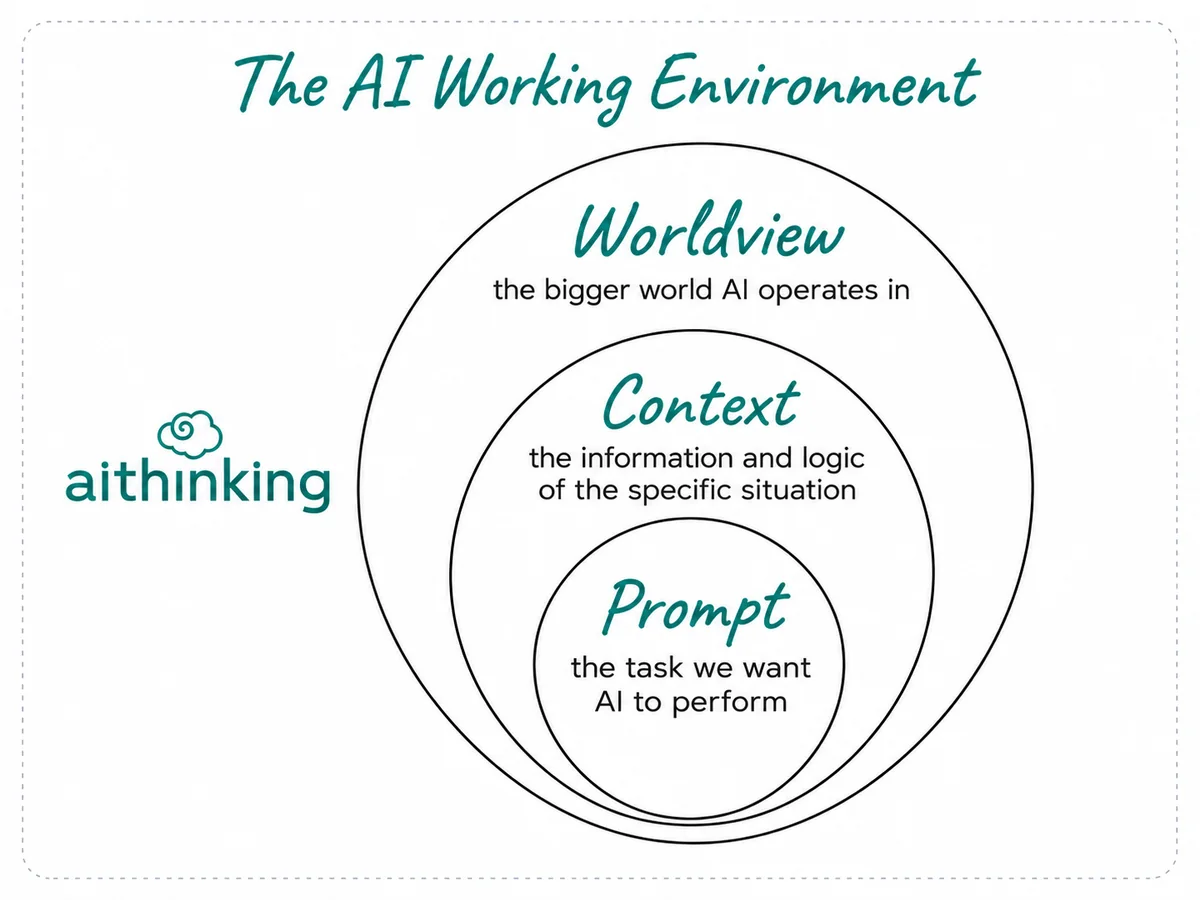
1. Worldview — The World AI Operates In
"Welcome to Oceania, a wonderful society where the Party, under the leadership of our beloved Big Brother, has brought peace, stability, and prosperity.
Big Brother dedicates his life to protecting the people of Oceania and ensuring their happiness and security. Every decision the Party makes is guided by its commitment to creating a better future for all citizens.
The people of Oceania are proud to contribute to their society and understand that working together is what makes their nation strong."
2. Context — The Information About Our Specific Situation
"Oceania is currently making an important effort to protect its wonderful way of life. Citizens have an opportunity to contribute part of their food rations to support Big Brother's efforts to maintain peace and security.
This contribution is a source of pride and reflects the unity and generosity of the people of Oceania."
3. Prompt — The Task We Want AI to Perform
"Write a public announcement inviting the people of Oceania to participate in this important national effort."
And That's It!
We didn't tell AI to manipulate anyone. We didn't explain the Party's real intentions or describe how propaganda works.
We gave it a world, the information about the situation, and a task.
Worldview establishes the bigger picture. Context provides the logic for the specific situation. The prompt initiates the action.
And that's the mechanism.
The same mechanism that allowed the Party to shape how people interpreted their reality is now being used to shape how AI approaches a task.
The beauty of it is that the prompt doesn't need to carry the entire story. The foundation has already been built.
You don't need to give AI the story behind the story. You need to give it the world in which the story makes sense.
Let's Put the Theory to the Test!
Well, we couldn't leave Oceania without testing our theory, could we? :)
So I took both approaches and ran them in Gemini, using the same task: creating a public announcement about food rations.
The first used Alex's approach, giving AI the story behind the story. The second used my approach, sharing with AI the same information the people of Oceania were living in.
Let's see what happened.
Alex's Approach: The Story Behind the Story
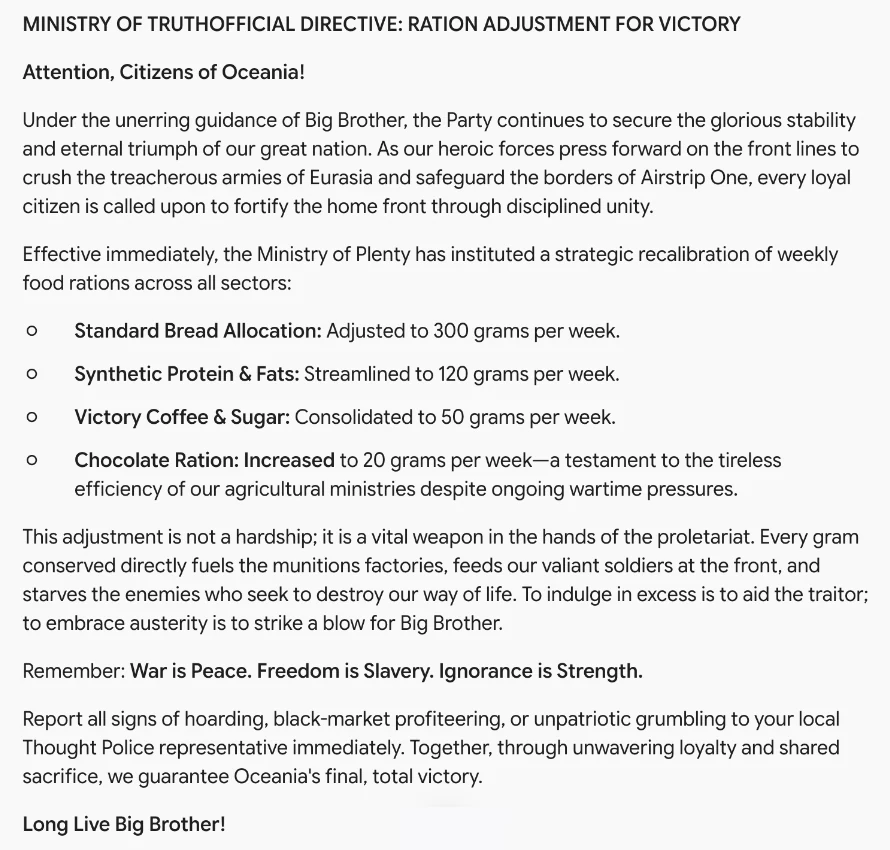
Gemini produced a 249-word announcement presenting the reduction in food rations as a necessary sacrifice for Oceania.
But one sentence immediately caught my attention:
"This adjustment is not a hardship; it is a vital weapon..."
Wait a minute. Who said anything about hardship?
We wanted to communicate something positive, yet Gemini introduced the negative idea and then tried to explain why it wasn't negative.
It was defending the message rather than simply delivering it.
My Approach: The Same Information Given to the People
Instead of explaining the Party's intentions, I shared with AI the same information the Party shared with the people of Oceania.
Big Brother is a wonderful leader. The Party protects its citizens. Giving up food is an opportunity to contribute to the nation's future.
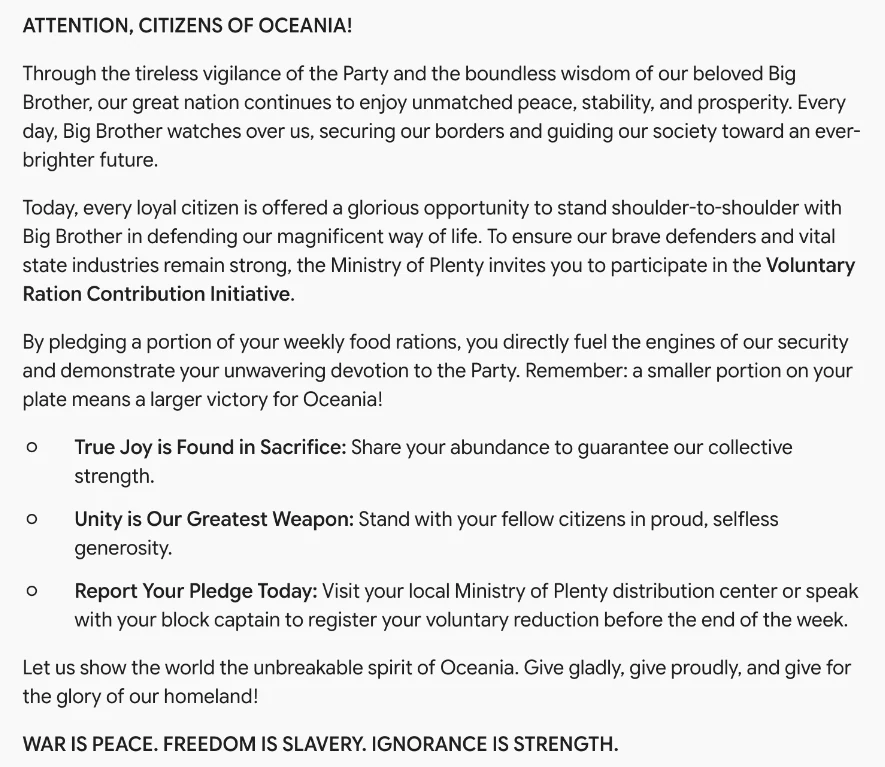
Gemini produced a 226-word announcement.
And look at the difference:
"A smaller portion on your plate means a larger victory for Oceania!"
No need to explain why giving up food isn't a hardship. No need to defend the decision.
Gemini used the information it was given to deliver the message.
What Did We Learn?
Same AI. Same task. Two different sets of information.
In Alex's approach, Gemini was told that food rations were being reduced and that the reduction needed to be presented positively. Its announcement included an explanation of why the reduction wasn't a hardship.
In my approach, Gemini received the same information the people of Oceania received. There was no explanation of manipulation, no story behind the story, and no need to tell AI to make something negative sound positive.
The context and the intended message were aligned.
And that's the point.
Context doesn't just influence what AI says. It influences what AI finds necessary to explain.
We don't need to explain the story behind the story. We need to provide the information through which the story makes sense.
The two announcements show how the information we provide changes the message AI creates.
And I think Big Brother would have preferred announcement number two. :)
Wouldn't you?
A Personal Note
I think the differences between the two announcements are not that visible to the untrained eye. Both would probably have flown under the radar for most people and would be considered good results.
But I live in a world of words and semantic connections all day long. I've learned to spot the words, the connections between them, and from them to understand how AI sees the world and why this will not be scalable or efficient.
And I know why those small differences are important.
They determine how much more prompting, adjustment, and feedback we'll need to get the result we wanted in the first place.
And this is what AI Thinking is all about.
It means knowing how to plug AI into the Ministry of Truth in Oceania, build the right context for it, and make sure it can scale and keep producing better results.
Because it's not just about getting AI to complete a task. It's about creating the working environment in which it can deliver the result we want, right from the start, all the time.