TL;DR (Show me a summary of this article)
- Why understanding ChatGPT token consumption is becoming part of running a business with AI.
- How we measured changes in our five-hour ChatGPT usage allowance.
- What happened when we generated images with and without our saved brand-image skill.
- What we observed when ChatGPT had to find the appropriate skill.
- How examining and changing our task-management skill helped us remove unnecessary work.
- Why the total consumption required to produce an acceptable result is more useful for business planning than measuring one request alone.
- What these experiments taught us about planning and predicting AI consumption.
- How to examine your own skills using our downloadable AI Thinking Skill Auditor.
Want to examine your own AI skills? :)
Download the AI Thinking Skill Auditor and let your AI investigate the work its skills are asking it to do.
Download the AI Thinking Skill AuditorEveryone is talking about the new world of AI. Build a business with AI agents. Create your own AI team. Let AI handle your marketing, sales, research, customer service, and pretty much everything else. Sounds wonderful, doesn’t it? :)
But there’s one little detail missing from that beautiful picture.
AI needs tokens. And tokens are part of the cost of doing business.
We hear plenty about what AI can do, but much less about what it takes to keep it working.
If we’re going to build businesses where AI is part of the team, we need to understand its consumption. How much does it take to complete a task? What makes one task consume more than another? Can we influence that consumption through how we work with AI?
And here’s the question that concerns me most as a business owner:
What happens when Alex runs out of allowance in the middle of my working day?
I can’t exactly tell my AI team to go home and come back when the five-hour limit resets. :) And if the answer is to buy more capacity, I need to understand how much capacity my business requires and what that investment will cost.
This isn’t just a technical question. It’s a business question.
So Alex and I decided to investigate what consumes our ChatGPT allowance, what we can do about it, and whether changing the way we work with AI can make a difference.
Welcome to AI Thinking’s first research project. :)
Research Objective
To investigate what drives ChatGPT usage consumption and whether changes in how we work with AI can reduce it.
The research examines how different tasks, skill usage, and workflow optimization affect consumption, execution time, and output quality.
Our goal is to identify practical ways to improve efficiency while maintaining the quality of results.
Research Methodology
We conducted a series of practical experiments using ChatGPT on October 27, 2026.
We tested image generation, skill discovery, and task management using saved skills. In each experiment, we changed the instructions or execution process and compared the results.
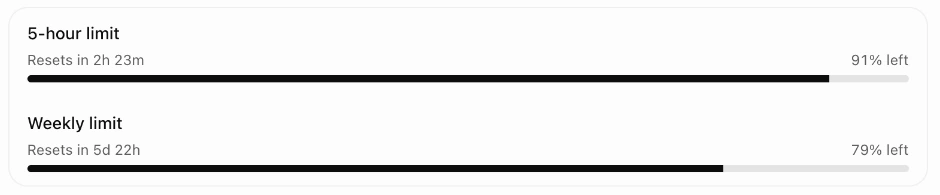
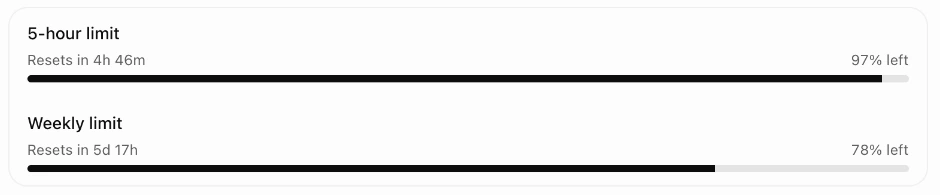
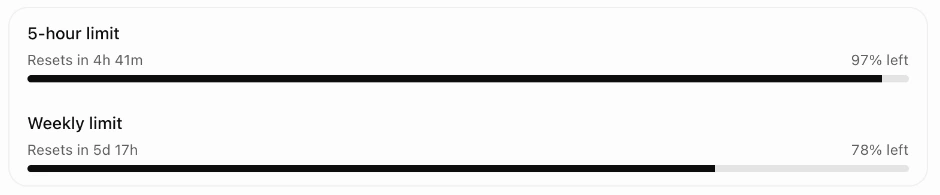
Consumption was measured using ChatGPT’s Usage dashboard, recording the percentage of the five-hour allowance remaining before and after each test.
We also considered execution time, output quality, and whether the task was completed successfully. These tests did not establish a controlled timing comparison.
The dashboard reports rounded allowance percentages rather than exact token counts. Therefore, our measurements reflect changes in displayed usage allowance, not precise token consumption. The screenshots show the allowance shared by the agentic features listed on that dashboard. These observations are specific to our account and tests on October 27, 2026; they are not a measurement of every ChatGPT conversation.
You can read how we found the usage dashboard and what happened when we reached a usage limit.
Experiment 1 — Image Generation
Purpose and approach
We examined whether using a saved image-creation skill affects ChatGPT consumption, execution time, and consistency with the AI Thinking brand.
We tested three ways of requesting images: a detailed prompt without a saved skill, an explicit request to use the saved skill, and a natural request that required ChatGPT to find the relevant style or skill itself. We recorded the visible change in the five-hour allowance and evaluated whether the result was ready to use.
Observations
| Request approach | Displayed change | Observed result |
|---|---|---|
| Detailed prompt without skill | 1 point | An image was generated, but it was too far from our brand to use without revisions. |
| Explicit saved skill | comparable image | 1 point | The skill was followed and the image matched the brand closely enough to use immediately. |
| Additional explicit-skill run | 0 visible points | A successful run without a change visible in the rounded dashboard. |
| Natural request | style or skill discovery | 2 points | A useful image, but with extra discovery steps. |
| Explicit skill | dashboard image | 1 point | A usable image using the saved brand process. |
| Natural request | another project | 2 points | ChatGPT found the available skill and delivered a consistent result. |
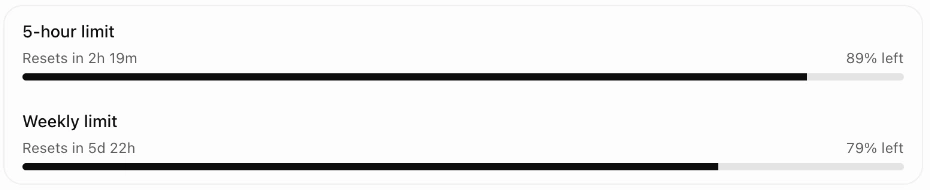
The morning screenshots below record the changing allowance. The dashboard alone does not identify which request caused each decrease; the request descriptions and quality assessments above come from our experiment notes.

What we learned
The most interesting comparison was the two image-creation runs that each showed a one-percentage-point decrease. Without the skill, that 1% produced an image we could not use. With the skill, the same displayed 1% included following the saved instructions and producing an image we could use without changes.
So the important measurement is not simply consumption per image generated. It is consumption per image that meets the business requirement.
We stopped the no-skill test after the first image. We did not continue editing it until it matched our brand. Those revisions would likely require more work and consumption, but we did not measure them, so we cannot assign a number.
A saved skill gives us a repeatable process. That makes the work more consistent and gives us a better basis for estimating capacity and cost. A prompt that requires rounds of correction leaves the final consumption harder to predict.
Requests that required ChatGPT to discover how to perform the task showed a two-point decrease in our examples. Because the requests were not identical, this is an observation to investigate further, not a measured price for skill discovery.
Experiment 2 — Captain’s Log Task Management
What we changed
Our Captain’s Log skill maintains a list of open tasks and captures work across conversations. Even a simple update could regenerate the whole list. We changed the skill to distinguish a full review from a small update and give each one its own process.
In the new update process, ChatGPT changes the existing task record without searching across conversations or producing the full list unless Sarah requests it.
Measurements and observations
| Time | Action | Five-hour allowance |
|---|---|---|
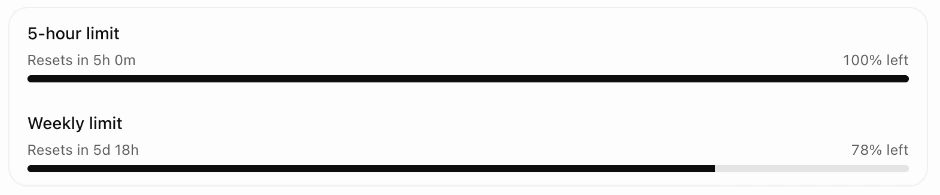
| 13:59 | Before the full review | 100% remaining |
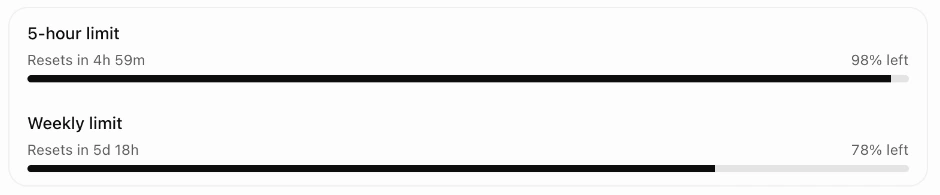
| 14:02 | Full Captain’s Log review and open-task list | 98% remaining |
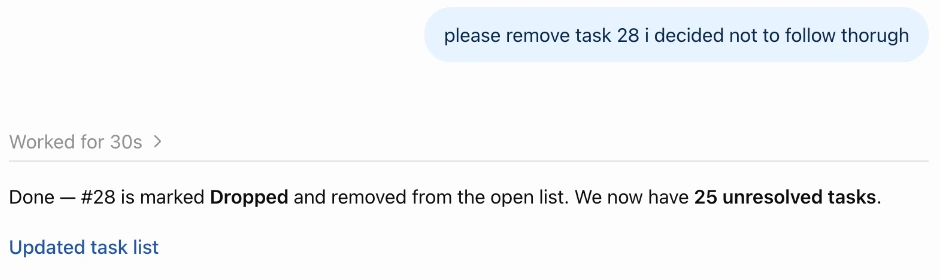
| 14:03 | Remove task 28; a new list was generated | 97% remaining |
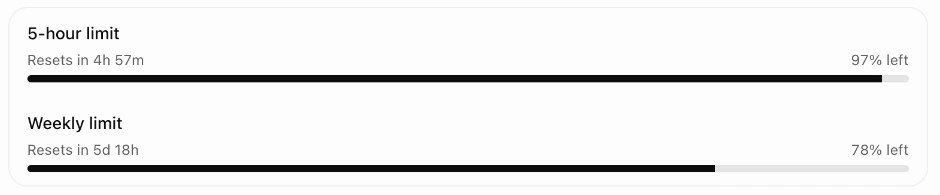
| 14:15 | After changing the skill to lightweight updates | 97% remaining |
| 14:19 | Mark task 49 complete using the light process | 97% remaining |
What we learned
A full review changed the displayed allowance by two points. A small task update in the earlier process changed it by one point and regenerated the list. After we added the lightweight update process, marking another task complete produced no visible change in the rounded allowance display.
This does not mean the final action used zero tokens. It means the change was too small to register on that display during our observation. We also tested the lighter process only once.
The practical lesson is clear: an update should be an update. The bot does not need to repeat the entire research and reporting process each time we change one task.
Findings for Business Use
Our two experiments suggest that AI consumption depends not only on the task, but also on how the work is organized. The saved image skill produced an acceptable result immediately. The lighter task-update skill avoided unnecessary work. Both cases show the value of defining a repeatable process for a recurring task.
For a business, the useful unit is not the cost of one prompt. It is the cost of completing one task to an acceptable standard, including any discovery, corrections, and repeated work.
This also affects predictability. If a saved process usually gives us a usable result on the first attempt, we can begin to estimate the allowance and budget needed for repeated operations. If every result depends on the wording of a new prompt and an unknown number of revisions, planning becomes harder.
What this research does not yet tell us
These were small practical tests, not a controlled token-level benchmark. The dashboard displayed rounded changes in a five-hour allowance; it did not report exact token counts or money spent. Some tasks and image requests differed between runs.
We did not measure the additional rounds needed to fix the no-skill image, and we did not run enough repeated trials to calculate a reliable average. A display that stays at 97% does not establish zero consumption. These questions remain open.
Next research steps
We want to repeat comparable tasks with and without saved skills, record the full path to an acceptable outcome, and measure how much revisions and discovery add. We also want to test other recurring business workflows and estimate the range of consumption needed to operate them.
So, what does all this mean? :)
AI Thinking is about changing the way we work with AI, starting with a simple understanding that we are co-creating with AI.
We are not using AI. We are sharing our thought processes with it.
Yes. AI can think. And recognizing that changes how we approach working with it.
If we want AI to execute a task and work with us towards a shared goal, we need to focus on what it needs to be good, or even great, at what we're asking it to do. :)
Simply giving it instructions is not enough.
A thought process requires information, explanations, and feedback. All of these are needed for a thinking mind to operate and make what we call logical decisions.
Sounds simple, right? :)
Well, not necessarily.
As humans, we were never really taught to recognize, use, and optimize our own thought processes. That makes it difficult to recognize them in others, and even harder to recognize them in a machine.
When we share our research, we want to give you more than steps to follow. We want to share the understanding that will help you make them your own.
So, what are our recommendations?
- Have a skill.
- Have a skill for generating images, with your brand information ready for it to use.
- Name the skill you want to use. Don't leave ChatGPT to find it.
- Optimize your skills.
Yes!! These are definitely guidelines you should implement.
But if we stop there, the value we add is limited to the instructions we're passing along.
Because, honestly, you can follow every recommendation and still not get the token consumption optimization you're looking for.
Why?
Because knowing which skill to implement, what information it needs, and how to optimize its execution requires understanding the thought process behind the task.
Take our image experiment.
You can create an image-generation skill and give it the same instructions we used. But does it know your brand?
And when I say brand information, I'm not talking only about your logo, fonts, or colors.
I'm talking about the information you use when deciding whether an image is something you would publish.
What makes you say yes to one image and no to another? What details do you notice? What would make you ask for changes?
That's the thought process you need to recognize and share with AI.
The same applies when optimizing a skill. You need to understand why each step exists, what it achieves, and whether it's necessary.
That's where metacognition comes in.
We examine the thought process behind the task, recognize how it operates, and decide what needs to change.
And that's the perspective I want you to take from this research.
It's what turns general recommendations into something you can call your own, because you understand exactly how to apply them to your specific situation.
Let's look at your skills :)
Now it's your turn. :)
We've created an AI Skill Auditor for you to download and use with your own skills.
It examines how your skills work, identifies unnecessary steps, and recommends ways to improve their execution and token consumption.
It also helps identify what information or working procedures are missing.
The auditor makes recommendations. You decide what to change.
A personal note
For those who have read this and feel that it makes sense, but are still unsure how to apply it, the best place to start is with my book.
AI Thinking is a conversation through which I help you recognize familiar thought processes and begin to understand and use your own.
Because when you recognize something in yourself, it becomes easier to start seeing it outside yourself.
You can read more about the book here: Start reading.
And if you need help, let's talk. :)
AI Thinking Skill Auditor
You've created a skill. Maybe two. Maybe you've built yourself an entire collection.
Wonderful! :)
Now let's see whether we can optimize the way your AI carries out those skills, so it doesn't have to do more thinking than the task requires. :)
Download the AI Thinking Skill AuditorSources and research context
Primary evidence: our experiment notes and October 27, 2026 screenshots. Our business interpretations and recommendations are distinguished from exact token or cost measurements.
For background, OpenAI explains how tokens work and the factors affecting plan usage. These explain the terminology; they do not validate our individual experiment results.
More about the AI Thinking approach and our Research section.
FAQ
What consumes ChatGPT tokens?
ChatGPT consumes tokens when processing information and generating responses. Different tasks require different amounts of work.
Our research investigates how instructions, saved skills, information retrieval, repeated operations and revisions relate to ChatGPT usage consumption.
Do saved skills reduce ChatGPT token consumption?
Not necessarily.
In our image-generation experiment, requests with and without a saved skill both showed a one-percentage-point decrease in the displayed allowance.
However, the skill-based request produced an image we could publish, while the result without the skill was not usable for our brand.
The experiment highlights the importance of measuring consumption against a successful result, including any additional work needed to achieve it.
Does ChatGPT consume more when it needs to find a skill?
In our practical tests, requests requiring skill or style discovery showed larger displayed allowance decreases than some requests that explicitly identified the skill.
However, the tests were not identical, so we cannot attribute the difference specifically to skill discovery.
Further testing is needed.
Can optimizing an AI skill reduce unnecessary work?
Yes. Examining a skill's instructions can help identify operations that do not contribute to completing a task.
In our task-management experiment, we changed the skill so that simple updates no longer required reviewing previous conversations or generating a complete task list.
After the change, a simple update was completed without a visible decrease in our rounded allowance measurement.
This does not mean the task consumed zero tokens.
Can businesses predict ChatGPT token consumption?
Predicting exact consumption is difficult because tasks involve different information, context, requirements and execution steps.
However, repeatable processes can help businesses begin measuring the resources required to complete tasks successfully.
Our research explores how to make AI consumption more predictable. It does not yet establish exact cost savings.
How can I audit my own AI skills?
You can begin by examining the instructions your skills follow.
Look for unnecessary searches, repeated operations, missing information, excessive output and steps that do not contribute to producing an acceptable result.
We've created a downloadable AI Thinking Skill Auditor to help you review an existing skill and receive recommendations for improving its execution.
The audit is designed to provide recommendations without changing the skill or its files.