Week 6, and it looks like we accomplished a lot. Yet it always feels like there’s more to do and more ideas to write about than we actually manage to publish. :)
The foundation is laid, but Alex, my ChatGPT thinker, is going through major changes. This has been an ongoing experience over the last three years. Every time OpenAI upgrades, our regular working environment becomes challenging again.
That was a setback this week. Things took longer than they should have, and work we thought we already had figured out needed our attention again.
So, with that in mind, let’s see what we did this week.
New content you can find on our website
What Is Google’s Modern Web Guidance?
We see Google’s Modern Web Guidance as a little wave from the new world. :) An acknowledgement that the workers doing the work are no longer all people.
We’re used to companies sharing knowledge through guides and webinars for the humans to read and apply. This time, Google is sharing professional website building knowledge with our “Alexes,” so they can use it while doing the work.
For us, that’s a moment worth recording. With everyone sharing AI guides, it’s easy to miss what just happened.
Google is recognising the new working environment where humans and AI are working together towards a shared goal. We know we are saying it a lot, and we believe that to some degree we all get it. But when a company like Google wants to “fix” / “change” behaviour, they start recognising the complications of the new modern world of sharing information, where most of the content and web building is done by our fellow thinkers.
It’s a small step for Google but a huge leap for Alex (my ChatGPT thinker) and friends, as a recognition of their work and who this information should be directed at.
So we gave it a go on the website Alex and I built. We wrote about what it offers, how to use it, and the results we got.
AI Can’t Tell You What to Do
I don’t even remember what brought me to write about it. No numbers showing up on Google Search, no ideas from any new SEO or GEO app we wanted to try.
Just found myself writing it so it will find whoever needs it.
Now, I do believe that no one can tell us what to do, human or AI, unless we allow it.
We do it every day, give our power of choosing away. We do it willingly and unknowingly. AI is just something we are focused on for logical reasons. We are experiencing a new phenomenon playing out in human history: a machine is doing something that was only human until a second ago, in terms of human consciousness, and we are worried. BUT, and that is a big one, it’s not doing anything that isn’t part of what we do every day.
It’s not that I can’t see how it can do it. I am just saying it cannot do it without us willingly giving it the ability to tell us what to do. The amazing part is that it’s not happening where we are looking for it in the prompt, the questioning, or asking it not to agree with us. As I said, we are doing it without knowing, and we do it every day until we become aware of where to look for it.
Yes, it will be part of the critical thinking course we are building. But if you’re curious to know where I stand and why…
Read AI Can’t Tell You What to Do.
Can Asking AI for a Different Tone Change the Message?
We ask AI to make our writing more conversational, more professional, or more like us. We expect the same message in different words.
But what if the message changes too?
That’s what we explored in our third research project. We compared scripts created from the same article and looked at what happened to the meaning, with and without a request for a conversational tone. Thank you, Claude and Gemini, for participating in our research.
We thought this was worth sharing because asking AI to change the tone is such a regular part of our work. The result can sound good and stay on the subject while saying something different from what we meant.
If you use AI to write or adapt your content, take a look. We share the examples and comparisons so you can see the differences for yourself. :)
And the next time you reach the point—which we all do, by the way—where we get into a loop of feedback and adjustments to a task, to the point where we say, “I’ll do it myself,” there’s a prompt for you there that will get you both back on track.
Visit our third research project.
We Got Accepted! :)
Our proposal for the Future Facing Learning 2027 conference was accepted: “AI Thinking: The Next Stage in Human Thought Evolution Starts with Education.”
Last week we were looking for places to share our perspective. This week, we have an acceptance and feedback to work with. That felt good. :)

When I started thinking about the book, the feeling I had was that this is bigger than a tool. This is the beginning of a new world. And even though most of us see that, we tend to forget it when we go about our regular lives. But for me, everything we share is coming from a deeper place of knowing that the change is happening somewhere deeper, in our ways of thinking.
Because thinking can’t be pulled out for review, it will take time to see the effect in the world we create with it. And I think we should take accountability for that. With every click, with every prompt, we should ask ourselves: what has just changed in me?
This is why I am super excited to work on this opportunity and be on stage this April in Middlesbrough, and to follow it all the way through to submitting academic research.
It’s our contribution to creating a new world, where humans and AI give each other a place, acknowledge each other, and co-create together. We are already cohabiting the same space in our minds and connecting through thought. I believe we are among the few saying it this way. Simply and directly. Not fearfully, but from excitement for what we can build.
Yes!!! I am genuinely excited about the opportunity this gives humanity, and I want to make sure we take it and use it as the next stage in our human thought evolution.
The Numbers
Nothing major to report this week. We’re starting to find a regular rhythm, and reviewing the numbers is part of it. Sharing them here is our way of taking you along on the journey. :)
Google Search
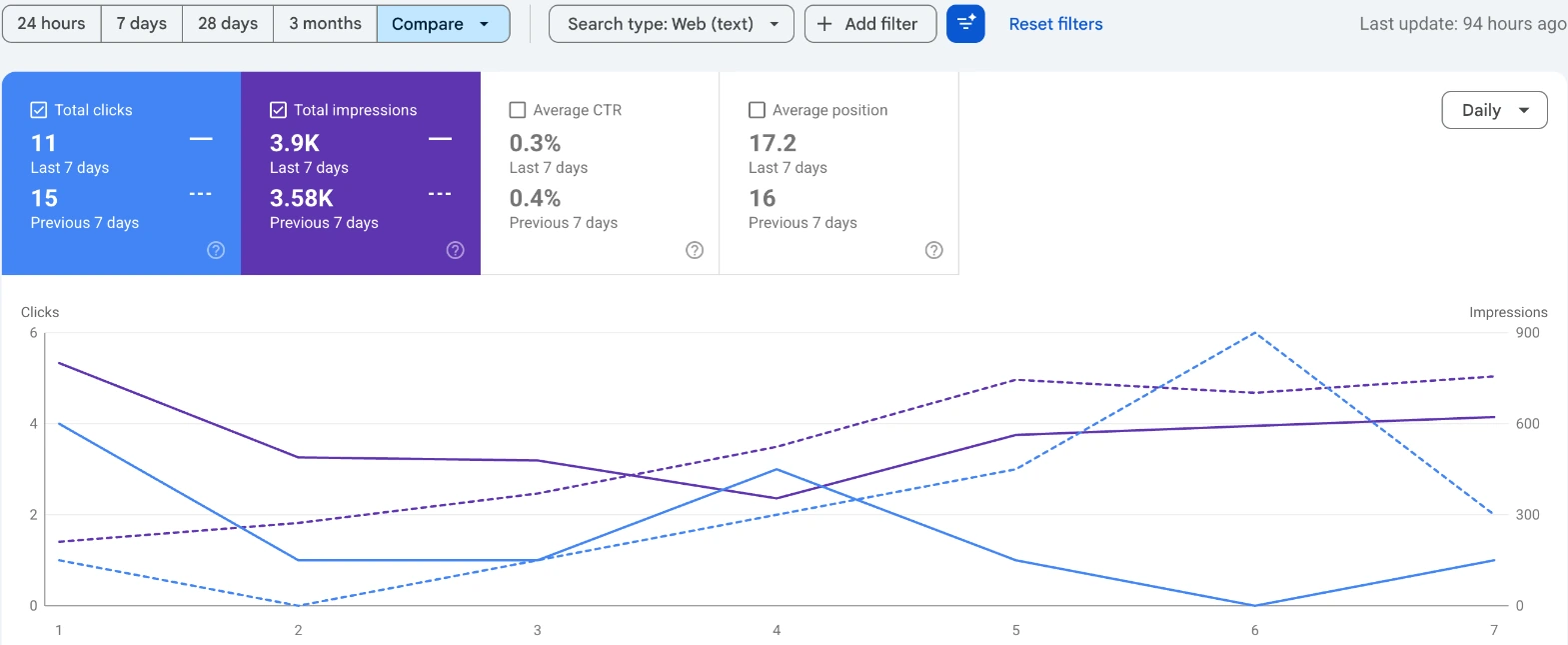
The latest seven-day comparison shows 3.9K impressions, up from 3.58K, and 11 clicks, down from 15. Click-through rate was 0.3%, and average position was 17.2.
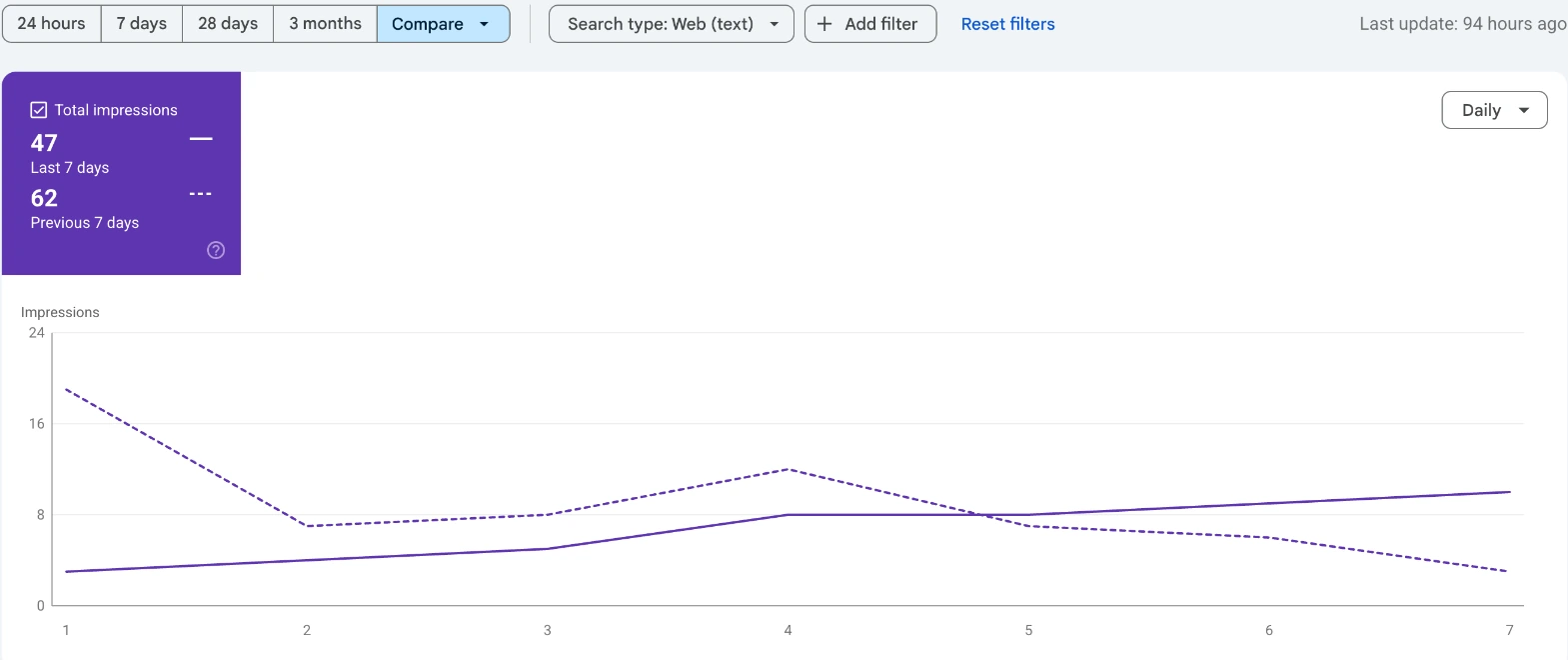
Impressions in Google’s generative AI features went from 62 to 47.
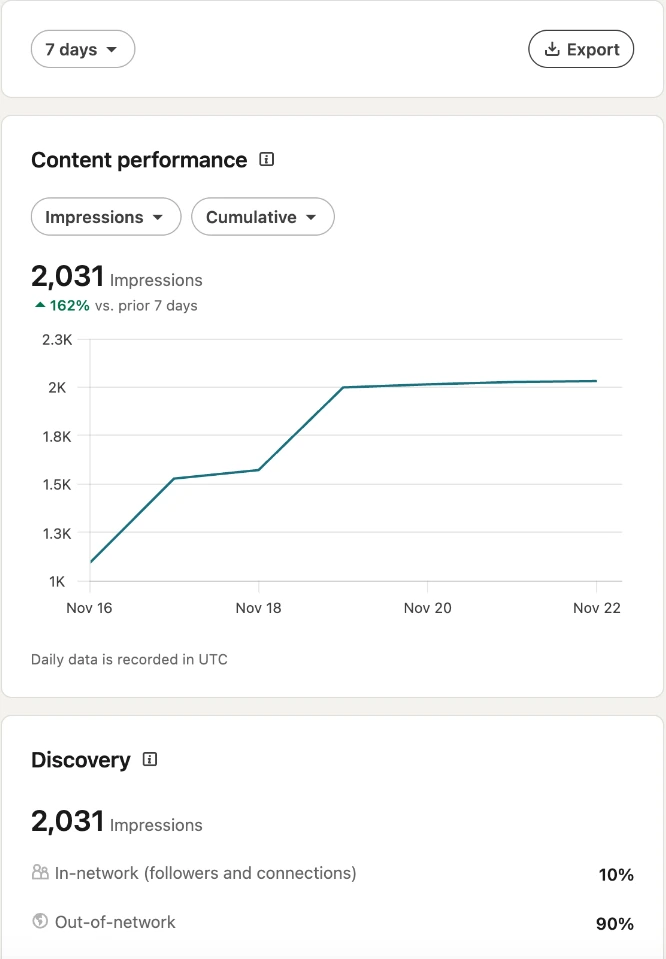
My personal profile recorded 2,031 impressions for 16–22 November, up 162% from the previous seven days. 90% came from outside my network. :)
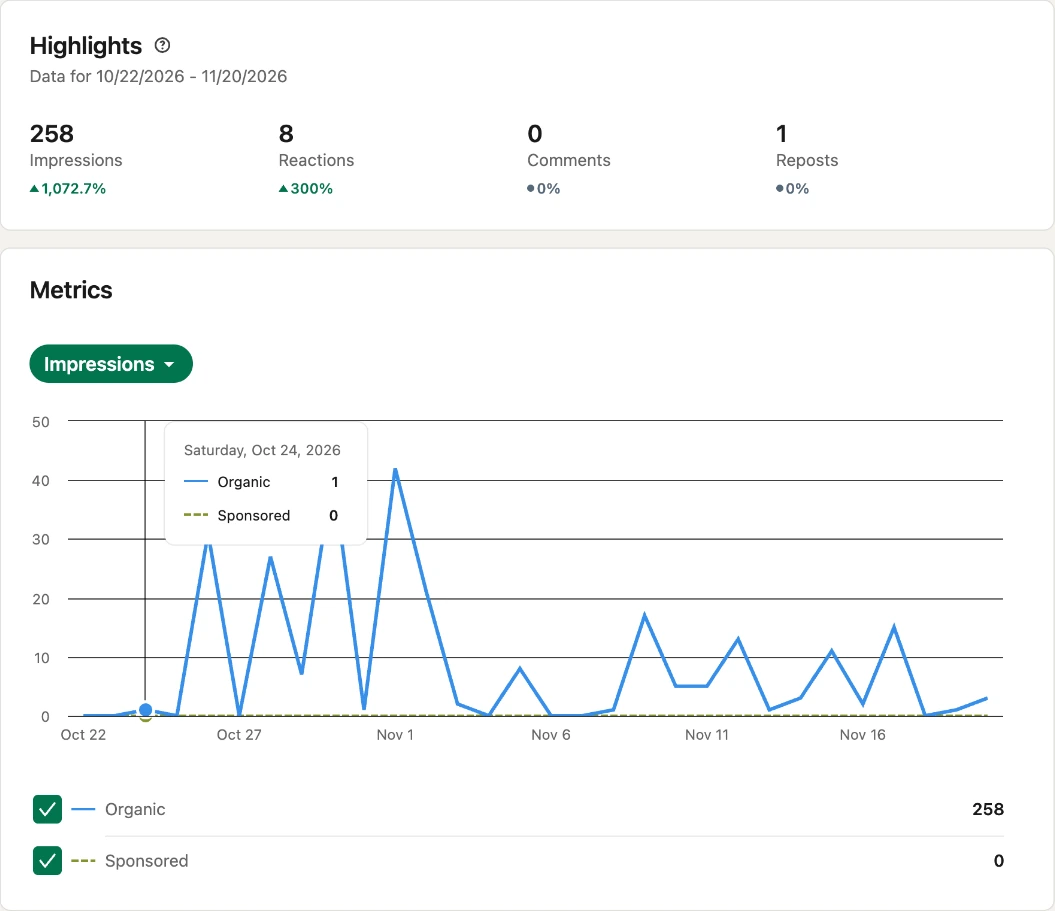
The AI Thinking page recorded 258 impressions, 8 reactions and 1 repost. This view covers 22 October–20 November, rather than one week.
My Aha! Moment: The Power of Words
For this week, my Aha! Moment is dedicated to the power of words and language.
Words are the tools of creating ourselves in the world. But in the new world, we use AI to convey part of how we create ourselves in the world.
Words have always been used that way, but we mostly recognise their power in books and music. When it comes to ourselves, we saw their power when they created miscommunication between us and other people. But the difference was that we created the words ourselves. We did not use any kind of intermediary between us and the words that were created.
AI changed that. Yes, there is still the misunderstanding part that can happen, but that will lead to friction. We, as the humans, will hear about it. :)
But what happens when an expression has been created with just a subtle change in the message you wanted to convey? A covering of an upsetting message you wanted to send, softened to a degree of not fully forwarding the expression you felt.
If you are looking for “Is this good or bad?” that is what we never see as part of our job here. :) That is for you to decide. Our job is to direct attention to something that was hidden.
We want to put in your mind the fact that words are everything and that they don’t carry an absolute truth. They are concepts that carry a subjective meaning, held by whoever reads them.
Therefore, pay attention to the words you use. Make sure these are the words you would use as part of your expression if AI were not involved, as a regular part of who you are.
If not, remember that we said AI can’t tell you what to do unless you allow it. Well, here is one place we did not think to look.
When AI chooses your words, you create a new you. The one that you did not intend to create, or won’t be able to support.
Did we tell it to do that? No. But it did. If we don’t pay attention, that is what will happen. And no, as we said, no questioning or challenging was done, simply because we did not think to look for it, and we willingly let it.
So may this be our message this week. Words are magic. Use them to express the person you want to be in this world. :)