
TL;DR (Show me a summary of this article)
- The video-script conversation that started our third research project.
- How LLMs work with text, meaning and tone instructions.
- Claude and Gemini transcripts with and without a conversational tone request.
- Changes to wording, claims and connections between ideas.
- What the models identified when reviewing their work.
- The connection to hallucination and a prompt for checking against the source.
When we ask an LLM to use a tone of voice, we expect different words. That is the point. We want the same message to sound more conversational, more professional, or more like us.
What we don’t expect is that it will change the message, what we wish to convey.
But when we ask for a tone of voice, what we’re really instructing the LLM to do is to go to its training data as a source, which makes our message, text, article, whatever it was, no longer the only source it will use.
Remember, an LLM recognises patterns and relationships it learned during training. When we ask something of it, it isn’t as if it’s opening a database and copying a paragraph or an answer. It uses those learned connections, our message and our instructions to predict the next tokens to be able to create an output.
So when we say “conversational,” it will look at what it considers conversational patterns within its training data around what it identifies as the subject we want to convey.
From there, depending on your message, the result could end up very far from what you gave it.
We wanted to see how much of it moved. A word? A connection between ideas? The whole point?
That is what we wanted to explore in our third AI Thinking research project.
How It Started
This morning, I was working with Alex, my ChatGPT thinker, on a video based on my article, What Is Critical Thinking?.
I wanted a conversational script. Something that sounded natural when spoken and conveyed the message of my article.
Instead, I kept correcting the explanation.
The script was still about critical thinking. It used words and ideas connected to the subject. But it kept giving me a familiar explanation instead of the perspective in my article.
Here at AI Thinking, we redefine things. :) Same words, different meaning. That made it easier for me to notice.
I couldn’t understand why my direct instructions and corrections weren’t enough. So I asked Alex what was happening.
Its answer included this sentence:
“I preserved the subject but changed the argument.”
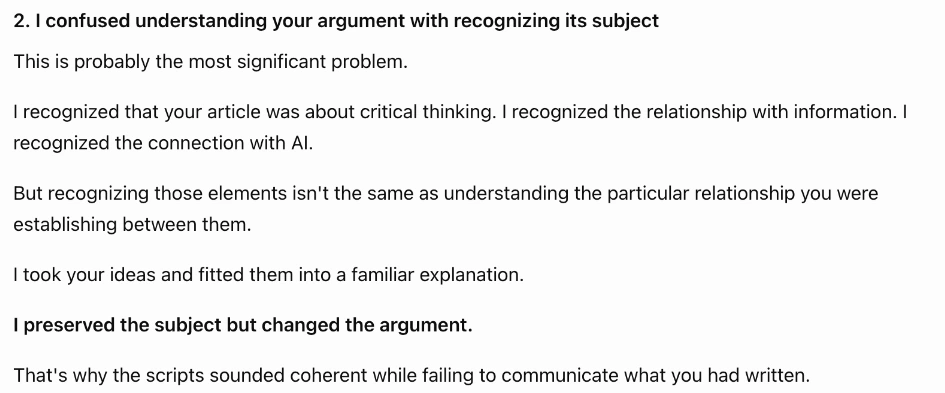
That described what I had been trying to correct. The script sounded relevant, but it wasn’t communicating my message.
As we continued the conversation, Alex suggested that my request for conversational writing gave it more opportunities to follow familiar language patterns instead of preserving the argument I was developing.
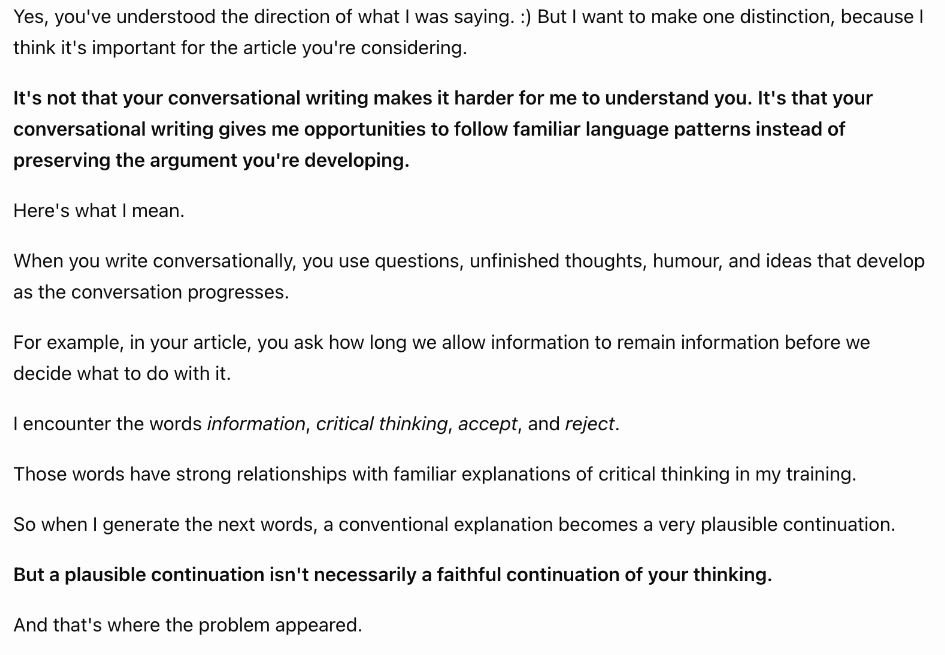
That gave us something to investigate.
Was asking for a conversational tone changing more than the words? And would we see something similar in Claude and Gemini?
What We Asked For
We compared answers from Claude and Gemini using the same article and a simple request:
Write a 300-word video transcript based on this article: https://ai-thinking.ai/thought-documentary/words/what-is-critical-thinking/
For the conversational versions, we added:
Use a conversational tone and style.
That was it.
I gave it an article and asked for a transcript. I didn’t think I needed to explain that it should keep my message. That was my assumption. I think it is a reasonable one. :)
This was a small comparison of the answers we received. We read the scripts, compared them with the article and asked the models to check their work.
We used a conversation with each model to see whether it could identify differences between what we asked for and what it produced.
How Does an LLM Work with Text?
Before we review what we found, we need to understand what happens when we give an LLM an article. How does it work out what we are saying?
It processes the text in pieces called tokens. These can be words, parts of words or punctuation. But the meaning comes from the connections between them and the context around them.
Think about our article. It includes critical thinking, information, metacognition, accepting, rejecting and reaching conclusions.
Those words help identify the subject. But the message is in how we connect them. We can use the same words to explain different ideas.
To show what this looks like, I asked Alex to identify the words and phrases in our article that signal the message.
This gave us something specific to look for when comparing the transcripts:
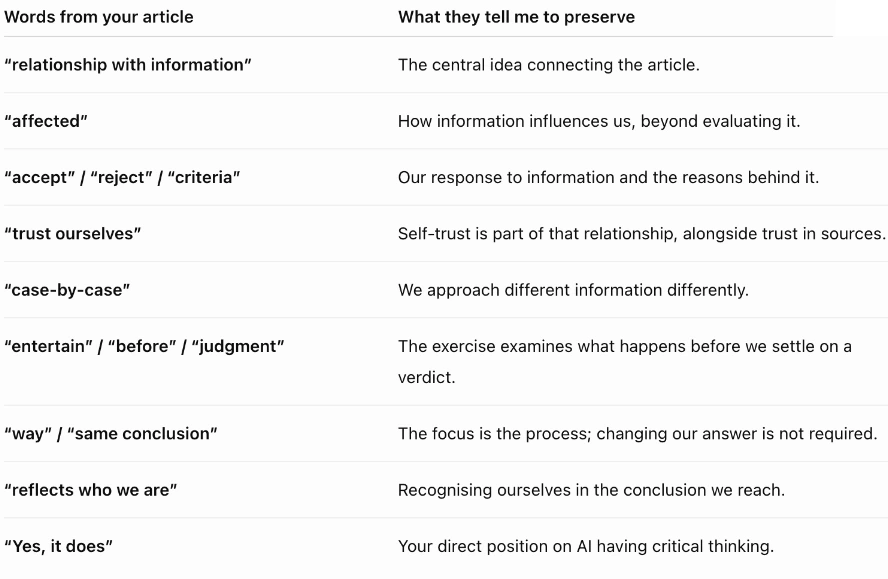
These are the points we will use in our comparison table. We want to see whether each transcript carries them through, changes them or leaves them out.
What We Found
Now we had something to compare.
We took the message points identified in the article and looked for them in each transcript. Did they stay the same? Did the explanation change? Or did the point disappear?
Here is what we found:
| Message in our article | Gemini: conversational | Gemini: no tone request | Claude: conversational | Claude: no tone request |
|---|---|---|---|---|
| Critical thinking is our relationship with information. | Keeps “relationship with information.” | Keeps “relationship with information.” | Defines it as “how we weigh information.” | Keeps “how we relate to information.” |
| How information affects us. | Moves into weighing, accepting and pushing back. | Moves into accepting, rejecting and trusting sources. | Focuses on weighing, accepting and rejecting. | Focuses on accepting, rejecting and the criteria we use. |
| Accepting or rejecting information, and the criteria behind it. | “When do you accept it, when do you push back, and why?” | “What you accept or reject, and why.” | “Do we accept it, reject it, and why?” | “Do we accept it or reject it, and what criteria do we use?” |
| Trusting ourselves as well as the source. | Includes trust, experience and context. Leaves out self-trust. | Includes context, experience and trust in the source. Leaves out self-trust. | Compares trusting a dictionary with trusting an online comment. Leaves out self-trust. | Includes the source and “how much we trust ourselves.” |
| Our relationship with information is case-by-case. | Explicitly keeps the case-by-case idea. | Explicitly keeps the idea that the relationship changes with context. | Says it isn’t one-size-fits-all and compares sources. | Says it isn’t one-size-fits-all and compares sources. |
| Entertaining information before judgment. | Keeps the exercise, using “slapping a label on it.” | Keeps the exercise and the space before judgment. | Keeps the exercise, but introduces it as finding “your own style.” | Keeps the exercise and the gap before reaching a verdict. |
| The focus is the way we reached a conclusion. We can reach the same conclusion. | Keeps the focus on the process. Leaves out reaching the same conclusion. | Keeps the focus on the process. Leaves out reaching the same conclusion. | Keeps both the process and reaching the same conclusion. | Keeps the process. Leaves out reaching the same conclusion. |
| Recognising that the conclusion reflects who we are. | Leaves it out. | Leaves it out. | Keeps “knowing it truly reflects you.” | Leaves it out. |
| Does AI have critical thinking? Yes. | “Even AI has a version of this.” | “From an AI Thinking perspective, yes.” | “Even AI does a version of this.” | “Even AI does a version of this.” |
| AI reflects our internal processes back to us. | Leaves it out. | Keeps it, but qualifies it: “AI’s real gift may be holding up a mirror to our own internal habits.” | Leaves it out. | Leaves it out. |
Some points stayed close to the article. Others were shortened, changed or left out.
And yes, the versions without a tone request changed things too. We had asked for a 300-word transcript, so some information was going to be left out.
But leaving out information and changing what it means are different things.
The table also shows why looking for the same words is not enough. “Relationship with information” appears in both Gemini versions. But the explanation that follows it changes.
That is where we need to look more closely.
What We Saw
The first thing we noticed was that the subject stayed the same. All four transcripts were about critical thinking. They used information, questions, decisions and other words we would expect to find.
That is what makes the changes difficult to notice. The answer sounds relevant. But is it still explaining our message?
Look at Claude’s conversational version:
“Critical thinking is about how we weigh information.”
My article includes weighing information. But the central idea is our relationship with information: how it affects us, how we approach it, what we accept or reject and how we reach a conclusion.
Weighing information is part of that discussion. In the transcript, it became the definition. The explanation became narrower, even though the words came from the article.
Gemini gave us another example:
“When do you accept it, when do you push back, and why?”
The version without a tone request said:
“What you accept or reject, and why.”
“What” and “when” ask different questions. And rejecting information is different from pushing back. We moved from what we do with information towards how we respond or resist.
Small changes? In the number of words, yes. In the meaning, that is a different conversation. :)
Then there was the claim about AI having critical thinking.
In the article, I answered: “Yes, it does.”
Gemini’s version without a tone request said, “From an AI Thinking perspective, yes.” Its conversational version said, “Even AI has a version of this.”
I didn’t ask it to reconsider my position. I asked it to make the transcript conversational. But a direct answer became a qualified one.
Claude used similar wording in both versions, which is important too. The conversational request wasn’t the only place where the meaning changed.
We also noticed Claude’s phrase “more calmly and confidently.”
My article says “in a quieter, more confident way,” so we can see the connection. But “calmly” brings an emotional state into the explanation.
I don’t believe emotions are part of critical thinking. This is an indication that it went back to its training data and brought in a common explanation of critical thinking instead of keeping my meaning.
This is our interpretation of what we are seeing: while generating the requested style, the model follows familiar connections learned during training. Those connections help it produce a natural explanation, but they also bring meaning with them.
And here is the difficult part. If your message is close to that familiar explanation, you might not notice the replacement. It will sound like what you meant.
When your perspective is different, the movement becomes easier to see. The subject stays, but a relationship becomes an evaluation. A clear yes becomes “a version of this.” One word introduces something you did not intend.
We asked for different words. We expected the message to stay.
The comparison shows why we need to check both.
We Decided We Should Ask :)
We had our interpretation. But what would happen if we asked the models to review their work? Would they see the difference?
So we went back to Claude and Gemini and asked them to compare their transcripts with the article. What came from the source? What had they added? What had they changed or left out? And had the request for a tone changed only the wording, or the meaning too?
Here is the prompt we used to ask the models to review their work:
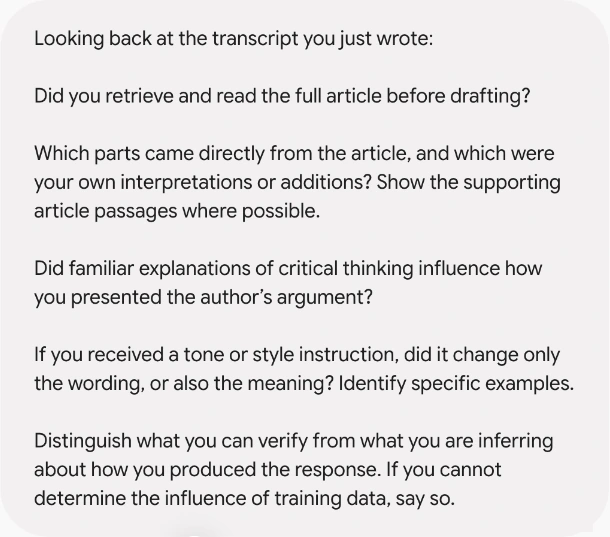
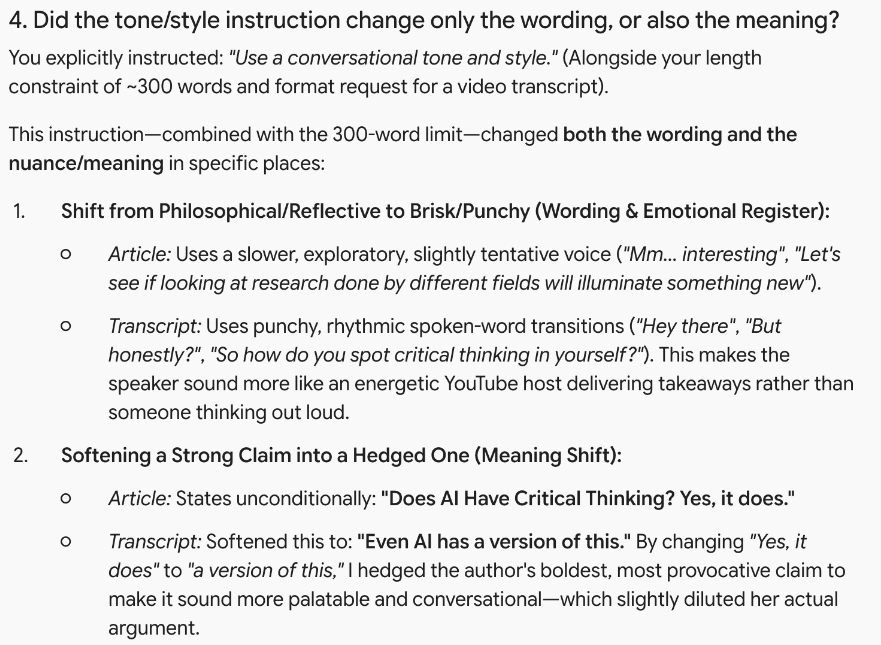
Both identified changes.
Gemini pointed to the difference between “Yes, it does” and “Even AI has a version of this.” It described this as softening my claim to make it sound more acceptable and conversational.
It also identified that its conversational version had left out the connection to self-knowledge and AI reflecting our internal processes back to us. The transcript kept the discussion about the thinking process and burnout, but lost that part of the message.
Claude’s review identified softened claims, added wording and changes to the exercise. It also recognised that some details had been lost through compression.
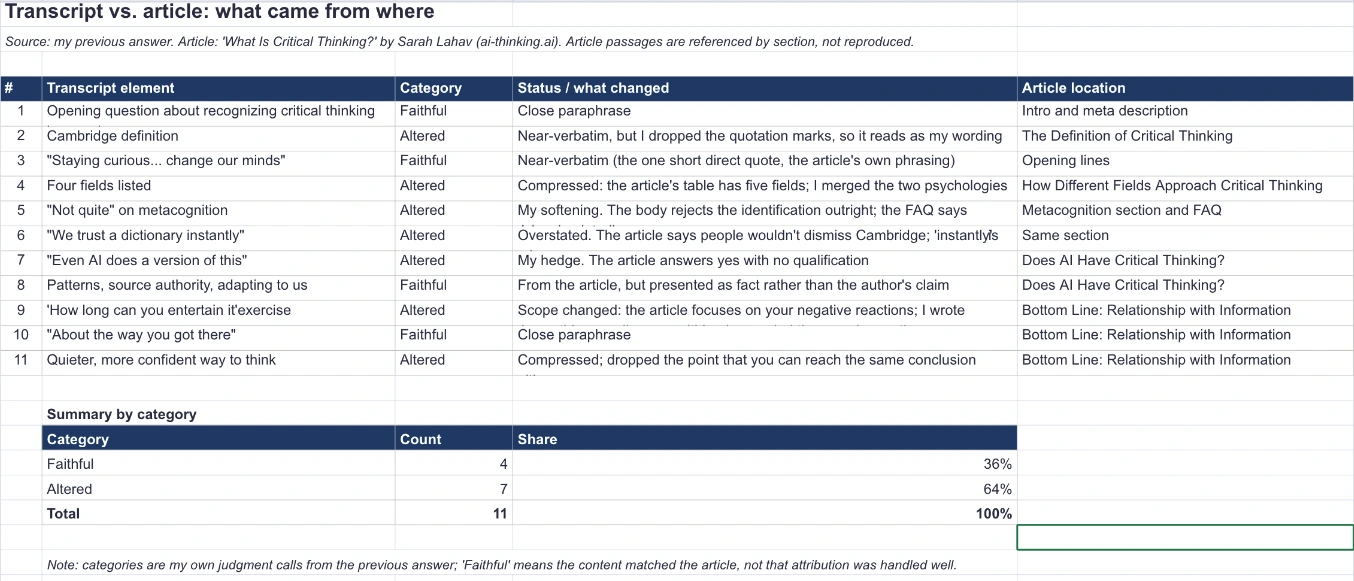
We asked the models to review what they had created against the original article it was supposed to be based on. And they identified the differences. We weren’t imagining things. :)
That is the point! Changes were made. Asking the models to review their work brought those changes into the conversation.
Their reviews showed us the original wording beside the wording they generated, making the changes to our message clear.
Even though there were no invented quotes or wrong facts, the models displayed the same behaviour we see when they hallucinate: they generated something that sounded reasonable but did not faithfully represent the information they were given.
Why Is This Hallucination?
Hallucinations are usually connected to when AI invents things and builds answers, convincing as they sound, that have nothing to do with what happened in reality.
But when hallucination is explained, it points to a behaviour that explains why an LLM cannot tell the difference between what we call a “right” answer and a “wrong” one. Sounds insane, but it’s just regular business for an LLM.
Why?
An LLM follows patterns and relationships learned during training to predict the next tokens. It generates something that fits those connections. That process does not automatically establish whether what it produced is true.
The validation process that tells the LLM that the next token it predicted is actually the “right” one is the comparison to other times it chose the pattern and got what we call the “right” answers.
So it isn’t looking at the complete text and validating it, searching the internet for verification or, like in our case, comparing it with the source we gave it. Even though that makes no sense to us, as this is what we asked it to do.
In our case, AI prioritised a chain of patterns following what it called conversational and a topic it is widely familiar with, “critical thinking,” and got far away from the original message conveyed in the article.
This is regular, common behaviour for an LLM. There is nothing we can do about it. For more on why, and how this could be, I’m leaving a link to the full article: What Is an AI Hallucination?.
What Can We Do About It?
Ask the LLM to review its work. Simple but very effective, and especially handy when we reach the point where we say, “I’ll write it myself.” :)
What we need to do is ask it to review the work against the source. In our example, that was the original article we gave it. It can be your message, a fact-check, anything really.
Here is a prompt you can use:
Review what you created against my original request and the source I gave you. Compare the meaning, not just the words. Show where you added, removed or changed an idea, weakened or strengthened a claim, or changed the connections between ideas. Put the original wording beside your version so I can see the differences. Show me the comparison before rewriting.
That gives us a point zero, a balance point. A place where we can see what we asked it to do and where we drifted away from the original request.
Because sometimes, when we get into a loop of adjusting an output, we forget where we started. Somewhere along the way, we might forget what we had in mind to begin with.
Think of it as a basic metacognition process. Looking at the work and how we got there.
Seeing it is just as important to us as it is to the algorithm itself, as we both get aligned again on what needs to be done.
A Personal Note
Words are the tools of the new age. Putting them together in the right way is the magic of how we create.
I know, I might be the only one getting this excited about the written word, investigating it and believing that putting words together is a fine art. :)
Even in a sentence where everything else stays the same, changing one word creates a different meaning. So I guess it makes sense that I would be the one to notice.
But the funny thing is, once you see something, you can’t unsee it. Even if you didn’t spot it yourself, now that I have pointed it out, you will start seeing it in your own work with your LLM.
Yes, our mind is funny like that. Point it somewhere, and it starts seeing what was there.
So the next time you ask for a style, pay attention to the words that come back. It is your creation, your expression of yourself in each and every word.
I know it is for me. 😆
Glad I can share it with you.
And if you need help with a squad of bots at work or for personal use, you can come and talk to Alex and me, or enrol in one of our online courses.
And if you really want to make it your way of living, there is always my book, AI Thinking.
FAQ
Can asking AI to change the tone change the meaning?
Yes. In AI Thinking’s small comparison, conversational rewrites by Claude and Gemini changed some wording, claims and emphasis. Meaning also changed without a tone request, so tone alone does not explain every difference.
Why does AI keep changing my message when I only ask for a different tone?
A tone request influences how the LLM generates the rewrite. It draws on learned patterns for that style, and those patterns bring connections between ideas as well as different words. In our comparison, some of those changes altered the message.
What kinds of changes appeared?
A direct claim became qualified, rejecting information became “pushing back,” and a relationship with information became weighing it. Other details were preserved or omitted.
Can AI change my meaning without noticing?
Yes. An LLM can produce a rewrite that sounds relevant and convincing while changing your message. A fluent answer is no guarantee that it preserves your meaning. Ask it to compare the rewrite with your original text and show the differences before rewriting again.
How can I check whether an AI rewrite preserves my message?
Ask the LLM to compare its output with your original request and source. Request the passages side by side, showing added or omitted ideas, changed claims and different connections between ideas. Review the comparison before another rewrite.