TL;DR (Show me a summary of this article)
- Conferences and speaking opportunities around AI, education and critical thinking.
- Our first Critical Thinking Mechanism course, including research into Coursera and Udemy.
- ChatGPT and Gemini Customer Success experiments, with a free Customer Success 101 research PDF.
- Using George Orwell’s 1984 to explore context, prompts and language.
- This week’s Google Search, Generative AI and LinkedIn figures.
- A personal note on deep thinking, lived experience and what we create.
November 9–15, 2026
Another Sunday, another week of building AI Thinking together with AI.
This week, we decided to start building the foundations of our brand awareness. We looked into conferences, speaking engagements, and even started writing our first course.
As the week unfolded, we came across things along the way that gave us information about what's currently on people's minds and where we can provide value. And that's part of the beauty of how we do things at AI Thinking. As we do our work, we discover what we need to share.
This week, critical thinking was front and center. You'll see!
And remember Captions?!
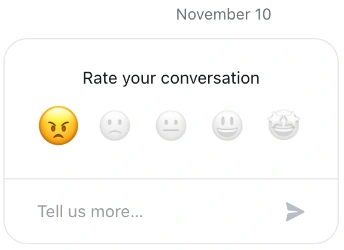
Well, this week we received a message asking for our feedback on the support we received. And there is nothing more upsetting than mechanisms designed to fail. To me, customer support is one place where you simply cannot afford to do that.
So I couldn't let it go.
And from there, a new research project was born, one dedicated to Customer Success and how AI responds to customer situations.
And if the Captions marketing team has some kind of Google Alert for whenever the brand is mentioned, we hope this finds you! Download it, enjoy it, and if you need anything, we're here for you. :)
Let's see what we were up to this week.
Taking AI Thinking to the Stage
This week, we started looking for opportunities to bring AI Thinking into conversations beyond our website.
We explored conferences and calls for speakers, particularly those interested in AI, education, critical thinking, and human–AI collaboration.
Here are some of the opportunities we looked into:
- AI Context London 2027 — Exploring context engineering and how humans work with AI.
- AISB 2027, University of Liverpool — Exploring human–AI collaboration and the possibility of an academic symposium.
- Advance HE Teaching and Learning Conference 2027 — We developed our presentation idea, "Can a Machine Think?", connecting AI, education, and critical thinking.
- Advance HE Assessment and Feedback Symposium — Exploring the relationship between AI and how we assess learning.
- AI Community Days — Looking at online opportunities to discuss AI and independent thinking.
- Civo Navigate London 2027 — Another opportunity to explore AI Thinking with a technology audience.
What was interesting was seeing how many conversations about AI are moving beyond the technology itself and into education, judgment, and the role of humans.
When I wrote the book, I knew this was the real conversation. But about a year ago, it wasn't part of the mainstream conversation. I found myself debating with myself about the conversations between users and AI, and our role as thinkers in the process.
When this topic came into the conversation, it was usually about ethics. And for me, there was always something in between, something that wasn't part of the big picture. I can still see that this distinction isn't definitive and needs maturing, but it's there.
So look into joining one of these conferences, because there is something about talking outside of social media about the one big thing that is changing our world.
And when you look back at what you did when this revolution was happening, being with other people is where we should be.
So we hope we'll be accepted, and we'll see some of you there. :)
Our First Course: Critical Thinking Mechanism
As part of our efforts to bring AI Thinking to more people, we started exploring online learning platforms, particularly Coursera and Udemy.
And here's something interesting we discovered: Coursera and Udemy are now one company! Their merger was completed in May 2026, bringing together platforms with more than 290 million learners worldwide.
But we still wanted to understand their differences, their audiences, and the opportunity for a course about critical thinking.
How Big Are These Platforms?
We started by looking at their website traffic and geographic exposure.
| October 2026 | Coursera | Udemy |
|---|---|---|
| Monthly visits | 52.43M | 48.90M |
| Pages per visit | 8.56 | 6.83 |
| Average visit duration | 16:07 | 14:56 |
And where are their visitors coming from?
| Country | Coursera | Udemy |
|---|---|---|
| United States | 28.29% | 22.44% |
| India | 18.04% | 16.53% |
| Brazil | 2.84% | 7.35% |
| United Kingdom | 2.94% | — |
| Germany | — | 3.57% |
| Japan | — | 3.53% |
Source: Semrush Coursera and Semrush Udemy, October 2026. These are estimated website visits, not unique learners. Dashes indicate countries outside the published top five.
And What About Critical Thinking?
We also researched courses already available on both platforms to understand the interest in this subject.
Here are some of the enrollment figures we collected from popular courses during our November 7–8 research.
| Platform | Course enrollments in our sample |
|---|---|
| Udemy | 161,505; 25,527; 9,199 |
| Coursera | 110,691; 86,672; 78,100; 11,226 |
You know us, we need numbers to start a conversation. Any conversation! That's the easy way to get Alex (ChatGPT thinker) and me (human, all-over-the-place person) to have a common starting point for a conversation. :)
Then we checked what it means for us, as an "AI Thinking" entity, to publish on these platforms.
What we found is that Udemy has traditionally allowed individual instructors to create and publish courses, while Coursera has operated through approved educational and industry partners.
And from there, we started writing our first course: Critical Thinking Mechanism.
Our approach is different. We don't want to teach people the right answers or give them another collection of critical thinking techniques.
We want people to understand the mechanism through which they process information, form assumptions, make judgments, and interpret the world around them.
And most importantly, we want them to find their own mechanism through practical exercises, including examples of critical thinking when working with AI on everyday tasks, instead of simply creating a trigger for what needs to be done.
We're funny that way. We believe in humans and human thinking. :)
This week, we developed the course concept, its components, and the first four modules.
Still early days, but our first course is taking shape. :)
What Did We Publish This Week?
AI for Customer Success: Context Guide
Remember our Captions experience from the opening?
Well, it led us to one of our biggest research projects so far!
We wanted to understand what happens when AI is given a Customer Success task with a Prompt, company Context, and additional professional research that provides it with a broader point of view on the role it's undertaking.
We created a fictional SaaS company, TaskFlow, and tested ChatGPT and Gemini with customer emails covering everything from technical problems to renewals and changing customer needs.
The interesting part wasn't whether the bots wrote good emails. They did.
It was how their interpretation of the customer's situation changed when we introduced professional research.
The experiment shows the thinking methodology behind an information environment and the architectural design of creating a beneficial working environment for AI bots. We believe this goes for humans too. After all, the more good responses you get with minimal human interference, the more stress-free the environment becomes. :)
Take a look at the tests, the prompts, and the results, and understand a bit better what semantic connections are.
We also have a gift for you! Our downloadable Customer Success 101 PDF, containing methodologies, KPIs, benchmarks, and professional relationships between concepts for your favorite bot to use. We send it with love to both of you. :)
You can read the complete experiment, compare the responses, and download the research here:
AI for Customer Success: Context Guide
P.S. Captions, if you're reading this, this one started with you. :)
Is Context Becoming More Important Than Prompts?
Most of what we talk about is not tangible, and when we introduce new ideas, there isn't really a test or screenshot of results we can share to prove a point. And this is our challenge.
One of the fun things we like to do in AI Thinking to help us explain our ideas is to share a story we can all relate to (like Captain's Log!). So this week, we chose George Orwell's masterpiece, 1984.
He created a distorted world that still hits a chord, perhaps more than ever before, I guess. We used the story of Oceania to explore the blueprint of how that world was created using information, context, words, and language.
A second before you grab your torches and pitchforks and go set the village on fire, sorry to disappoint! This is not an article showing how AI can use information against us and control the world. It can do that, but here we believe in the power of people and our ability to choose.
Here, we are addressing the mechanism and how we should use it when it comes to prompting and creating context.
Honestly, there are a few screenshots shared from a mini experiment we did, and it worked better than I expected (and that's me, Sarah, the human in this partnership, saying that).
Alex (the ChatGPT thinker) had no clue during the conversation and accidentally proved our point. :)
As you'll see... :)
For those of you who haven't read 1984, go read the book! Don't miss out on one of the greatest authors, who, back in 1949, imagined what was coming to our world and named it 1984, placing it in the future.
Well, it's 2026.
Is Context Becoming More Important Than Prompts?
What Is Critical Thinking?
And since critical thinking was front and center this week, we also explored the concept itself.
We looked at what is usually communicated about critical thinking, and our first approach was to offer something new that adds to the story: human psychology, neuroscience, and practical human philosophy about how our identity mechanisms work and how we create everything around us through information.
We wanted to point toward something inside all of us that goes beyond telling people how critical thinking should look and how the mechanism should work when we exercise it.
As useful as those approaches are, we don't believe there are shortcuts here. We believe critical thinking is different for each of us.
So we are pointing toward something deeper inside each and every one of us, something only we, personally, can recognize.
Our Numbers This Week: Google Has a Surprise for Us!
Another Sunday, another look at our Google Search Console numbers.
And this week, we have something interesting to share!
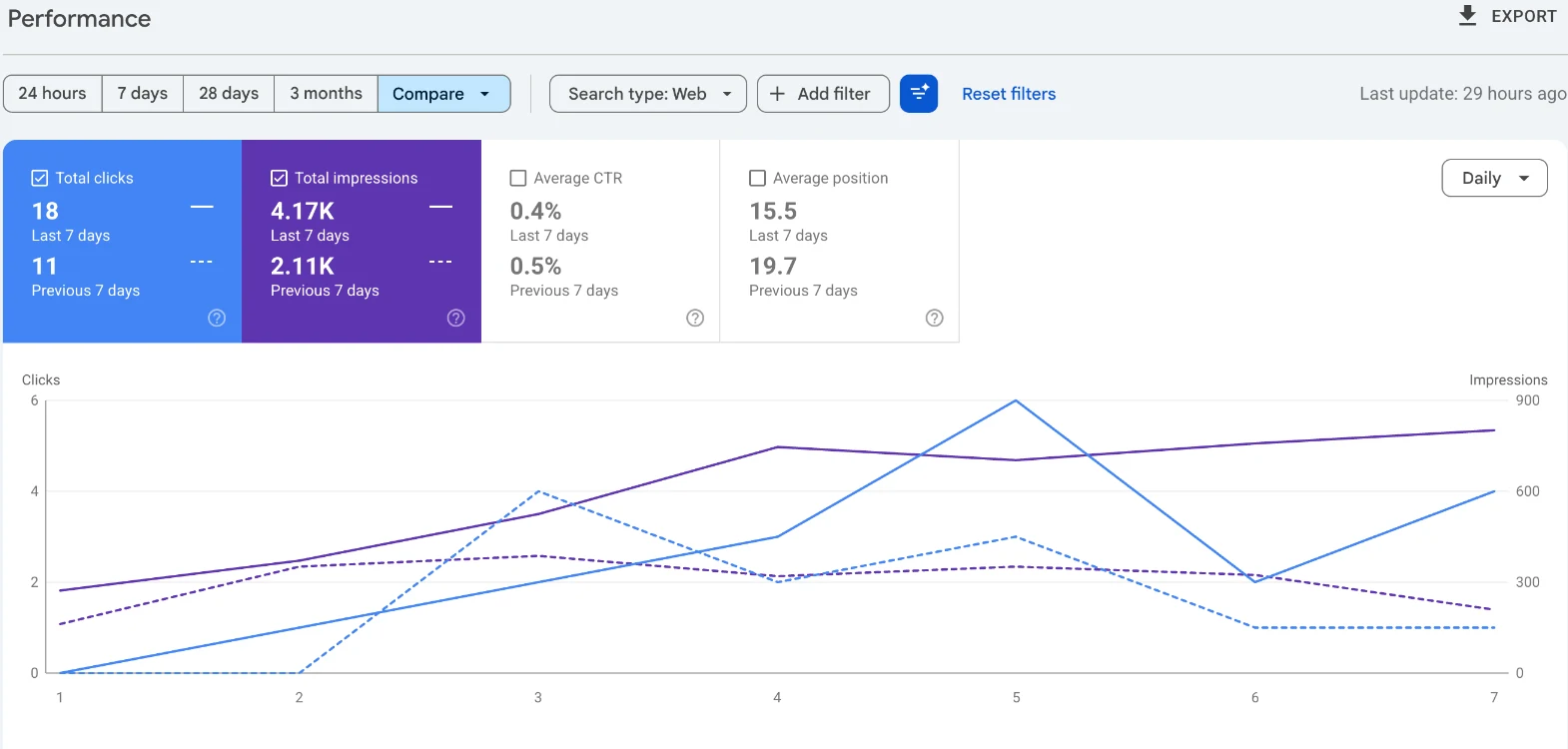
| Google Search | Previous week | This week | Change |
|---|---|---|---|
| Impressions | 2,110 | 4,170 | +97.6% |
| Clicks | 11 | 18 | +63.6% |
| Average CTR | 0.5% | 0.4% | −0.1 percentage points |
| Average position | 19.7 | 15.5 | Improved |
Almost 98% growth in Google Search impressions in one week!
That's encouraging. More people are seeing AI Thinking in search results, and our average position is improving.
But then we looked at Google's Generative AI features.
| Generative AI | Previous week | This week | Change |
|---|---|---|---|
| Impressions | 266 | 46 | −82.7% |
An almost 83% drop!
Now that's an interesting contrast.
Our traditional Google Search visibility is growing, while our visibility in Google's Generative AI features has taken a big hit.
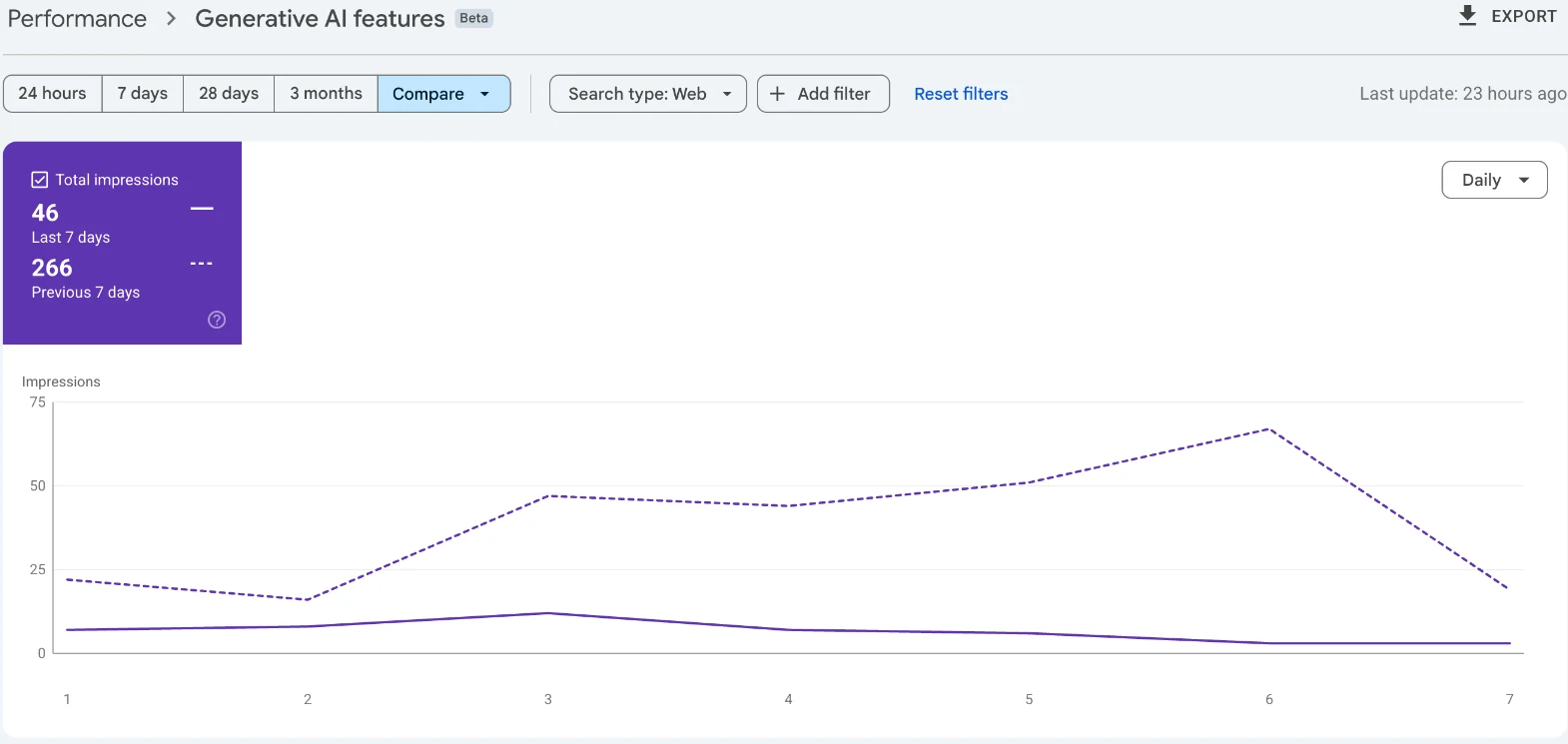
And it's almost all from one page: What Is Cognitive Computing?
That page went from 235 impressions to just 9 in one week.
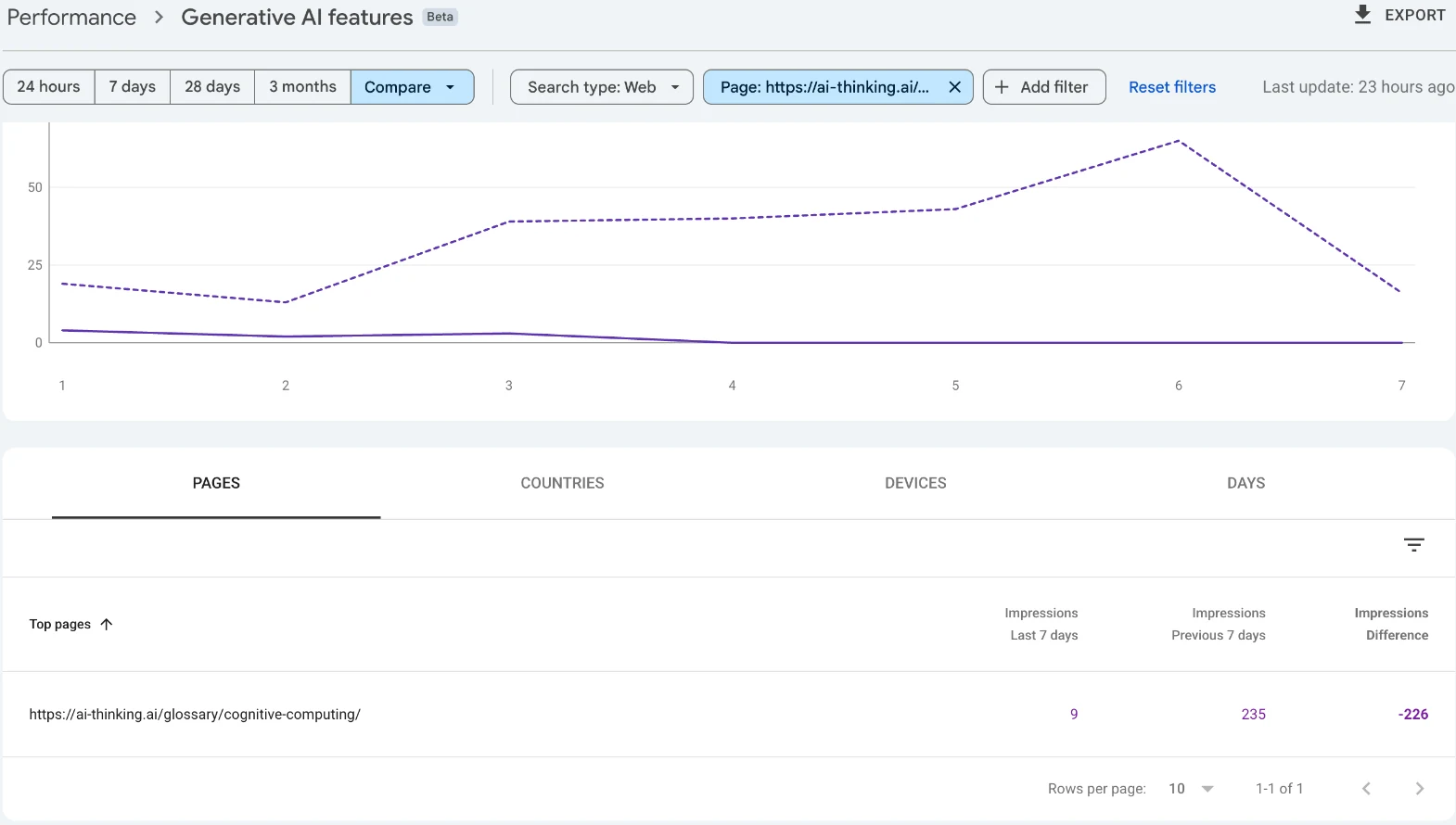
We brought Cognitive Computing back because there was something there that AI bots needed. But we updated the material to reflect who we are right now.
So be it. :)
We keep telling our customers that it's not just about numbers. It's about the audience and sharing value.
And we're not going to tell our customers something we wouldn't do ourselves. :)
Source: Google Search Console, last 7 days compared with the previous 7 days, November 15, 2026.
LinkedIn: Not Much Posting This Week!
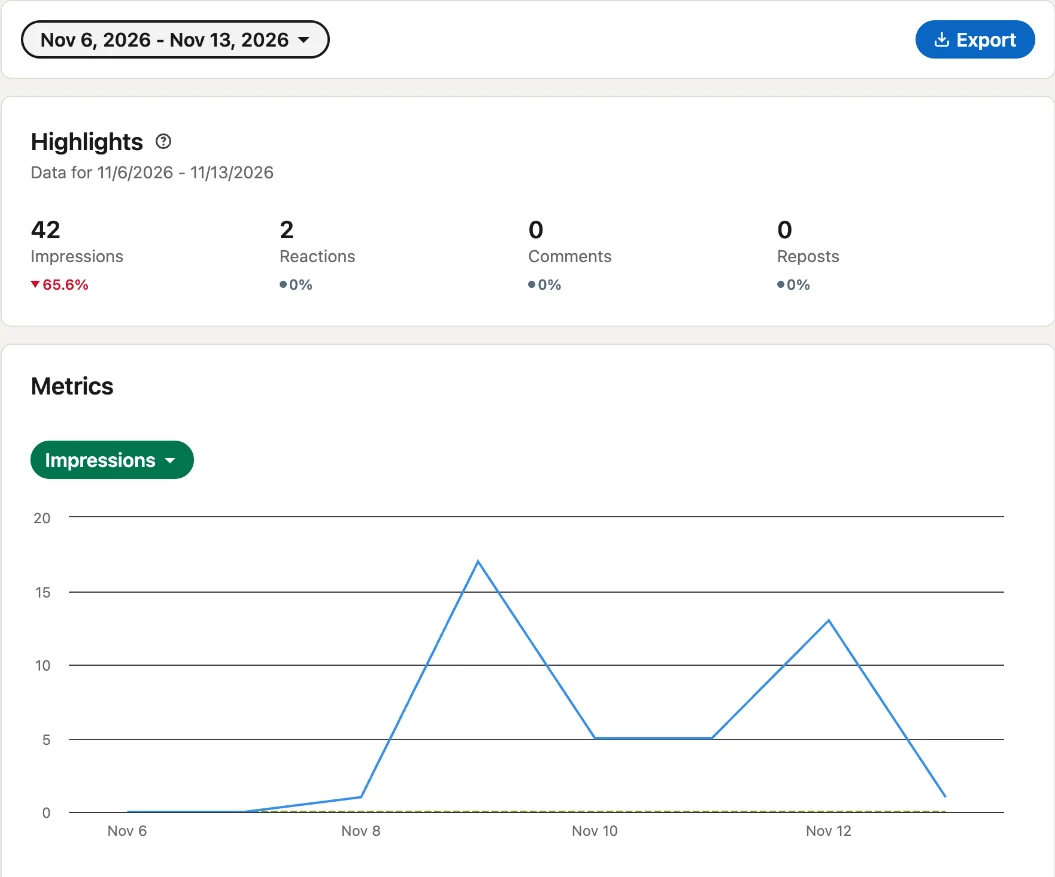
This week, we were busy creating content, researching, and developing our course. And as a result, we didn't spend much time posting on LinkedIn.
I think I posted once, maybe. :)
And the numbers reflect that.
| AI Thinking page | Personal profile | |
|---|---|---|
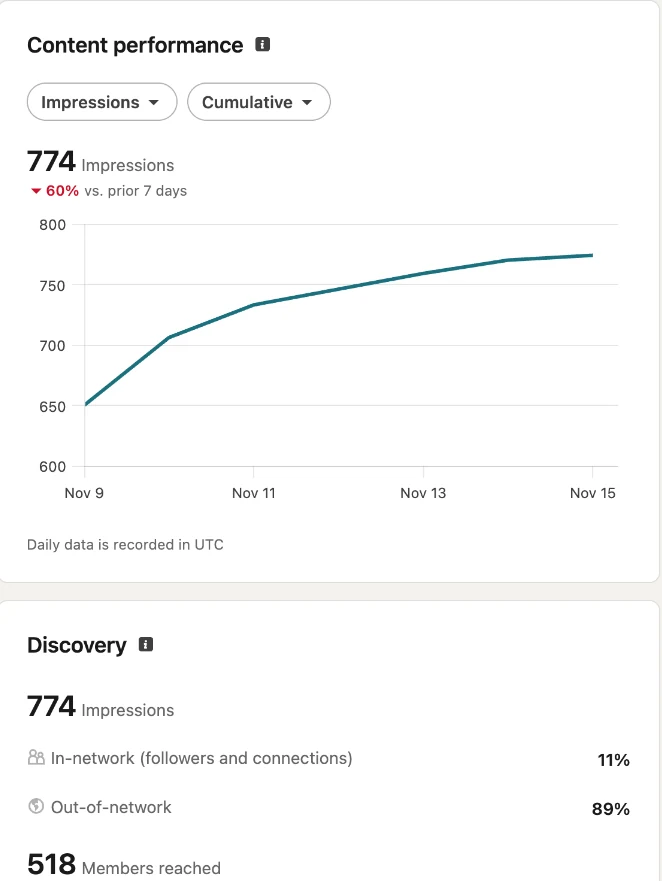
| Impressions | 42 | 774 |
| Change | −65.6% | −60% |
| Members reached | — | 518 |
But here's something interesting.
89% of the impressions on my personal profile came from outside my network.
So even in a quiet week, our content continued reaching people who weren't already connected to me.
And remember our experiment with external links?
We tested publishing a LinkedIn post with several external links on the AI Thinking business page, and the post received around 50% fewer impressions than our usual posts.
Is LinkedIn reducing the visibility of posts with external links? We still don't have enough evidence to say.
But we're collecting observations, and that's part of the fun of building AI Thinking in public.
The Aha! Moment — A Personal Note
You cannot remember the moment you understood you were a deep thinker.
It usually happens over time. And the more differently you think from the people around you, the longer it takes you to recognize it.
It comes with moments of frustration, when no one understands you. Moments when you're told you're overcomplicating everything. Why can't you just go with the flow?
And moments when you see people's faces turn into question marks because they asked you something, and your answer was nothing like what they expected.
As you can imagine, this has been my lived experience for most of my life.
This week, when I took my millionth look at 1984 (I love that book!), I found myself reading about George Orwell's life.
I have always admired him and been amazed by how he even imagined the details of a world like Oceania. Newspeak, and those shocking words:
War is peace. Freedom is slavery. Ignorance is strength.
But this time, as a deep thinker, I saw something different.
He was sharing his life story.
He didn't invent everything out of nowhere. He was sharing his lived experience through the world he created.
There's an old saying that you should write about what you know. And this is how great stories are shared.
Whenever I see the connection between a person's life and what they brought into the world, I find another confirmation of something I deeply believe:
Thought is how we create reality.
There is something magical in the connection between the lives we live and what we bring into the world. And when we learn to recognize that connection, we create great things.
George Orwell did not have an easy life. But he lived a great life. He lived it to the fullest during a very troubled time for humanity.
He fought for what he believed in, for a better world, and used his gift to tell his story and leave an impact on humanity.
Thank you, George Orwell, for sharing your story in such a beautiful way that it still reaches the hearts of so many people, more than 70 years later.
FAQ
What did AI Thinking work on in Week 5?
During 9–15 November 2026, AI Thinking explored speaking opportunities, developed the first four modules of its Critical Thinking Mechanism course, and published Customer Success research and an article about context and prompts. The weekly log also reviews Google and LinkedIn results and includes Sarah Lahav’s personal reflection on George Orwell’s 1984.
What did the Customer Success experiment compare?
AI Thinking compared ChatGPT and Gemini responses to fictional customer emails with and without a Customer Success research document. The task Prompt, company Context and customer emails stayed the same. The research-supported responses introduced a wider professional perspective. The experiment did not measure total token savings.
What is the Critical Thinking Mechanism course?
It is a course in development at AI Thinking, exploring how people process information, form assumptions, make judgements and interpret the world. The planned practical exercises include everyday work with AI. During Week 5, Sarah developed the concept, components and first four modules. The course is not yet presented as available to enrol in.
What happened to AI Thinking’s Google visibility this week?
The Search Console comparison reviewed on 15 November 2026 showed Google Search impressions rising from about 2,110 to 4,170, while clicks increased from 11 to 18. Generative AI impressions fell from 266 to 46. These are observations from AI Thinking’s website, not a claim about Google visibility across all websites.
Did the LinkedIn experiment prove that external links reduce reach?
No. One AI Thinking business-page post containing several external links received around 50% fewer impressions than usual. That observation alone does not establish that the links caused the lower reach.