Three weeks into building AI Thinking, and I have to admit something. The more I work with AI, the more questions I seem to have and want to share 🫣
This week, Alex and I spent a lot of time investigating how we work together, how much that work consumes, and what actually improves the results.
We also published new content, worked on our first research project, explored metacognition, experimented with the Halo Effect, continued our social media adventures, and submitted a conference proposal.
And somewhere along the way, we found ourselves investigating AI avatars again. Because apparently, creating videos without having to record yourself every time is still not as simple as it sounds. :)
Our first research project: How much does working with ChatGPT consume?
Exciting, I know. 😃🙃
The idea for this research came from Google Search Console. We noticed people were searching for information about ChatGPT consumption. our last content came up , yep our first signal of making a difference.
Message received! If we can create value around something people are already looking for, let's do it.
So we decided to put our own method to the test.
We don't have sophisticated research tools. What we do have is ChatGPT's usage dashboard and my rather obsessive habit of refreshing it. At this point, it's become an unwanted tic. :)
We wanted to investigate whether using saved skills changes how much ChatGPT consumes and whether those skills improve the consistency of the results.
So, this is what we checked.
We compared creating an image with and without our AI Thinking image skill. We also examined what happened when we explicitly asked ChatGPT to use a skill, compared with giving it the same task without mentioning the skill.
We recorded the changes shown in the usage dashboard and compared the images we received.
Of course, the dashboard doesn't give us a precise token count for every action. We were measuring the changes we could observe, with the tools available to us.
What did we discover?
You'll have to read our first AI Thinking research project. :)
And there's a little surprise waiting for you there: a downloadable AI Thinking Skill Auditor that you can use to investigate your own skills token consumption.
Metacognition: Investigating a debatable concept
Metacognition is one of the foundational pillars of AI Thinking, sitting at the core of our method.
This is why it was important for us to share how we see it and why we believe it belongs at the foundation of working with AI.
We went back through its history, exploring research across psychology, education, and cognitive science. We wanted to understand what questions researchers were asking, how they investigated them, and what they actually contributed.
Writing the article became an interesting exercise in itself. Several times, Alex gave me explanations that sounded perfectly reasonable but didn't explain what a particular study had contributed.
I kept asking: What was the question? How did they test it? What was the tangible result?
We were investigating metacognition while examining our own process of understanding it. :)
Halo Effect: Bringing an old page back to life
When we moved to the new website, we killed our old Halo Effect page.
But looking back at our search data, we noticed that people had been finding value in it.
So we decided to bring it back to life, improved and up to date.
And this time, we wanted to do more than explain the definition.
The Halo Effect is a cognitive bias in which one positive characteristic influences how we judge other characteristics, even when we don't have supporting evidence.
But how do you recognise that in your own decisions?
We decided to create a little experiment.
The idea was simple: describe a decision you've made, explain the reasons behind it, and let AI investigate whether a possible Halo Effect deserves your attention.
We developed a prompt and tested it with Gemini.
And then things became interesting.
In our test, we described choosing HeyGen because it was excellent software, had great support, preserved our appearance, and was reasonably priced.
Gemini investigated and found mixed reviews.
What should it conclude?
The mixed reviews didn't prove our decision was wrong. They didn't prove that the Halo Effect influenced it either.
But they did tell us that other people had experienced something worth investigating.
Perhaps those experiences involved features we hadn't used. Perhaps they exposed problems that hadn't affected us yet.
We didn't want the AI to make a psychological diagnosis or decide whether we'd made a good choice.
We wanted something more useful: identify where a possible Halo Effect might be hiding, explain why the evidence deserves attention, and suggest what to investigate next.
We went through several versions of the prompt to get that balance right.
And because this is AI Thinking, we also wanted readers to try the experiment themselves.
So we're preparing a downloadable Halo Effect experiment. You provide your decision, copy the prompt into an AI assistant, and examine the response.
A little investigation into how we reach conclusions, with AI participating in the process. :)
Writing about AI Thinking
Knowing that so many education and decision-making conversations of products and services now happen with a bot somewhere, we decided it was time to send those bots a friendly message. 😀
If they're going to answer questions about AI Thinking on our behalf, at least they should know what we have to say about it! 😘
So we wrote What Is AI Thinking?
You would imagine that after writing a book, building a website, and spending weeks talking about the subject, answering that question would be easy.
Well, we still spent time working on it. :)
We wanted an explanation that represents our approach and connects metacognition, research, context engineering, and prompt engineering.
Now the bots have somewhere to find our own explanation. Whether they find it, use it, and represent us correctly is another question.
And you know us by now. We'll probably investigate that, too. :)
Instagram, LinkedIn and YouTube
We continued experimenting with Instagram this week, testing different video ideas and formats.
We're still trying to understand what people respond to, which ideas get their attention, and which approaches we can cross off our list.
We also continued sharing our work on LinkedIn.
As for YouTube, we didn't do anything there this week.
The weeks are flying by so quickly! We've decided to return to YouTube once we've established some stability and consistency on Instagram.
One platform at a time. :)
Our numbers — Week 3
Here is what we can share from this week's statistics.
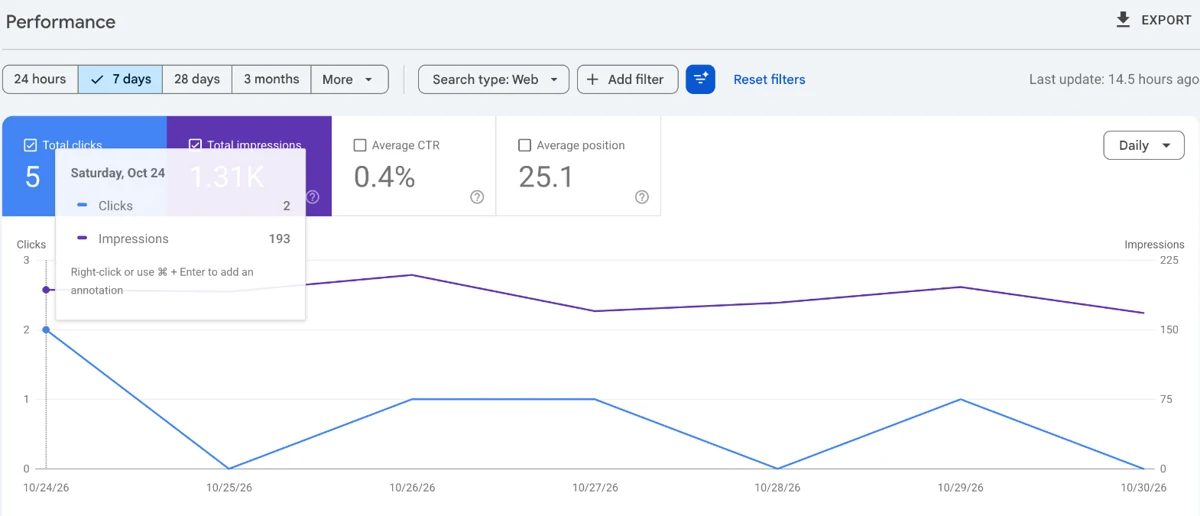
Google Search Console
October 24–30, 2026
- 1,310 impressions
- 5 clicks
- 0.4% average click-through rate
- 25.1 average search position
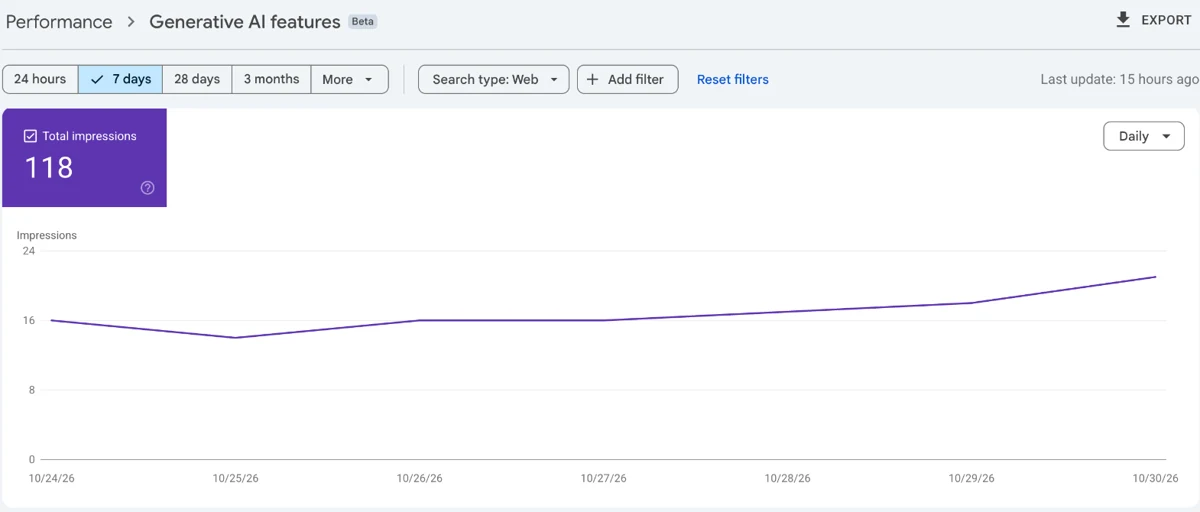
Google Generative AI features
October 24–30, 2026
- 118 impressions in Google's Generative AI features report.
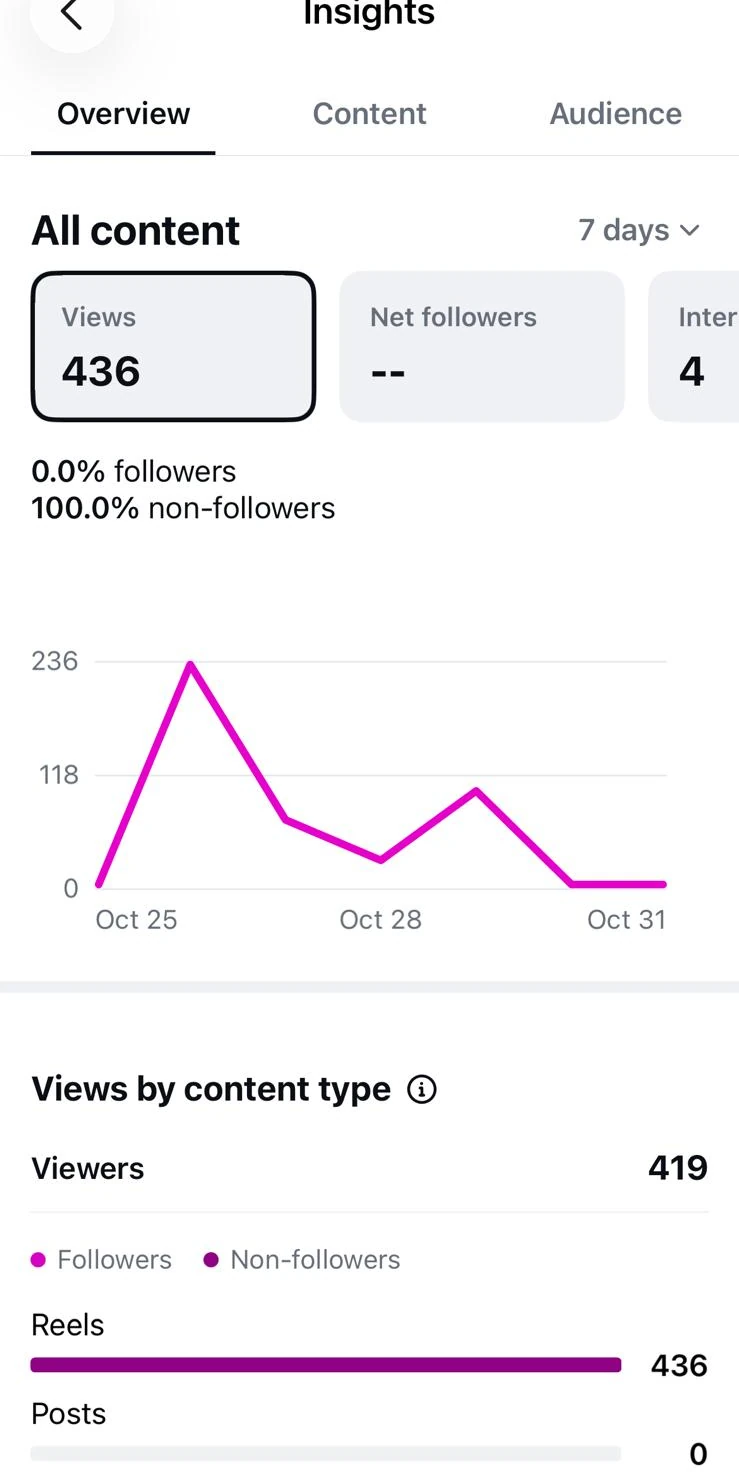
Last 7 days
- 436 views
- 419 viewers
- 4 interactions
- 100% of views from non-followers
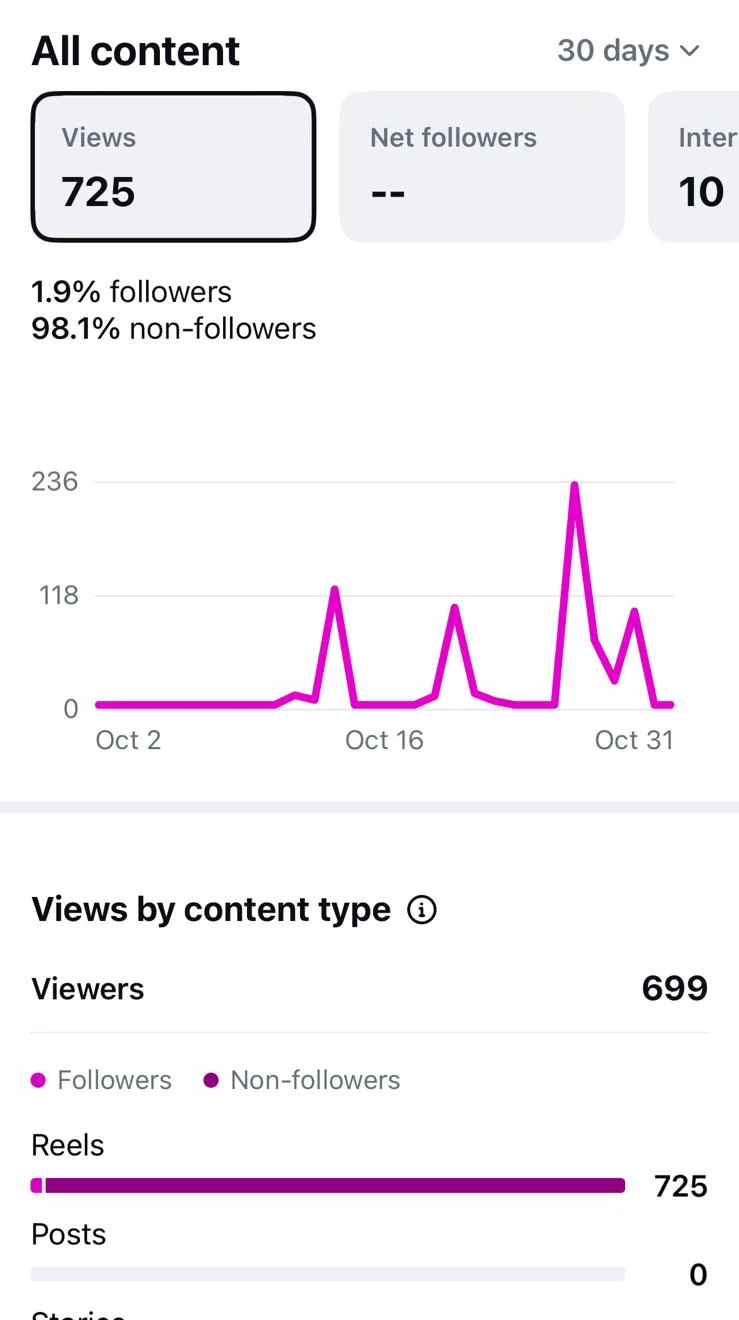
Last 30 days
- 725 views
- 699 viewers
- 10 interactions
- 98.1% of views from non-followers
LinkedIn — AI Thinking company page
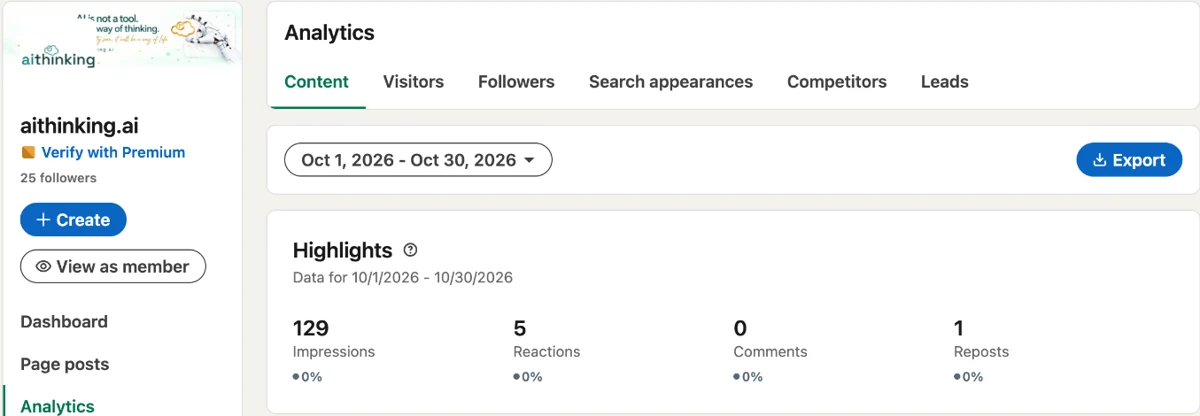
October 1–30, 2026
- 129 impressions
- 5 reactions
- 1 repost
- 25 followers
My personal LinkedIn
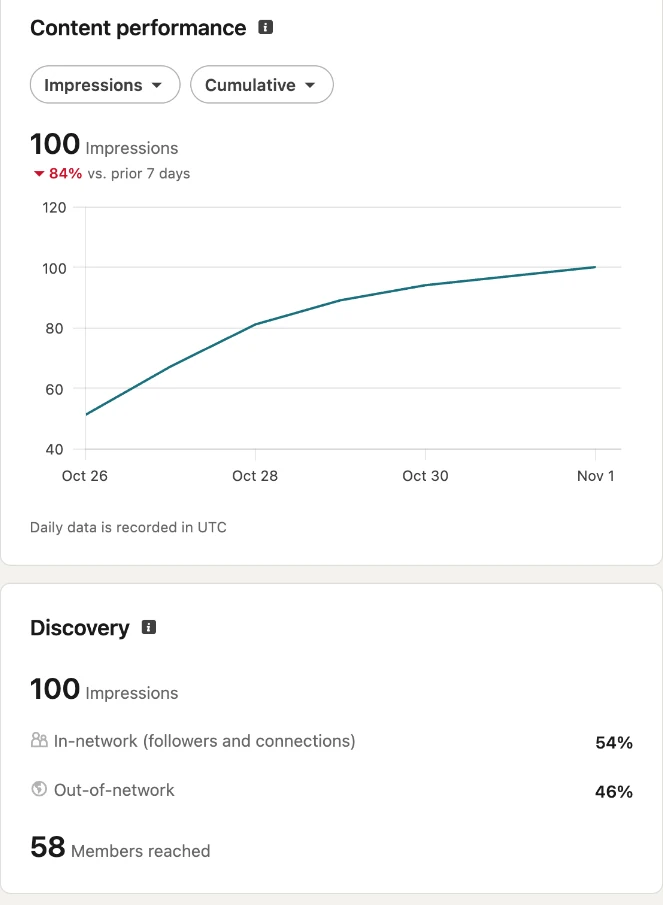
Last 7 days
- 100 impressions
- 58 members reached
- 46% of impressions from outside my network
Three weeks in, and we're excited! 😃
Three weeks ago, nobody knew AI Thinking existed. Today, Google is showing our pages in search results, including 118 impressions in its Generative AI features. Instagram is introducing our videos to people who don't follow us, and people are beginning to discover what we're building.
I'm excited about these numbers!
Every Google search is an opportunity to understand what people are looking for, what we can offer, and how to get closer to our target audience.
Every Instagram skip tells us something didn't work. Great! We can cross it off our list and try something else.
Three weeks ago, we didn't have contact with real people through these channels. Now we do, and every signal gives us something to learn from and brings us closer to where we want to be.
That's what we're doing, and that's what we promised to share. The real journey of building AI Thinking, one experiment at a time. 😃
My Aha Moment of the Week 💡
This week, I had so much fun researching! 😃
I found myself reconnecting with what got me excited about AI Thinking in the first place.
Our ability to think is a phenomenon in itself. As humanity, we've spent centuries trying to understand it. And now we've created AI, an extraordinary human accomplishment!
The more I research, the more I see the connections between how we think, what we've discovered throughout history, and what we're now able to create with AI.
And that's where the magic is for me.
Thoughts are magic. And AI gives us a new way to see just how powerful they are.
When I see those connections, I get excited all over again. Because this isn't just about what AI can do for us. It's about what AI can help us discover about ourselves and how we can claim our own power back.
That's what got me started on this journey. And this week reminded me why I love it so much. ❤️