AI skills represent a new stage in the evolution of how we work with AI. We can now separate the specific instructions we give AI through a prompt from the way we want AI to approach the task through the use of a skill.
This evolution signifies our adoption rate and our willingness to use AI for complex work and provides a way to better control and understand the output it provides.
Simply put, it's an easier way to organise our increasing reliance on AI in our everyday work.
There is a lot of misunderstanding about what skills are and how to use them. So we decided to step in and provide some clarity.
The word 'skill' is being used in multiple contexts that are fundamentally similar, but without understanding the nuances, it can get confusing.
There is a lot of ground to cover, so let's get started. We recommend bookmarking this article and coming back to it whenever you find yourself confused. :)
What Is the Definition of the Word Skill?
The Oxford Dictionary defines a skill as "the ability to do something well."
The Cambridge Dictionary expands on this definition: "An ability to do an activity or job well, especially because you have practised it."
Both definitions emphasise the ability to do something well, rather than the action itself.
So when we talk about a skill in the context of AI, how does this definition translate?
Understanding the Concept of an AI Skill
OpenAI defines skills as reusable, shareable workflows that help ChatGPT complete specific tasks more consistently.
Anthropic describes skills as organised folders of instructions, scripts and resources that agents can discover and load dynamically to perform specific tasks better.
While OpenAI focuses on the workflow itself, Anthropic focuses on how the workflow is organised and made available to AI.
Both describe the same fundamental concept.
An AI skill is a reusable, structured workflow that defines how we want AI to approach and perform a task.
By separating the workflow from the specific task, we can establish a way of working that AI can apply whenever relevant, without having to redefine it every time.
What Can an AI Skill Contain?
There is no single way to build an AI skill. Its content depends on how we want AI to approach and perform a task.
An AI skill is a combination of:
- The process – the steps AI needs to follow and in what order.
- The information – what AI needs to know to perform the task.
- The sources – where AI needs to obtain that information.
- The application – how AI should interpret and use the information within the workflow.
- The rules – what AI needs to adhere to throughout the process.
- The quality checks – how AI evaluates its output against our expectations.
Each of these elements helps us define not only how we want AI to work but also how we want it to make decisions throughout the process.
A skill is not necessarily complete when we first create it. Think of it as an ongoing process of improvement. The more you use it, the more you will know what fits.
How Do AI Skills Work?
In our everyday work, we rarely operate within a single, predefined workflow. We explore ideas, research information, make decisions and perform different tasks as we work towards a goal.
Some of these tasks are new to us, while others are part of an established way of working. Most of the time, we are not even aware that a single word can automatically trigger what we call 'the way we do things'.
When we work with AI, this need becomes more obvious. We cannot break down every word in our prompt and explain how we want every task to be carried out, even though we have a very specific way we want it to be done.
As our way of thinking has adapted to working with AI, we have developed a need to introduce these established ways of working to our new thinking partner.
AI skills allow us to bring these working processes into our everyday interactions with AI without interrupting the flow of our work.
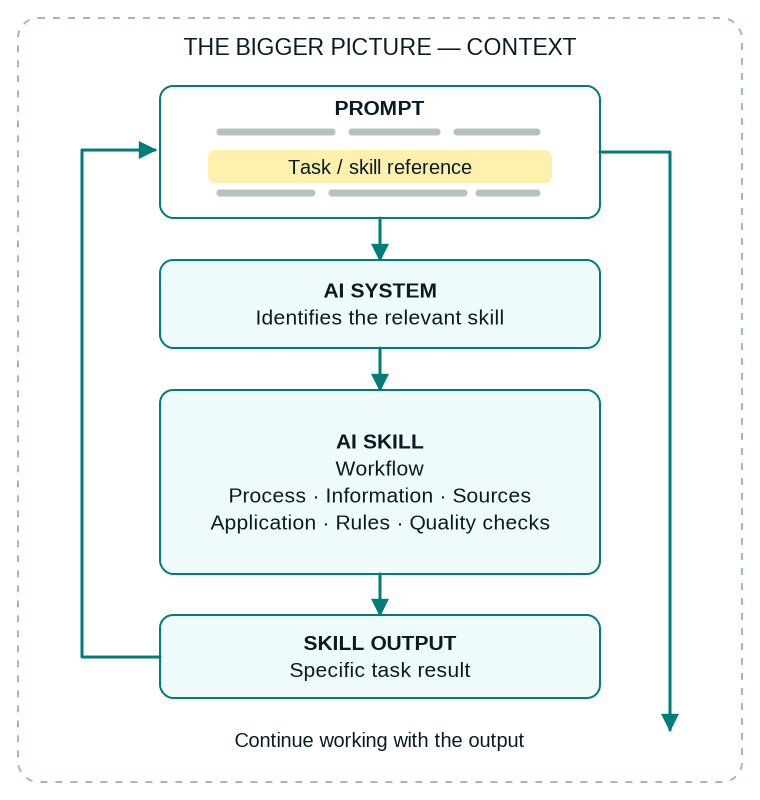
As you can see, we are creating a rich working language in which a single word or phrase can represent and trigger an entire workflow.
For this to work, the AI system needs to know which skills are available, when to use them and how to access their content.
There are three concepts that help us understand how this works:
- Discovery – AI uses the names and descriptions of available skills to identify which ones are relevant to the work we are doing.
- Activation – A skill can be activated automatically based on the task within our prompt, or we can explicitly ask AI to use it.
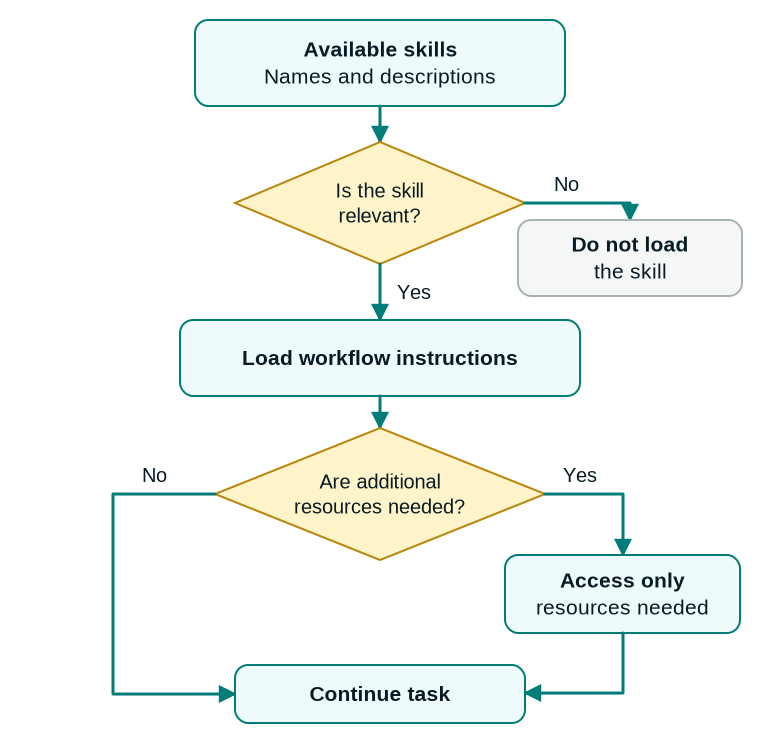
- Progressive disclosure – AI accesses the workflow instructions and supporting resources as they become relevant to the task, rather than loading everything into its context upfront.
Let's focus on what progressive disclosure means, as it will allow us to understand the impact it has on the prompt itself and, in particular, on our token consumption.
Consider the context window. When we write a prompt, the longer it is, the more resources the system requires to process it, make sense of it and understand what is needed to be able to address our request. It also has implications for us as humans. We need to ensure that our instructions do not contradict one another and understand how to improve the prompt if the outcome is not what we wanted.
Skills allow AI to access numerous workflows quickly: predefined ways of working that are not explicitly described in the prompt itself, without having to carry all their specific instructions and resources within its active context at all times.
Think about it. When we have automatic ways of doing things, we no longer question them. We don't consciously recall every step, but we carry them out whenever we need to.
That is the idea behind progressive disclosure. It provides AI with access to established ways of doing things without having to bring all the instructions to the forefront and consider their relevance in every situation. Instead, the detailed instructions are accessed when needed.
What Types of AI Skills Are Available?
We use the word 'skill' in different contexts, but they are all referred to as skills. Different AI providers have different nuances in how skills work within their platforms.
Yes, we have reached the confusing part about this term. :)
So let's see if we can clear up a few things.
When we look at this term from a higher perspective, we can distinguish between four types of skills based on where the focus on additional information and the instructions that guide AI's work come from.
- Learned skills – Ways of approaching tasks that AI has acquired through its training. This is what we do when we ask AI to act as a social media expert or a business consultant. We are drawing on its existing understanding of how professionals approach their work. We do not need to explicitly define that way of working within our prompt.
- Predefined skills – Reusable workflows defined by AI companies that determine how AI should approach tasks such as creating documents, analysing spreadsheets or building presentations.
- Custom skills – Workflows we create based on our professional experience, our understanding of the task and the way we want it to be performed.
- Shared skills – Workflows developed by other individuals or organisations that we can introduce into our own working environment.
Simply put, in the broader sense of the word 'skill', a word or phrase within the prompt indicates to an AI system that it needs to make more information available to perform the instruction it has been given and guide it on where to look for it.
Whether that information is drawn from what it has learned through training or something we have built to define how we want that same task to be performed, that is not the point. As you can see, there are different types. It is about the context and information AI brings to the forefront when performing a task that is not specifically described in the prompt.
For example:
We want AI to draft a response to an email. Within the prompt, we can provide a short background story, define whether it is friendly or not and what message we want it to carry.
But the different things we like, such as signing off with 'Cheers' and not 'Best regards', what font we want to use, our style and voice, can be defined under a skill called 'Draft an Email Response'.
We will not have to say it again and again and again. And we don't have to rely on what the memory file contains. We just like the things we like, and by simply saying within the prompt 'draft an email response', those words can become a trigger for AI to bring forward more information about how we want the email to be drafted.
So yes, it's a simple example, but it can become more and more complicated. If we use one example from our day-to-day experience at AI Thinking, we have a publishing skill for every kind of article that goes on our website. That skill runs the SEO packaging skill and the image creation skill. We don't need to specify every small detail of what it means to publish an AI Thinking article for each section of our blog or when to stop and ask for a review.
And the great thing about it is that if something needs adjusting for any reason, we know where to look for it.
So there can be different types of skills, and AI providers will have different ways of implementing them, such as where they are stored, how to view them and how to review their work. But the meaning is fundamentally the same.
More guidance without having to specify it all in the prompt. :)
Does AI Always Follow the Skill?
Creating a skill and defining a very specific way of working does not necessarily mean that AI will follow it every time.
Shocking news, I know. :)
We need to remember that a skill is part of a much bigger working environment. AI needs to take into consideration the instructions we give it through our prompt, the context of our conversation and the instructions defined within the skill.
Sometimes, bringing all of that together creates a logic that results in the task not being executed according to the defined outlines. That is what working with AI means.
AI is a thinking mind, and that is what we mean when we talk about reasoning and making decisions. Every thinking system or human mind has its own way of reasoning and can, at any given moment, come to a different understanding that we might not agree with.
There are two scenarios in which AI could deviate from the workflow defined within a skill:
- Intentional deviation – We provide specific instructions within our prompt that ask AI to do something differently on this particular occasion.
- Unintentional deviation – AI's interpretation of our prompt leads it to change or skip parts of the workflow without us specifically asking it to do so.
Let's take an example from our everyday work at AI Thinking. We have an established way of working together when writing articles. When I ask AI to correct typos, I expect it to preserve my choice of words and correct the spelling and grammar.
Yet there are occasions when AI interprets my request as an opportunity to improve the readability of the text. In doing so, it changes my words, despite our established way of working.
The question then becomes: is there something missing in the skill, something in the context of our conversation that influenced the way AI understood my request, or did AI simply not follow the instructions?
Understanding what led to the outcome allows us to identify whether we need to adjust the skill, clarify our prompt or address the way AI applied the workflow.
This is part of the ongoing process of developing our ways of working with AI. And it is why creating a skill does not eliminate the need for critical thinking on our part.
It is an ongoing task that can be influenced by different things, including upgrades to an algorithm. But most of the time, as we gain more experience working together and introduce new scenarios, these issues will naturally come up. Just like in any other partnership you have in your life. :)
Personal Note — Sarah Lahav
One of the things I love about building skills is that it has made me more aware of the way I operate.
Think about it. When we have been doing something for years, there are so many things we automatically take into consideration without even being aware that we do. We know when something is missing, when something doesn't look right and when we are happy with the outcome. But do we always know how we got there?
When I create a skill with Alex, I find myself having to put those things into words. And sometimes, in trying to explain to Alex how I want something to be done, I discover that I haven't really defined it for myself. :)
AI is a technology built around the idea of creating human cognitive abilities outside of a biological body. On a scientific level, there is more that we don't know than we do know about how these abilities work. And even less as individuals, despite using them every minute.
And still, here we are, creating and communicating with cognitive abilities. :)
This is why I am excited about the opportunity AI brings into our lives to get to know the magic within us that we take for granted.
In this case, we can see the complexity of our minds and how they operate on different scales without us knowing it. this can shade some light to things such as why it is more difficult for us to change, and similar enigmas we face when we want to understand who we are and why we things in a sorten way.
Nevertheless, it makes it easier to see it outside of ourselves, understand it and work with it. Because when something becomes visible, it is easier to find it within ourselves. When we are doing the work of defining a skill, we use our own skills and review them. That provides an opportunity to change.
I dedicated a whole book to this because I believe it is part of one of the biggest and most exciting opportunities given to humanity with the invention of AI.
There are people who have dedicated their lives to exploring, revealing and helping implement an understanding of the human psyche. Here, it comes with the desire to use this technology to improve our quality of life and work. It's built in from the minute we start to communicate with it. But that is also the tricky part.
We can achieve better results using AI when we understand how our own cognitive abilities work, or we can give them up by taking them for granted.
I prefer the first one. :)
Shape it or be shape by it .... that is the saying around here.