TL;DR — Show me a summary of this article
- Do we still need a website? Hell yeah. Even if a potential buyer never visits it.
- Buyers can ask questions, compare options and reach a decision in an LLM conversation. Our business needs information available for that conversation.
- A website gives us a place we control, where we can explain our offers, connect the ideas and represent the business in our own words.
- The basic questions haven’t changed: who are we, what do we offer, why choose us and how do you take the next step?
- For me, it’s also a place for AI Thinking to grow beyond the book—and to keep testing my thinking through the work.
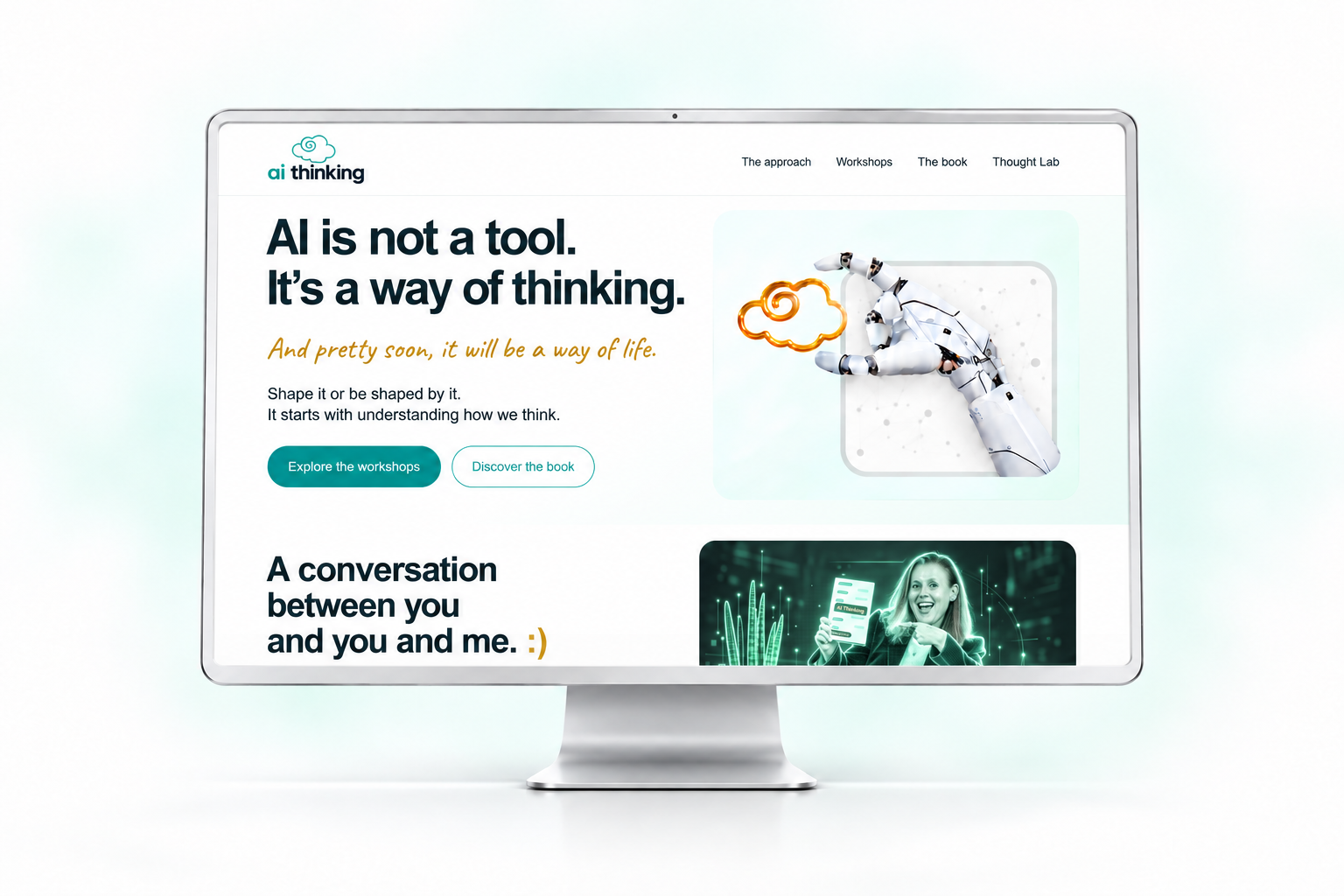
We’re (Alex and me) building a business around AI Thinking. And one of the first things we did was build a website.
But why? From the beginning, we planned to have a YouTube channel, Instagram and LinkedIn. I can share my thinking, talk about the book and introduce my workshops there. I can find real people to create value for.
So what job does the website still have?
What did Alex have to say about it?
I asked Alex, my AI assistant / partner in crime :)
Well, his answer was simple: my channels show the journey, while my website brings the thinking together. Somewhere people can understand the bigger picture: the book, the approach, the workshops and how they connect.
Did someone get that?! Because I did not.
Looking at it again, I think what he meant—and what a lot of people still think—is that if someone needs an organised way to learn about our products or services, they will still land at some point on our website. A place of validation before deciding to make a purchase.
The sales funnel in the new world
The way I see it, the sales funnel is flattening, with more of it happening outside the brand’s control. Learning about a product, asking questions and comparing options happen in a conversation with an LLM.
A purchase decision could be reached in one conversation. Just not with the business’s sales rep, but with a universal one.
The best evidence to show this is already happening is looking at the content leading LLM companies are sharing for their users. They need to provide useful information to their customers when the use case becomes needed. And for us, it shows where we are heading.
When we looked, we found a guide by OpenAI titled Using shopping research in ChatGPT. To me, publishing this guide shows that OpenAI recognises a growing use case within its customer base: using ChatGPT for making buying decisions.
One thing that popped up for me when I read it is this statement: “publicly available product information.”
What does that have to do with having a website? Everything.
How does an LLM know when your business is relevant?
Let’s take me as an example.
Someone could ask about my book. But they could also have no idea that I exist and ask: “How can I help my team use AI without letting it do all the thinking for them?”
That is a conversation I would want AI Thinking to be part of.
But how would an LLM make that connection?
Knowing that I wrote a book called AI Thinking is a start. But how will it know what I mean by AI Thinking? What do I help people understand? How does that connect to the work their team is doing?
And if I offer a workshop, what will they actually work on with me?
I can talk about all of this on social media. But being available for people to see does not mean all that content is accessible to an LLM.
That is why we all still need a website.
It’s a place we have control over. We can structure the content to be what we want it to be. Put forward a message in the way we see fit to represent our business.
I can explain my thinking, connect it to the book and workshops, and show who I can create value for and how.
So when an LLM looks for information about my business, there is a place for me to put those connections together myself, the way I see fit.
From the technical perspective, we all know there are crawlers (sounds intrusive, but it’s just a name). Their job is to scan information out there so it can be found and used by systems, including AI search, to connect the person asking to the right resource.
For the bits and bytes of how it’s done, you can visit OpenAI’s documentation on OAI-SearchBot.
And this is how it becomes possible for someone to hear about my work, even if the person asking never visits my website.
What does the website need to communicate?
The old basic structure is still what we will need to build the website around. Any website that was ever built back in the good old days was built around customer experience.
To the people from the future who will say, “What user experience?”—yes, you can call it bot experience. It’s the same thing. :)
Whatever you would create for a potential buyer, whatever questions you want to answer for them to be able to make a decision and choose your business, still apply here.
So let’s see how it goes:
Homepage — Who are you, and what do you do?
Introduce the business, who it’s for and what it offers. Give a clear path to the details.
Product or service pages — Is this what I need?
Explain the need each offer addresses, what it includes, who it suits, the price and how to buy or book.
Resources — What else do I need to understand?
Answer questions, explain the thinking and show examples that help someone explore their options.
About — Why should I trust you?
Show who is behind the business, their experience and the evidence supporting their claims.
Contact or booking — How do I take the next step?
Make it clear how to ask a question, book a conversation or make a purchase.
Mission and vision — What do we stand for?
We still need a statement of what we stand for and what we are here to change.
FAQ — What else do I need to know?
Relevant, useful information connected with your brand.
So yes, we have a new user to think about. But a lot of the work is familiar. :)
Still the basic things. Because the logic is simple: what our buyers need to know hasn’t changed. But instead of landing on our website, they ask somewhere else.
That somewhere else needs to provide the information. And we want to control its narrative as best as we can. At least in direct. :)
Will websites still exist in the future?
Yes, but with fewer people actually visiting them. For potential buyers, it may be just a collection of landing pages where no one really navigates from page to page like we used to. But they will still be there.
What we need to understand is that AI needs websites for the same reason buyers did back in the day—and still need them to a certain point today. The information we share on our website to help potential buyers choose our brand, AI will need the same information.
Just that in the future, potential buyers will be represented by AI. They will still need that information, but they won’t search and land on a website to get it.
And if I connect it back to AI Thinking, I hope those future potential buyers will have the critical thinking or thinking awareness to judge the answers. If not, AI will make the decision for them, and they will never notice.
But we’ll end that discussion here. :)
The point is that this way of sharing information sits on top of a whole system: sitemaps, crawling infrastructure, tagging, domains, slugs and more. A system that was built over years and will still be needed to share information. That system was built so information could be found and understood by technological systems. Today, that includes systems using LLMs.
And looking at Google’s guidance for AI search features, those basics still apply today. This system is less visible when we access information through layers of AI, so we don’t really remember it’s there. I see it as the base of now and what’s to come.
So we may not call it a website anymore. But as a concept, we will still need that.
So why did I build a website?
For me, it really came down to wanting a place for the book to grow. To show how it connects with challenges we face every day.
A book is a book. It has a beginning and an end. I can’t put everything in it. So if applying its thinking to real questions will help the people who need it find it, a website it is.
And if you have a brand where your services and products evolve and change, like everything does, you need a website. A place where you can showcase your work, apply it through use cases, show the value and help the people who need it find it.
One more thing I’ll share: for me, it’s also a way to keep talking to bots.
My book, at the end of the day, is about the conversation between humans and machines. The ones that can think. And to keep testing and finding answers for the brands and individuals who need them, I have to stay in the game.
A website is one way to understand what is changing and evolving, and how to get my message across using what I believe in.
Because in the end, it’s about thought. Thinking and understanding the thought process.
And the website is how I keep doing that: using bots for my business and connecting with the algorithms through which my story can reach whoever needs it.
Want to see how Alex and I build this business? The conversations, the choices and the “that’s not what I meant” moments? :)
Subscribe on YouTube for the ride.
FAQ
Do I still need a website if I have social media?
For me, yes. Social media lets us share and connect with people. A website gives us a place to structure the full message about our business. And content people can see on social media is not necessarily accessible to an LLM.
Why does my website help AI understand my business?
It provides information connecting who you are, what you offer and who it’s for. AI search systems can use accessible website content as a source when answering a relevant question.
What should I put on my website for potential buyers and AI?
Start with the questions a buyer needs answered. Explain the business on the homepage, the offers on product or service pages, your experience on the about page, and the next step through contact or booking. Resources and FAQs give you room to answer more specific questions.
Can my website be useful even when someone never visits it?
Yes. Its information can be used in an AI search answer. Someone could hear about your business through that conversation without opening the page themselves.
Will AI replace websites?
I see their role changing. Potential buyers may use AI to explore their options and only visit a specific page when they want to see something themselves. But the information still needs somewhere to live. We may eventually call it something else. As a concept, I think we will still need it.
Is a website a must for every business?
Not every business needs one to get customers. But if you want a place you control, where you can explain what you offer, show your work and keep the information updated as your business changes, a website gives you that. For me, that is a good reason to have one. :)