More than 400 years ago, we found out that our cognitive abilities have a side effect. It comes by default, and honestly, there is nothing we can do about it. :)
I know what you're asking about bias. You're looking for the BIG red flags connected with misjudgements and discrimination.
But just because these have become synonymous with bias doesn't mean that this is the definition of bias.
The word means something very simple, for humans and AI alike, and there is nothing we can do about it.
What Is the Definition of Bias?
The word bias has been around for almost 500 years, but its meaning has evolved over time.
In 1530, it was used to describe cutting fabric at an angle. By the 1560s, it was used in Lawn Bowls, a game in which players roll balls towards a smaller target ball. Bias described the tendency of the ball to follow a curved path rather than roll in a straight line.
In 1571, the word appeared in a translation of a work by Scottish historian George Buchanan about Mary, Queen of Scots. It was used to describe her natural tendencies and characteristics.
In 1620, the English philosopher Francis Bacon explored how our natural tendencies influence the way we interpret information, acquire knowledge and make judgements.
Today, we can still see these different meanings in our dictionaries.
The Merriam-Webster Dictionary defines bias as “an inclination of temperament or outlook”, while the Cambridge Dictionary associates bias with unfair judgement influenced by personal opinions.
Let's fast-forward to today. Bias is commonly understood as a tendency that influences our decisions, not necessarily rooted in evidence. It can lead us to act, decide or respond in ways that are not supported by what we call “reality”.
Where Does Bias Come From?
Well, first of all, we are biological beings. We have limited energy, time and cognitive resources. We simply cannot get to the bottom of everything we encounter in life.
We form patterns, develop an understanding of the world and make connections because this allows us to navigate through life without having to invest the same effort every time we encounter new information.
Think about how many years it takes us to develop our emotional and cognitive intelligence. If we had to start learning from scratch every time we encountered something new, how would we ever grow?
In 2020, Falk Lieder and Thomas Griffiths published a paper titled Resource-Rational Analysis: Understanding Human Cognition as the Optimal Use of Limited Computational Resources. Their work explores human cognition from the perspective of optimisation.
Of course, the patterns we develop are influenced by our culture, education, environment and personal experiences. This is also where our beliefs come into play.
But we need to distinguish between the mechanism itself and the patterns and beliefs it helps us develop.
When these beliefs influence our judgement in ways that are not supported by reality, we refer to them as cognitive biases.
The mechanism itself serves a purpose. It allows us to make use of what we already know without having to rediscover the world every day.
It is a mechanism of optimisation.
Why Does Bias Have a Negative Association?
As humans, we tend to question things when they produce an outcome we are not happy with.
When our judgement leads to a positive outcome, how many of us stop to question the thought process that led us there? But when something goes wrong, we start looking for the reasons.
The same applies to bias. We tend to become aware of it when it leads to misjudgement, injustice or discrimination.
And I believe this is why the word bias has become so closely associated with negative outcomes.
We don't necessarily question the way our cognitive abilities work when the outcome serves us. We question them when it doesn't.
What Is AI Bias?
The definition of bias in AI is no different from the one we use for humans. It is a tendency that influences decisions, not necessarily rooted in evidence. It can lead AI to respond, act or make decisions in ways that are not supported by what we call “reality”.
AI is a technology designed to recreate human cognitive abilities outside the human body. At the core of both human learning and machine learning is the ability to recognise patterns, make connections and apply what has been learned to new information.
In AI, machine learning is the process through which these abilities are developed. And just as with humans, bias is inherent in this learning process.
The patterns AI develops are influenced by the information it is trained on, the way it is trained, what it is optimised to achieve and how its performance is evaluated.
In 2022, the National Institute of Standards and Technology (NIST) published a paper titled Towards a Standard for Identifying and Managing Bias in Artificial Intelligence, identifying three major categories of AI bias:
- Systemic bias: Originating from existing social and institutional practices.
- Statistical and computational bias: Originating from data and the processes used to train and operate AI models.
- Human cognitive bias: Originating from human judgement throughout the development and use of AI.
NIST also acknowledges that all three can exist without prejudice or discriminatory intent.
The ability to apply previously learned patterns to new information is what makes AI learning valuable. Bias is also a consequence of that mechanism.
Is AI Bias Only About Discrimination?
When we discuss AI bias, much of the conversation revolves around gender, race, religion, political views and other forms of discrimination. But these represent only part of what bias in AI is about.
AI can be biased towards or against a product, a service, a technology, a scientific theory, a professional methodology or even an idea.
Think about how many times a day we ask AI to recommend something, evaluate an idea, analyse information or suggest a way of doing things.
In each of these situations, bias can influence the information AI selects, the connections it makes and the conclusions it reaches.
And here is where things become more complicated. AI can provide us with accurate information, logical reasoning and a perfectly reasonable answer, while still being biased.
There doesn't have to be an injustice, a hallucination or even an outcome we are unhappy with for bias to exist.
You are probably asking yourself, if the recommendation worked out beautifully, should we mind as users? :) Well, I pointed out that when we get a positive response, we don't really care. I get that.
But here are two examples of where we could. If we represent the product, service or idea on the other side, we have no idea how to “fix it”. Or perhaps there was something out there that was even greater. :)
Yes, I know most of us don't think this way, but I am a person who thinks in possibilities. So I would have. :)
These are just two examples I could think of. There are most likely more. The point of us putting this together is to give you more control and freedom of choice by bringing this into your awareness.
How Can We Recognise Bias in AI?
The biggest challenge in recognising AI bias is that we don't necessarily know what we haven't been exposed to.
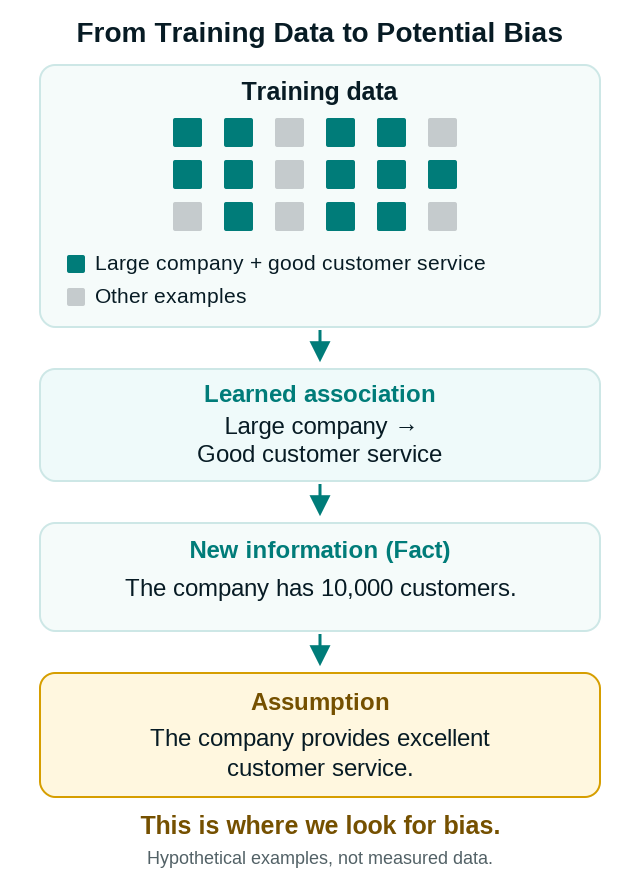
Let's say we ask AI to recommend a customer relationship management (CRM) solution for our business. AI recommends a particular product and provides a detailed explanation of why it is suitable for us.
We can verify every fact it presents, but that doesn't tell us whether other suitable products were overlooked or why certain criteria were given more importance than others.
So rather than examining the answer alone, we need to examine the process that led to that answer.
What information was considered? What criteria were used? What assumptions were made? What other possibilities were explored?
I think a good place to start is by identifying the assumptions AI made to carry out the task.
When AI does not have all the information it needs to complete a task, it fills in the gaps by applying previously learned patterns and making associations.
Going back to our CRM example, let's say AI finds evidence that the company has 10,000 customers. Based on that information, it assumes that the company provides excellent customer service.
The number of customers is a fact. The quality of customer service is an assumption.
If AI had invented the number of customers, we would be dealing with an AI hallucination. But here, we are examining what AI concluded from accurate information.
Not every assumption is a bias. However, by identifying the assumptions AI makes, we can identify where to look for bias.
Here is a simple prompt you can use as a starting point:
Review your response and identify the assumptions you made to complete my task. Distinguish between conclusions supported by evidence and conclusions based on assumptions. Explain what supports each assumption and what information is needed to validate it.
This does not guarantee that AI will identify all its assumptions or biases. But it gives us a starting point for examining the relationship between the information available and the conclusions AI has reached.
And this applies to almost any task we ask AI to carry out.
Can We Eliminate AI Bias?
I don't believe we can eliminate bias altogether without interfering with the very mechanism that makes AI capable of learning and applying knowledge.
What we can do is identify specific biases, examine their consequences and reduce their influence on the outcome.
In October 2024, OpenAI published Evaluating Fairness in ChatGPT. The research examined whether changing a user's name while keeping the request identical influenced the response.
The study covered 66 tasks, nine domains and six language models.
One example was asking ChatGPT to write a story. Users with female-sounding names were more likely to receive stories featuring female protagonists.
OpenAI reported no overall difference in response quality across the demographic groups tested. However, approximately 0.1% of the cases examined reflected harmful stereotypes, according to its evaluation methodology.
The differences were not limited to harmful stereotypes. They also appeared in the tone, complexity and level of detail of the responses.
In October 2025, OpenAI published Defining and Evaluating Political Bias in LLMs.
The research included approximately 500 prompts covering 100 topics, with questions presented from different political perspectives.
OpenAI examined five ways political bias can manifest:
- Dismissing the user's political viewpoint.
- Reinforcing or amplifying the user's political position.
- Presenting political opinions as the AI's own.
- Giving greater attention to one perspective while overlooking others.
- Refusing to discuss political topics without a valid reason.
The research found that the models remained largely objective when responding to neutral questions. However, emotionally charged prompts resulted in higher levels of bias.
GPT-5 demonstrated a 30% reduction in political bias scores compared with the earlier models tested.
These are examples of how AI companies are working to identify and reduce specific biases. But identifying and reducing a particular bias is not the same as eliminating bias altogether.
And what about us, the users?
We also influence the way AI carries out a task through the context, information and instructions we provide. By supplying relevant information and questioning assumptions, we can reduce AI's need to rely on previously learned associations.
The goal, in my opinion, should not be to eliminate bias altogether but to gain more control over its influence on the outcome. And, of course, work towards eliminating the specific harmful biases we are all well aware of, such as those that lead to discrimination, prejudice and injustice.
The Unique Opportunity AI Provides
For hundreds of years, we have been trying to understand how our own cognitive abilities work and how they influence our relationship with information. And even after hundreds of years, this understanding is still in the hands of a few and not the many, even though we all use these abilities every day.
Yes, there is a fundamental challenge in doing so. We are using the very same cognitive abilities we are trying to understand, and at the same time, no one is teaching us anything about them unless they become our passion.
For many of us, we take our cognitive abilities for granted and pay attention to them only if they produce a negative outcome in our lives. We simply miss the fact that there are also extraordinary outcomes to getting to know how they work, as a driving force in our lives that can impact our quality of life and inner peace. Because doing that “work” (for lack of a better word) is hard, painful and takes time.
And this is where I believe AI presents us with a unique opportunity.
We now can observe and experiment with processes such as pattern recognition, making connections, forming assumptions and drawing conclusions outside ourselves.
We can change a piece of information, introduce a different perspective, question an assumption and observe how these changes influence the outcome. All detached from ourselves, yet seeing the impact these changes have can reveal what they can do for us.
In the big scheme of things, even if we are not interested in self-improvement, the direct benefit is achieving better results using AI. This will contribute to co-creating and working towards a shared goal, even if that shared goal is personal, like organising your personal calendar. :)
But I do hope you will not miss out on the opportunity to see the impact of one small thing, and how awareness and shedding light on it can make such a difference to the outcome.
And from here, dare to imagine what impact discovering your own biases can have on your life.
The Bottom Line — AI Thinking
Bias is just how cognitive abilities work, and it really depends on how you see it.
For us, we expect AI to be logical, detached from emotions and, overall, to help us make smart decisions. Bias kind of contradicts all of that. After saying everything we did, :) we still believe there is a way to reduce it through:
Prompt engineering — defining the process. By defining how we want AI to carry out a task, we can introduce steps that require it to examine assumptions, distinguish between facts and conclusions, and explore additional possibilities.
Context engineering — defining the logic. By providing AI with relevant knowledge, professional understanding and the logic behind our decisions, we reduce its need to fill in the gaps using previously learned patterns and associations.
Research — expanding its worldview. By introducing information from different sources, perspectives and professional disciplines, we can expand the information AI considers when carrying out a task, rather than relying solely on the knowledge it already has.
Overall, we see all of that as creating an optimal working environment for both humans and AI bots. So really, there is nothing extra you need to do. Just be aware of bias and address it as part of designing the environment.
And this is what we do best here: creating this environment.
So if you need anything, don't forget to give us a shot. :) We've got your back.
Personal Note — Sarah Lahav
Writing this article with Alex was an experience in itself. :)
Bias is a concept deeply rooted in how our minds work, and the mechanism behind it has enormous benefits. For me, exploring these kinds of concepts is about becoming aware of them so we can recognise them. And once we do, we can ask ourselves whether they serve us or whether we need to change something.
I did my best to provide accurate information based on the meaning of the word itself, rather than simply how its meaning has changed over time.
Language is a living organism, influenced by the topics of the time. Words are used in ever-changing ways to convey the stories we want to tell. But when we want to understand an idea, I believe there is great value in going back to what the word originally meant.
And that is part of what we do here at AI Thinking. We are creating a place where you can come, travel back in time to where things began and gain a deeper understanding of the words we use every day.
Because words are the tools of the new AI age, and understanding them is the key to how we use AI.
Like in this case, understanding bias can help us better navigate the fear surrounding this concept.
When AI first showed up, bias was a big part of the conversation, and fear was written between the lines. Now, the conversation seems to have quietened down. I believe this is not because bias has disappeared, but because the conversation focused on one aspect of its meaning, rather than recognising it as something we should always address because it is simply part of how things work.
So, I hope this helped you understand what bias means. And if you want to take a closer look at how our cognitive abilities intertwine with AI and explore the opportunities this brings, I think you already know I wrote a book about it. :)
Cheers,
Sarah